

Why Cutting Your Aquatic Plants at the Base Is the Ultimate Lake Secret
 |

Summary:
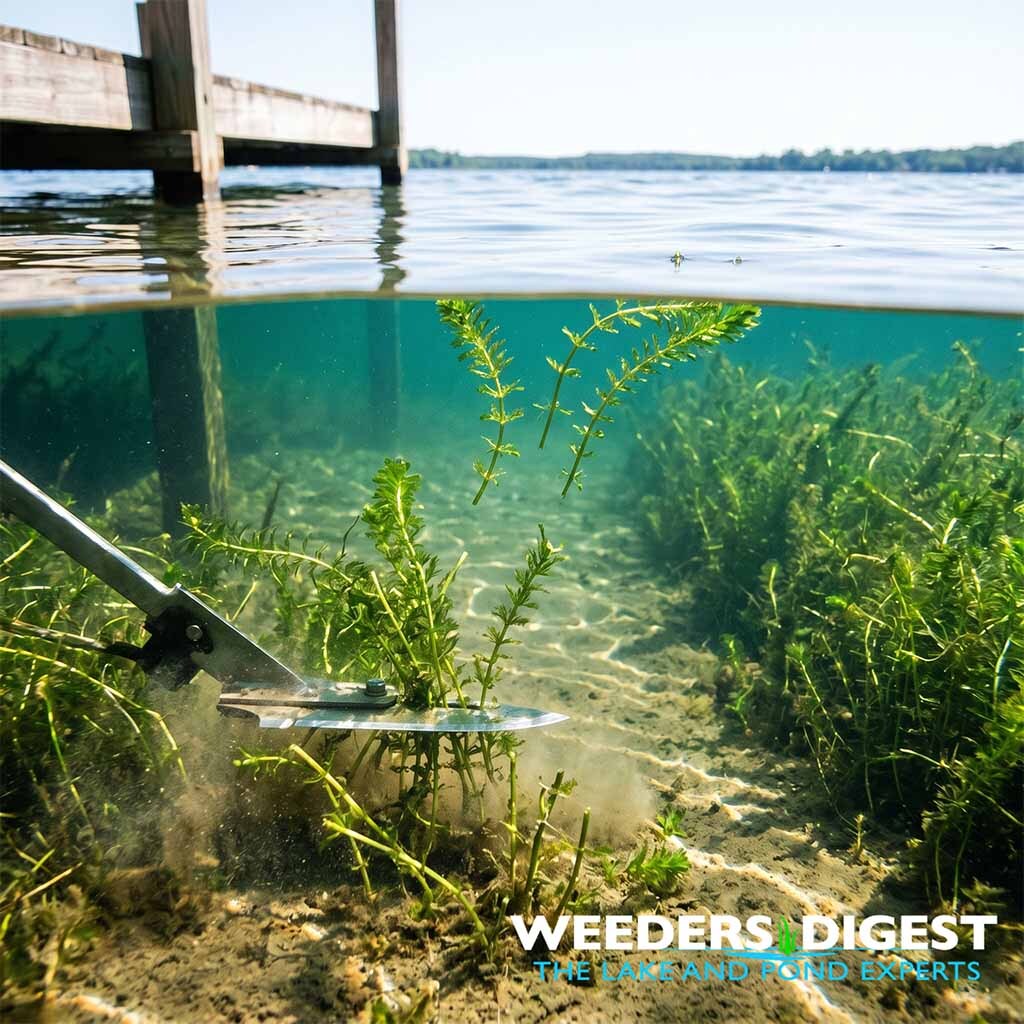
Cutting aquatic plants directly at their base is the single most effective way to mechanically manage a lake or pond because it maximizes biomass removal and structural disruption while delaying the weed's ability to reach the surface. When you sever a weed at its absolute lowest point near the lakebed, you take away its access to sunlight and force the plant to exhaust its underground energy reserves just to regrow. This method provides immediate relief for boaters and swimmers, offering a clean water column that lasts significantly longer than superficial "trimming" or surface skimming.
In my years managing private lakes and community reservoirs, I have consistently noticed that shorelines managed with superficial cutting look like an overgrown lawn again in less than three weeks. Conversely, when we drop our cutting bars all the way to the sediment line to perform a clean, low-level slice, homeowners enjoy clear water for months, rather than days. It is the difference between a temporary haircut and true habitat regulation.
The Science Behind It:
The physiological response of submersed macrophytes to mechanical slicing is deeply rooted in resource allocation and photosynthetic limitations. Submersed aquatic invasive species, such as Eurasian watermilfoil (Myriophyllum spicatum) and Hydrilla verticillata, are highly adapted to thrive in low-light environments, often growing from depths of 12 to 15 feet to establish dense canopy mats at the surface (Sperry et al., n.d.). When a mechanical cut is executed at the base of the plant rather than the surface canopy, it eliminates nearly 100% of the photosynthetic tissue. This sudden loss of the canopy destroys the plant's capacity to intercept light, stalling its carbon assimilation and forcing it into a severe carbohydrate deficit.
To recover from a basal cut, the remaining root crowns must mobilize stored starches and non-structural carbohydrates to produce new vegetative shoots. Research has shown that the intensity and depth of the harvest directly correlate with a drastic reduction in subsequent seasonal vitality. For instance, a study measuring the impacts of harvesting intensities on Hydrilla verticillata demonstrated that high-intensity biomass removal reduced the final cumulative biomass of the plant to just 29.94% compared to unharvested control groups (Zhu et al., 2022). Furthermore, high-intensity removal severely limits the plant's ability to produce winter buds and turions, thereby mitigating long-term population expansion and secondary infestation (Zhu et al., 2022).
Conversely, shallow cutting—often referred to as "mowing"—leaves massive structural "stumps" and intact lateral branches intact within the water column. Historically, shallow mechanical harvesting evaluations, such as those conducted at Saratoga Lake, revealed that Myriophyllum spicatum can rapidly recover from surface-level clips, returning to pre-harvest biomass levels in as little as 30 days (Mikol, 1984). Similarly, historic data from the LaDue Reservoir demonstrated that standard mowing allowed milfoil to bounce back to nuisance levels within 23 days, whereas cutting deeply at the sediment-water interface to target the root crowns successfully retarded regrowth below nuisance levels for over 28 days, with full-season suppression achievable via a secondary touch-up (Anderson, 1984, as cited in Cooke & Carlson, 1989).
From an ecosystem perspective, total basal cutting and subsequent biomass extraction also serve as a vital mechanism for nutrient remediation. Submersed plants contain approximately 95% water, meaning an average surface acre of dense submersed weeds holds roughly 10 to 15 tons of wet biomass, which translates to about 1,200 pounds of dry organic matter (Sperry et al., n.d.). By severing these plants at the base and completely removing them from the water budget, lake managers actively extract assimilated phosphorus and nitrogen before the plants can naturally senesce, decay, and trigger internal nutrient loading or local anoxic dead zones.
Sources / References:
- Cooke, G. D., & Carlson, R. E. (1989). The effect of harvesting on macrophyte regrowth and water quality in LaDue Reservoir, Ohio. Journal of Iowa Academy of Science, 96(2), 54-57. (Reprinted via UNI ScholarWorks). (Cited by: 12)
- Mikol, G. F. (1984). Effects of mechanical control of aquatic vegetation on biomass, regrowth rates, and juvenile fish populations at Saratoga Lake, New York. Lake and Reservoir Management, 1(1), 456-462. https://doi.org/10.1080/07438148409354556 (Cited by: 12)
- Sperry, B. P., Haller, W. T., & Ferrell, J. A. (n.d.). Mechanical harvesting of aquatic plants. U.S. Army Corps of Engineers, Engineer Research and Development Center. https://corpslakes.erdc.dren.mil/employees/invasive/pdfs/MechanicalHarvesting.pdf
- Zhu, S., Wu, X., Zhou, M., Ge, X., Yang, X., Wang, N., Lin, X., & Li, Z. (2022). Effects of harvesting intensity on the growth of Hydrilla verticillata and water quality. Sustainability, 14(22), 15390. https://doi.org/10.3390/su142215390 (Cited by: 11)