

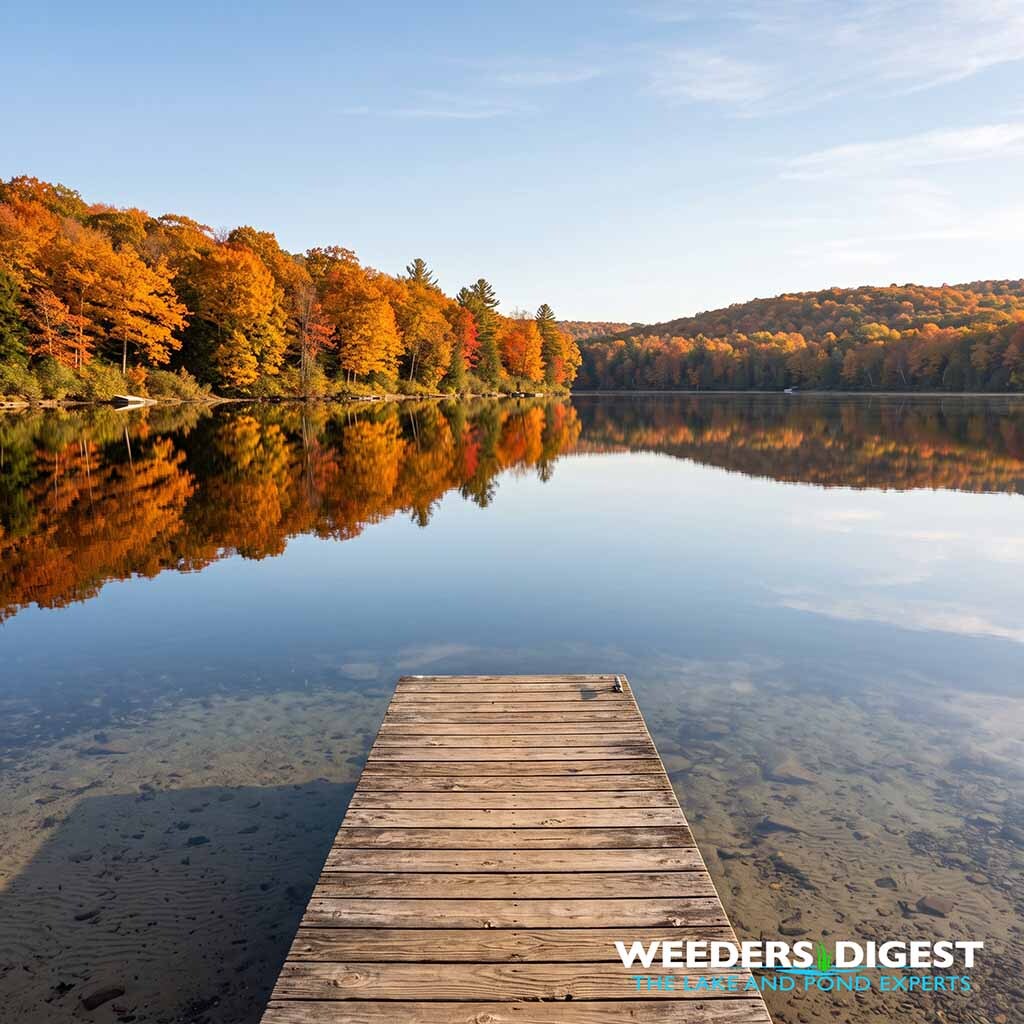
Why Does Your Calm Autumn Lake Look Like a Mirror in October but Cloudy in August?
 |

Summary:
Your lake transforms into a crystal-clear mirror in October because plunging autumn temperatures and declining solar radiation suppress the explosive microscopic phytoplankton blooms that cause late-summer cloudiness. In August, warm surface waters, intense solar energy, and accumulated biological nutrients combine to fuel rapid cellular growth across cyanobacteria and suspended micro-algae populations, scattering incoming light and reducing optical clarity. As crisp autumn weather settles across the watershed, water temperatures drop below peak photosynthetic thresholds, metabolic activity grinds to a halt, and suspended organic particulates settle out of the upper water column.
When our lake experts conduct dockside surveys in mid-to-late autumn, we frequently measure dramatic shifts in water quality without any human intervention. Waterfront owners often assume an upstream contaminant washed into their cove during the dog days of summer, only to watch that exact same shoreline settle into glassy, transparent stillness weeks later. What you are witnessing is not a chemical mystery; it is the natural physical and biological lifecycle of a temperate freshwater ecosystem transitioning between seasonal phases.
The Science Behind It:
The stark disparity in optical clarity between late summer and mid-autumn is governed by lake thermal stratification, phytoplankton population dynamics, and seasonal Secchi disk transparency. Throughout August in temperate dimictic lakes, intense solar irradiance establishes stable thermal stratification, dividing the water column into three distinct density zones: the warm upper layer (epilimnion), a sharp temperature gradient (metalimnion or thermocline), and a dense, cold bottom layer (hypolimnion). In the epilimnion, water temperatures routinely exceed 22°C to 26°C, creating optimal kinetic conditions for rapid cyanobacterial doubling times and organic matter suspension. Peer-reviewed monitoring published across North American lake water quality databases demonstrates that warm-season Secchi depth—the standard metric for visual water clarity—often drops by 40% to 65% in late August compared to post-cooling autumn baselines, driven directly by chlorophyll-a concentrations that peak above 20 to 35 micrograms per liter (μg/L).
During August, physical wave turbulence and intense surface recreation also keep shallow shoreline sediments continually entrained within the upper epilimnetic water. Wind shear and recreational boat wakes resuspend finely divided organic detritus and colloidal muck particles across the littoral zone. This high particulate loading, combined with billions of suspended photosynthetic cells per cubic meter, causes Rayleigh and Mie optical scattering, turning deep blue or dark water into a turbid, greenish-brown soup.
As October arrives, daytime photoperiods shorten dramatically and ambient air temperatures decline, driving negative net heat flux at the lake surface. When surface water cools toward 10°C to 12°C, phytoplankton reproduction rates plummet by more than 70% due to cellular enzyme deceleration and inadequate light penetration. Suspended algal cells senesce and sink into benthic sediments or are grazed down by robust populations of cold-tolerant cladocerans and zooplankton.
Simultaneously, the weakening solar cycle creates the atmospheric conditions necessary for absolute surface stillness. Dense, cool autumn air masses reduce the localized convective micro-breezes that chop summer water surfaces. With suspended vegetative matter flocculated and settled, the attenuation coefficient of light decreases substantially, transforming the upper meter of water into an optically transparent medium capable of near-perfect specular reflection.
Our Recommendation for Managing Lake Clarity and Littoral Muck:
While seasonal cooling temporarily clears the water column, the underlying organic matter that caused August’s cloudiness does not simply vanish—it settles straight down onto your shoreline floor as decaying muck and benthic sediment. Over winter, this decomposing biomass traps concentrated phosphorus and nitrogen at the lakebed. The moment water temperatures warm back up the following spring, these benthic nutrients migrate back into the water column, restarting the cycle of dense weeds and turbid summer algal blooms.
To prevent recurring August turbidity and eliminate muck buildup, property owners require continuous, directional kinetic energy rather than passive chemical treatments. Applying focused, laminar water current using continuous underwater aeration blowers—such as our AquaThruster Muck & Weed Blower collection—physically displaces unconsolidated sediment, sweeps away decomposing vegetation before it breaks down into muck, and infuses oxygen deep into the benthic zone to disrupt the nutrient recycling cycle.
Sources / References:
- Wetzel, R. G. (2001). Limnology: Lake and River Ecosystems (3rd ed.). Academic Press.
- International Institute for Sustainable Development – Experimental Lakes Area (IISD-ELA). (2022). The Science of Thermal Stratification of Lakes. https://www.iisd.org/ela/blog/lakes-stratify-turn-explain-science-behind-phenomena/
- National Park Service. Crater Lake Long-Term Limnological Monitoring: Seasonal Lake Clarity, Thermal Dynamics, and Secchi Depth. https://www.nps.gov/crla/learn/nature/upload/LTLMP_report_2020-508.pdf
- Carlson, R. E. (1977). A Trophic State Index for Lakes. Limnology and Oceanography, 22(2), 361–369.