

Why Does Your Shoreline Smell Like Rotten Eggs in Late Autumn? The Limnology Behind Low Water and Anoxic Muck
 |

Summary
That sharp, rotten-egg odor along your shoreline during late autumn low-water periods is caused by the release of hydrogen sulfide gas (H2S), which forms when specialized anaerobic bacteria break down thick organic muck in the absence of dissolved oxygen. Throughout the spring and summer, layers of dead weeds, algae, leaf litter, and runoff debris drift into shallow littoral zones and settle into dense sediment beds. When water levels drop in late fall, the protective water column thins, exposing these oxygen-starved muck layers directly to the air and releasing volatile gases trapped beneath the surface.
At the same time, declining autumn air temperatures trigger water turnover and dismantle summer thermal stratification. This destratification circulates stagnant, sulfur-rich bottom water toward the shoreline. Without sufficient water depth and hydrostatic pressure to dissolve or chemically cap the gas, volatile compounds vent directly into the atmosphere, creating an intense sulfuric stench around docks, beaches, and seawalls.
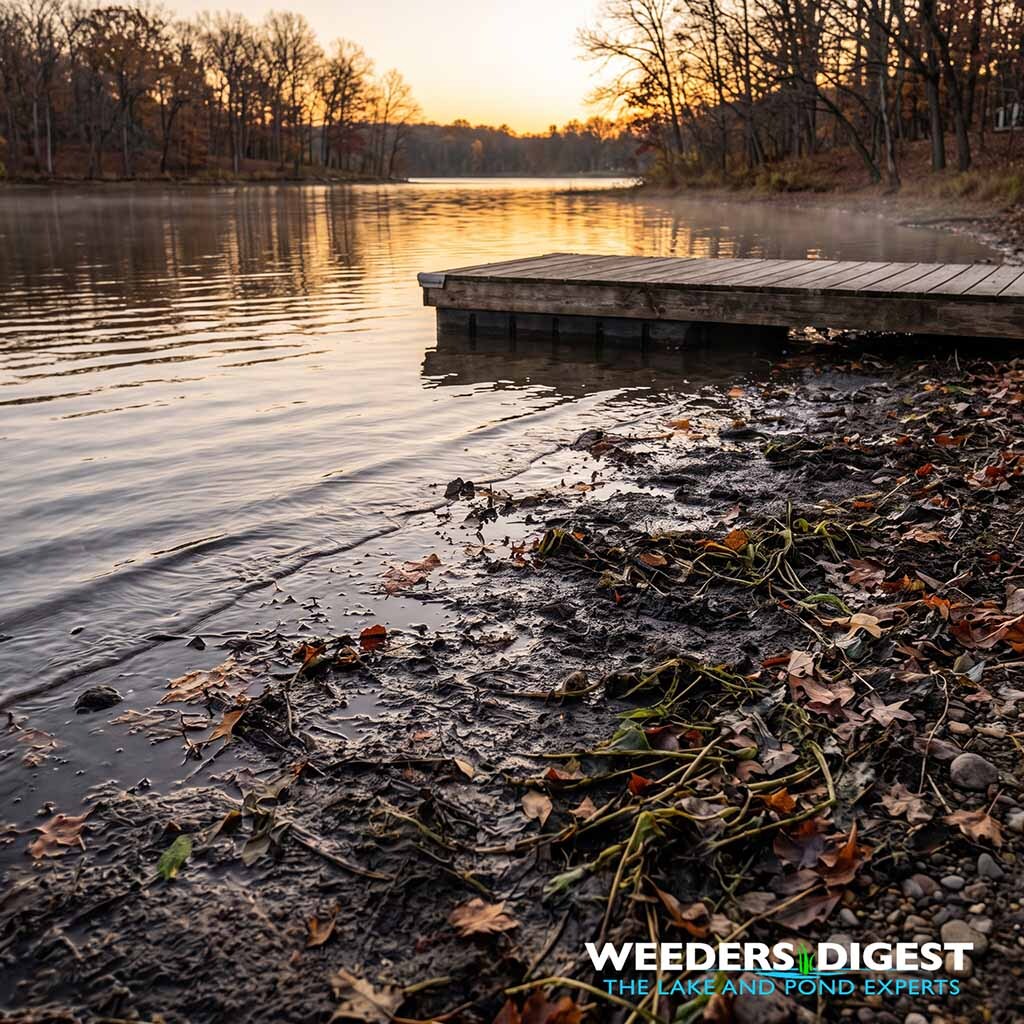
During late-season site assessments in October and November, our lake and pond experts routinely encounter property owners who fear a fractured septic tank or cracked municipal sewer pipe. In nearly every instance, stepping onto the exposed mudflats reveals the true culprit: stepping on or disturbing the damp, dark silt ruptures a thin surface crust, venting trapped biogenic gases straight into the cold autumn air.
While this smell is unpleasant and signals an overloaded benthic ecosystem, it is a predictable biochemical process. Understanding the relationship between sediment accumulation, dissolved oxygen depletion, and seasonal water drawdowns allows waterfront owners to remediate the underlying organic load before it creates seasonal odor spikes.
The Science Behind It
The rotten-egg odor originates from dissimilatory sulfate reduction, an anaerobic metabolic pathway carried out by benthic microorganisms. Under healthy, oxygenated conditions, aerobic decomposers use dissolved oxygen (DO) as the primary terminal electron acceptor to metabolize organic detritus into odorless carbon dioxide and water. However, as organic detritus accumulates along shorelines faster than it can naturally decompose, biological oxygen demand outpaces diffusion, exhausting benthic oxygen levels until anoxia (DO<0.5mg/L) sets in.
Once dissolved oxygen is depleted, microbial communities cycle through alternative electron acceptors according to thermodynamic yield: nitrates, manganese, ferric iron, and finally sulfates (SO42-). Sulfate-reducing bacteria (SRB), predominantly obligate anaerobes belonging to genera like Desulfovibrio and Desulfobacter, flourish in these conditions. Research published in Freshwater Biology demonstrates that sediment sulfate reduction rates peak in organic-rich littoral zones, generating significant quantities of dissolved hydrogen sulfide as the sediment oxidation-reduction potential (redox potential, Eh) plummets below -150to-200mV. In neutral to slightly acidic sediment porewater, dissolved sulfide protonates rapidly into volatile hydrogen sulfide gas.
Under normal summer depths, this gas rarely escapes into the ambient air in noticeable concentrations. In a submerged littoral zone with several feet of overlying water, diffusing H2S encounters an oxic benthic boundary layer where dissolved oxygen and chemotrophic sulfur-oxidizing bacteria oxidize sulfides back into odorless sulfate (SO42-), or bind them with dissolved iron to produce insoluble, black iron monosulfide (FeS) precipitates. Research on polymictic and shallow lake basins published in Environmental Science & Technology shows that sediment gas flux rates can surge dramatically during disturbance and seasonal mixing events, discharging between 8and 19 mmol . m^-2 . day^-1 of volatile sulfides directly into the surrounding atmosphere.
Autumn low-water events accelerate this release by stripping away the overlying water column. As the shoreline recedes, the diffusion barrier collapses to zero. Without an oxygenated water layer to oxidize sulfides, the partial pressure of H2S drives rapid volatilization directly from the damp sediment. According to toxicological assessments by the Agency for Toxic Substances and Disease Registry (ATSDR), the human olfactory threshold for hydrogen sulfide ranges from 0.5to5partsperbillion(ppb) (0.0005to0.005ppm). Because the human nose detects even trace concentrations, an exposed, uncirculated muck bed generates an unmistakable, widespread stench across the entire property.
Our Recommendation for Managing Shoreline Muck and Hydrogen Sulfide Odors
Because hydrogen sulfide synthesis requires two conditions—organic muck as fuel and stagnant, oxygen-depleted water—the most reliable remedy involves introducing high-velocity water movement and mechanical sediment displacement. Passive treatments cannot penetrate dense, compacted muck beds; resolving the odor requires breaking the stagnant boundary layer and reintroducing dissolved oxygen directly to the lake bed.
We advise waterfront owners to deploy high-volume directional water circulators to disrupt this anaerobic cycle before autumn drawdowns occur. Continuous, laminar flow sweeps oxygenated water across the sediment-water interface, raising the redox potential back into an oxidative state (Eh>+100mV). This oxygenated barrier suppresses obligate anaerobic bacteria, promotes aerobic digestion, and neutralizes dissolved sulfides before they can volatilize into the air.
For waterfronts with chronic, deep muck along docks, seawalls, and swimming areas, using automated sweeps from our AquaThruster Muck & Weed Blower collection mechanically dislodges loose, decaying silt and organic detritus, relocating it away from your high-use shoreline while infusing dissolved oxygen directly into the substrate. Combining steady water movement with regular mechanical raking prevents organic debris from decomposing into anoxic sediment, keeping your shoreline clear, healthy, and odor-free through every season.
Sources / References
- Agency for Toxic Substances and Disease Registry (ATSDR). Toxicological Profile for Hydrogen Sulfide and Carbonyl Sulfide. U.S. Department of Health and Human Services. https://www.atsdr.cdc.gov/toxprofiles/tp114.pdf
- Holmer, M., & Storkholm, P. (2001). Sulphate reduction and sulphur cycling in lake sediments: a review. Freshwater Biology, 46(4), 431–451. https://doi.org/10.1046/j.1365-2427.2001.00687.x
- Martin, R. P., et al. (2002). Hydrogen sulfide production and volatilization in a polymictic eutrophic lake. Environmental Science & Technology. https://pubs.acs.org/doi/10.1021/es015732k
- Wetzel, R. G. (2001). Limnology: Lake and River Ecosystems (3rd ed.). Academic Press.