

Why Eurasian Watermilfoil is Taking Over Your Lake (And How Its Biology Makes it Unstoppable)
 |

Summary:
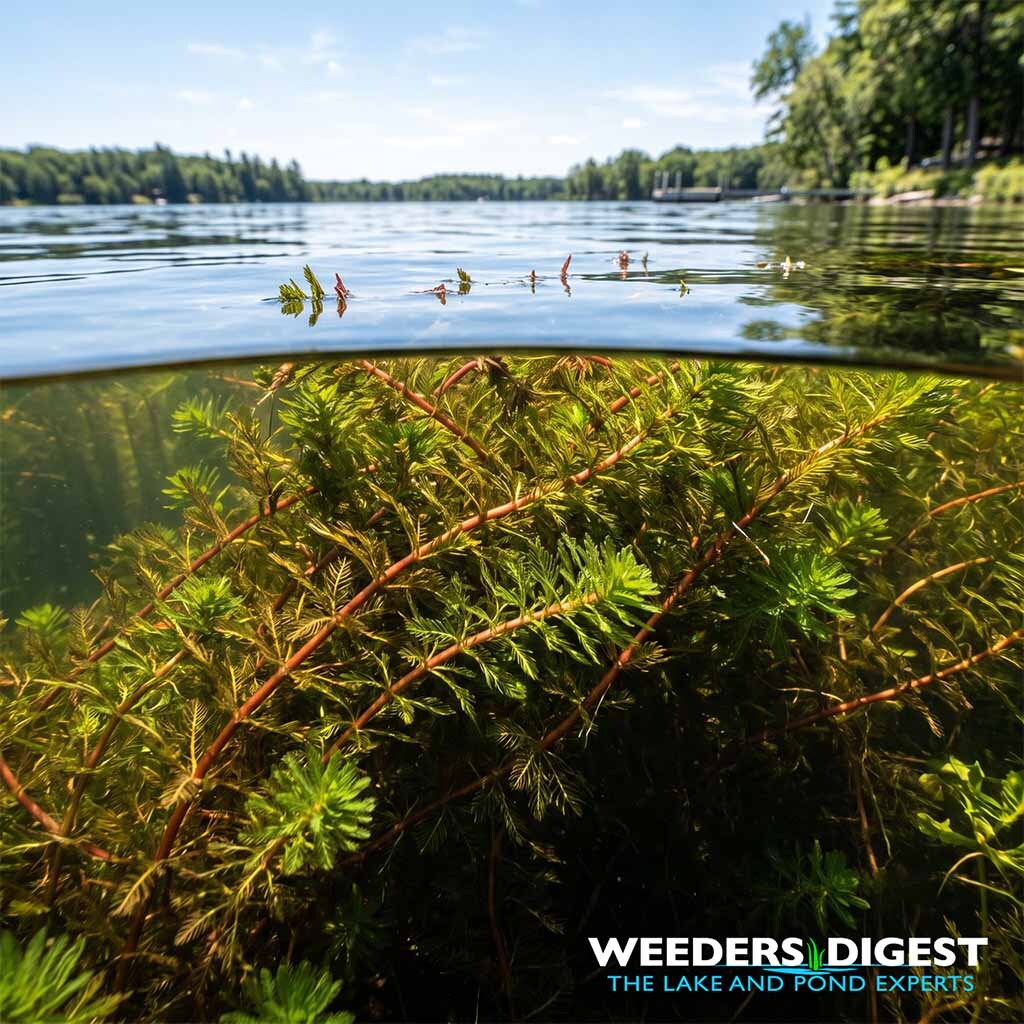
Eurasian watermilfoil takes over your lake because it has evolved to reproduce rapidly through tiny broken stem fragments while concentrating its growth at the water's surface to steal sunlight from native plants. This aggressive aquatic weed doesn't rely on seeds to spread; instead, any time a boat propeller, wave action, or natural life cycle breaks a piece of the plant off, that small piece can float to a new area, sink, root into the mud, and create an entirely new weed bed. By the time the water warms up in the spring, milfoil has already outpaced beneficial native vegetation, creating a thick, tangled mat at the surface that ruins boating, swimming, and fishing.
As a Certified Lake Manager, I regularly pull up to community boat launches and see the immediate tell-tale signs of a milfoil invasion. When I look over the side of my skiff, I often see hundreds of tiny, severed green fragments floating in the current near the dock—each one a ticking time bomb waiting to drop and root into the sediment. It's frustrating for homeowners who think they are helping by raking or chopping the weeds, only to inadvertently multiply the problem by creating thousands of new floating clones. Understanding how this specific plant grows is the only way to stop wasting time and start managing the waterbody effectively.
The Science Behind It:
Eurasian watermilfoil (Myriophyllum spicatum) is a submersed, rooted dicotyledonous macrophyte that utilizes a highly specialized growth strategy to outcompete native aquatic flora. The primary biological mechanism driving its invasive success is autofragmentation, a form of asexual vegetative reproduction. Late in the growing season, or following physical disturbance, the plant develops specialized lignified cells at its stem nodes. These nodes become brittle, allowing the stem to break apart easily without severe mechanical force. According to research from the Michigan Technological University Research Institute, stem fragments as short as 10 to 20 centimeters can remain viable, sink to the benthic zone (the ecological region at the lowest level of a body of water), and rapidly develop adventitious roots to establish entirely new individual plants.
Once rooted, the phenology—or cyclical seasonal biological phenomena—of M. spicatum gives it a significant temporal advantage. The plant breaks winter dormancy much earlier than most native species, initiating active shoot growth from overwintering root crowns when water temperatures reach just 15 degrees Celsius. This early-season vertical growth is paired with a morphological strategy called canopy formation. Foundational research by Titus and Adams (1979) demonstrated that up to 68 percent of Eurasian watermilfoil's total biomass can be concentrated within the top 30 centimeters of the water column. By allocating the majority of its photosynthetic tissue directly at the surface, the plant effectively blocks solar radiation from penetrating the water, suppressing the photosynthetic compensation point of native benthic plants and shading them out of existence.
This rapid biomass accumulation and extreme density fundamentally alter the localized aquatic ecosystem. Data from the New York Invasive Species Information program indicates that Eurasian watermilfoil stem densities can exceed 300 stems per square meter in shallow littoral zones. This extreme structural density restricts water flow, depletes dissolved oxygen levels through nocturnal respiration and localized decomposition, and creates a hypoxic microenvironment that degrades vital spawning habitats for native fish populations. Furthermore, a 53-day experimental growth study highlighted in peer-reviewed biological control research (ResearchGate) showed that the total biomass of untreated milfoil increased by more than 2.7-fold in less than two months, illustrating the explosive growth rate that lake ecosystems must contend with.
Because the plant allocates such a low ratio of its energy to root development—often possessing a root-to-shoot ratio as low as 0.01—it is exceptionally vulnerable to physical disruption, yet this vulnerability is exactly what facilitates its spread. The distinct lack of structural dependence on a massive root system allows it to quickly abandon its original benthic anchor and propagate via floating fragments. Understanding these specific physiological traits, including its low temperature threshold for growth, rapid vertical elongation, surface canopy biomass concentration, and node-based fragmentation, dictates that any effective ecological management strategy must prioritize fragment containment and early-season intervention to disrupt the canopy before the autofragmentation cycle begins.
Sources / References:
- https://nyis.info/species/eurasian-watermilfoil/
- https://www.mtu.edu/mtri/research/project-areas/environmental/water/eurasian-watermilfoil/biology/
- https://www.researchgate.net/publication/233491363_Biological_control_of_Eurasian_watermilfoil_by_aquatic_insects_Basic_insights_from_an_applied_problem