

Why Fish Abandon Our Shoreline Weeds for Deep Drop-Offs on Cold Fall Mornings
 |

Summary:
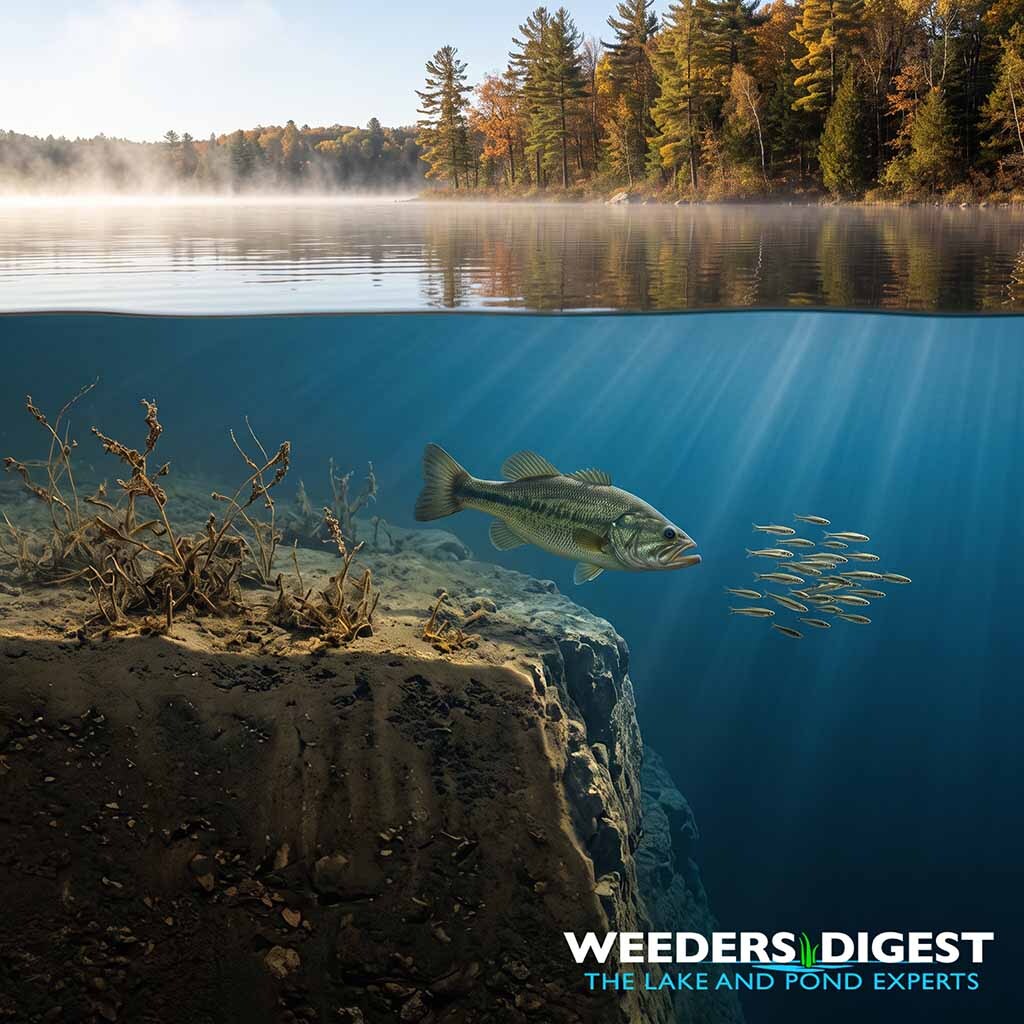
Fish strike lures along steep drop-offs rather than shallow weed beds during late fall mornings because rapid overnight radiational cooling, combined with the post-turnover collapse and microbial decay of littoral vegetation, strips shallow flats of their thermal stability and dissolved oxygen. When autumn water temperatures plunge toward 50°F (10°C) and below, cold water increases in density and sinks, leaving shallow bays subject to severe overnight temperature swings that stun warm-water game fish. At the same time, dying weeds stop producing oxygen through photosynthesis and shift to decomposition, a process where aerobic bacteria pull critical dissolved oxygen out of shallow zones. By retreating to deep drop-offs and breaklines, predatory fish position themselves in thermally buffered, oxygen-stable water while ambushing schooling baitfish moving off the cooling shelf.
During our late-season waterfront assessments, our lake experts routinely measure shallow littoral margins dropping 6°F to 10°F overnight, accompanied by dense mats of decomposing native milfoil and pondweeds that smell distinctly of sulfur and low oxygen. Dropping a multi-parameter probe just past the primary breakline reveals a completely different story: steady temperatures, clean oxygen levels, and clear sonar returns showing schools of baitfish and predator arcs stacked right along the edge.
The Science Behind It:
The primary driver behind this late fall transition is the physical destratification of the water column, commonly referred to as fall turnover, coupled with solar irradiance shifts. Throughout the summer, north-temperate dimictic lakes stratify into three distinct thermal zones: the warm, epilimnetic surface layer; the thermocline (metalimnion); and the cold, dense hypolimnion. As autumn progresses and surface water cools to maximum density at 39.2°F (4°C), thermal resistance to mixing vanishes. Wind-driven turbulence fully mixes the lake, equalizing dissolved oxygen and temperatures throughout deep basins. Once turnover is complete, game fish such as largemouth bass (Micropterus salmoides), walleye (Sander vitreus), and smallmouth bass (Micropterus dolomieu) are no longer restricted to shallow depths by an anoxic summer hypolimnion; deep water becomes fully habitable and oxygen-rich.
Simultaneously, the littoral zone undergoes an ecological collapse driven by photoperiod reduction and senescing macrophytes. During peak summer, dense aquatic plant beds provide up to 8–10 mg/L of dissolved oxygen through active photosynthesis during daylight hours, while offering complex physical structure for juvenile prey. By late fall, dying plant tissues cease oxygen production and become a massive biological oxygen demand (BOD) sink. Heterotrophic bacteria consuming cellulose and decomposing organic muck consume dissolved oxygen rapidly, frequently driving early-morning littoral dissolved oxygen levels well below 4.0 mg/L. Aquatic research published through university limnology extensions confirms that when dissolved oxygen drops below 5.0 mg/L, largemouth bass exhibit marked reductions in foraging frequency, swimming stamina, and metabolic efficiency, prompting active avoidance behavior.
Thermal inertia further compounds this spatial redistribution. Shallow flats possess low total thermal mass and cool rapidly overnight via atmospheric contact and radiational cooling. Limnological studies on temperate lake heat budgets demonstrate that shallow littoral zones (under 4 feet) experience diurnal temperature fluctuations exceeding 3°C to 5°C, whereas water below a drop-off at depths greater than 15 feet fluctuates by less than 0.5°C over a 24-hour cycle. Ectothermic fish must maintain core metabolic homeostasis; sharp morning drops in shallow water chill their digestive enzymes, lowering gastric evacuation rates by over 50% according to bioenergetics models. Fish avoid this energetic shock by seeking the thermal inertia of deep water.
Finally, predatory fish exploit steep bathymetric breaklines for optimal foraging mechanics. As prey species like bluegill (Lepomis macrochirus) and yellow perch vacate dying shallow weed cover, their primary retreat route funnels directly down structural contours. Sonar tracking and acoustic telemetry studies show that predatory game fish utilize the vertical wall of a drop-off as a natural ambush boundary. Because water clarity often reaches its seasonal maximum in late fall following algae die-offs, predators suspended along deep edges possess superior upward visual contrast against the surface light window, enabling them to strike high-riding lures and baitfish with aggressive, efficient burst swimming.
Our Recommendation for Managing Late-Season Muck and Decaying Weeds:
When shallow aquatic weeds die back and decay in late fall, they settle directly into the lakebed, creating thick layers of black, nutrient-dense organic muck that accelerate shoreline stagnation and deplete local oxygen levels. To break this annual accumulation cycle and prevent rotting vegetative mats from creating dead, anoxic zones around docks and swimming fronts, shoreline owners must maintain continuous water movement.
Deploying directional water thrusters from our AquaThruster Muck & Weed Blower collection introduces high-velocity laminar flow across the sediment floor. This continuous circulation physically sweeps out drifting plant debris and silt before it can compact into muck, while driving oxygen-rich water into shallow shorelines to accelerate healthy aerobic digestion. Pairing automated underwater sweepers with our heavy-duty aquatic weed cutters and shoreline maintenance tools ensures that autumn organic decay is physically removed rather than left to sour your beachfront all winter long.
Sources / References:
- University of Georgia Warnell School of Forestry & Natural Resources: Understanding Fall Pond Turnover and Fish Kills (https://warnell.uga.edu/news/stories/2024/understanding-fall-pond-turnover-and-fish-kills)
- Journal of Frontiers in Ecology and Evolution: Seasonality can affect ecological interactions between fishes of north-temperate dimictic lakes (https://www.frontiersin.org/journals/ecology-and-evolution/articles/10.3389/fevo.2022.986459/full)
- ResearchGate / North American Journal of Fisheries Management: Influences of dissolved oxygen and temperature on juvenile largemouth bass foraging behavior (https://www.researchgate.net/publication/318889558_Influences_of_dissolved_oxygen_on_juvenile_largemouth_bass_foraging_behaviour)