

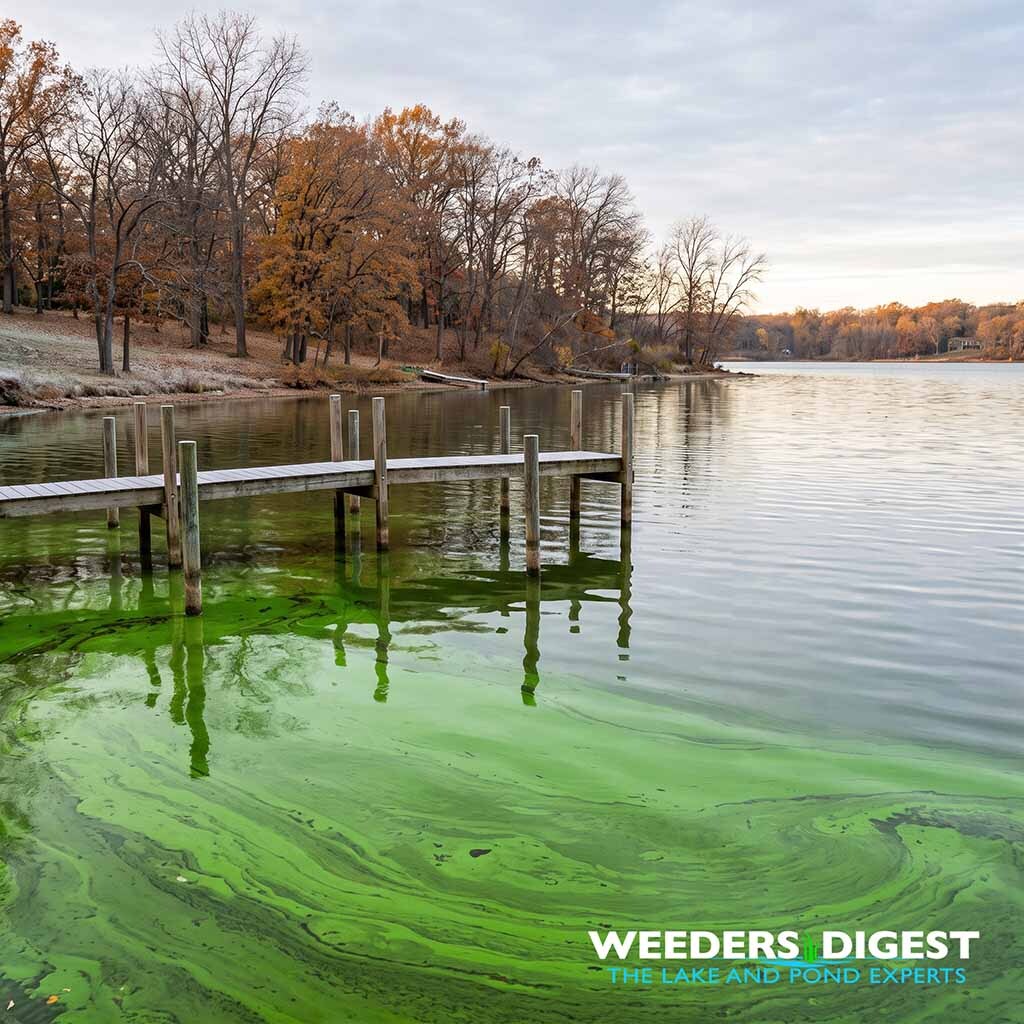
Why Is Bright Green Scum Still Coating Our Water Even After the Weather Turns Cold?
 |

Summary:
Bright green scum appears on your water in cold weather because seasonal lake turnover circulates trapped deep-water nutrients to the surface, fueling cold-adapted cyanobacteria and algae that thrive in low-temperature, high-light conditions. While high summer heat is traditionally blamed for algal blooms, dropping water temperatures cause distinct physical and biological shifts that create prime growing conditions. Surface waters cool, become denser, and sink, which mixes the entire water column and brings months of accumulated phosphorus and nitrogen up from the bottom muck.
During our late-autumn dock visits and waterfront consultations, our lake experts frequently see shorelines coated in a thick, pea-soup film just as homeowners prepare to pull their equipment for winter. It is often startling to see an aggressive bloom when the ambient temperature is hovering near freezing, but the underlying chemistry explains why this happens. Once deciduous trees drop their leaves and emergent aquatic vegetation dies back, sunlight penetrates deep into the clear water column. This unshaded light, paired with an abrupt surge of dissolved fertilizers from the lakebed, triggers a sudden late-season bloom.
Cold-hardy cyanobacteria species possess internal gas vesicles that allow them to regulate buoyancy. Even as ambient biological activity slows, these organisms float directly to the surface to capture low-angle autumn sunlight. Without continuous wind or targeted water movement to break them up, gentle autumn breezes gather these floating colonies into dense, stagnant scum lines along docks, seawalls, and protected bays.
The Science Behind It:
The appearance of late-season surface scums challenges the traditional paradigm that harmful algal blooms (HABs) require warm water temperatures above 20°C to 25°C. A comprehensive global study published in Limnology and Oceanography Letters by Reinl et al. (2023) documented widespread cold-water cyanobacterial blooms occurring at water temperatures well below 15°C, including active proliferations under ice-covered conditions. In temperate lakes, autumnal thermal destratification—commonly termed "fall turnover"—is the primary hydrodynamic driver. As surface water cools toward maximum density at 4°C, it plunges downward and destabilizes the thermocline. This turnover entrains hypolimnetic waters that have spent months accumulating bioavailable orthophosphate and ammonium under anoxic bottom conditions.
Peer-reviewed field dynamics demonstrate that nutrient thresholds directly govern bloom intensity during colder months. Research published in Environmental Pollution and documented by the National Center for Biotechnology Information (NCBI) tracked temperate boreal systems through seasonal cycles, observing that cyanobacterial cell abundance peaked in late autumn at an astonishing 210,000 cells/mL in November compared to just 28,000 cells/mL in late winter. The probability of rapid cyanobacterial proliferation accelerates sharply once total dissolved phosphorus exceeds 20 to 30 micrograms per liter (µg/L) alongside total nitrogen concentrations above 0.3 mg/L. Fall mixing distributes these high nutrient loads throughout the photic zone right when competing macroscopic plants have entered dormancy.
Cold-tolerant filamentous cyanobacterial genera, such as Planktothrix, Microcystis, and Limnothrix, exhibit cellular adaptations specifically evolved for low thermal regimes. These taxa produce cold-shock proteins and synthesize cell membranes rich in unsaturated fatty acids that prevent stiffening and maintain transport function in near-freezing water. Furthermore, studies show they upregulate accessory pigments such as phycocyanin to maximize photosynthesis under low-intensity, low-angle winter sunlight, allowing continuous biomass accumulation while conventional green algae remain inactive.
Compounding this physiological efficiency is the collapse of summer zooplankton grazing pressure. Filter-feeding cladocerans, such as Daphnia, drastically curtail reproduction and metabolic rates as water temperatures drop below 10°C, removing the primary top-down predatory check on phytoplankton populations. With zero herbivory to control cell counts, an abundance of upwelled phosphorus, and calm conditions between seasonal cold fronts, buoyancy-regulating cyanobacteria migrate to the surface to form dense, persistent surface scums.
Our Recommendation for Managing Late-Season Scum and Algae:
To resolve late-season green scum, you must counter the physical conditions that allow cold-adapted cyanobacteria to dominate: water stagnation and concentrated bottom nutrients. Chemical herbicides or algaecides are often sluggish and ineffective once water drops below 50°F to 55°F, as plant metabolism slows down. The most reliable physical strategy is targeted hydrodynamic movement. Installing high-velocity, directional flow tools like our AquaThruster Muck & Weed Blower collection disrupts thermal stagnation, breaks surface surface-tension, and prevents buoyancy-regulating cells from grouping into toxic mats along your shoreline.
Continuous directional water flow also works proactively on the underlying fuel source. By maintaining gentle, steady laminar movement over the sediment surface, underwater flow systems prevent localized anoxia and sweep decaying seasonal leaf fall out of private bays. Pairing continuous aeration or flow generators with our specialized lake weed cutters and mechanical harvesters ensures that dying vegetation is physically removed from the water before it settles to the lakebed to become the decaying muck that feeds future autumn blooms.
Sources / References:
- Reinl, K. L., et al. (2023). Blooms also like it cold: Cyanobacteria blooms in cold water temperatures. Limnology and Oceanography Letters. https://afbi.dspacedirect.org/bitstreams/878d242b-39c8-4d59-aaeb-e5d80a305514/download
- NCBI / PMC Research Repository. Cyanobacteria in winter: Seasonal dynamics of harmful algal blooms in cold temperate waters. https://pmc.ncbi.nlm.nih.gov/articles/PMC11697692/
- University of Minnesota Extension & Leibniz Institute of Freshwater Ecology (IGB). Cold-water cyanobacterial bloom adaptations and fall turnover dynamics. https://www.igb-berlin.de/en/news/cyanobacterial-blooms-also-it-cold-and-not-exclusively-warm