

Why Late Fall Shoreline Lights Swarm With Midges and Water Bugs
 |

Summary
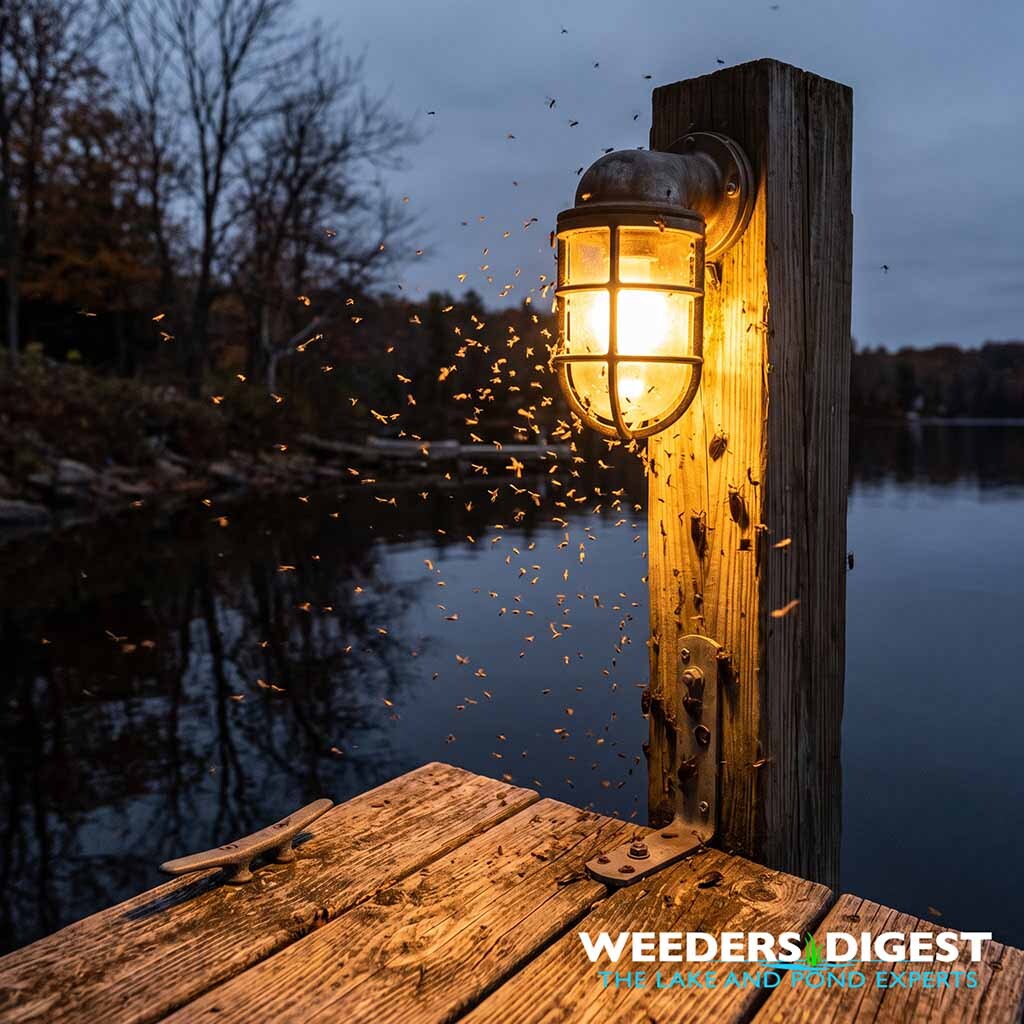
Late fall swarms of midges and aquatic water bugs around shoreline fixtures occur because artificial lights disrupt the natural celestial navigation systems of these insects during their final seasonal dispersal flights. As autumn temperatures fall, aquatic hemipterans like water boatmen (Corixidae) and backswimmers (Notonectidae) take flight to relocate to deeper, non-freezing overwintering basins. Simultaneously, late-season non-biting midges (Chironomidae) synchronize massive final emergences. When these dispersers encounter high-intensity artificial light on our docks and waterfronts, positive phototaxis forces them off course, trapping them in continuous, frantic flight loops.
During late-season dock maintenance and winterization calls, our lake experts regularly observe millions of midges and aquatic beetles coating siding, boat lifts, and light fixtures within minutes of dusk. Waterfront owners often assume these insects are feeding or breeding on terrestrial structures. In reality, the shore acts as an ecological funnel where artificial illumination disrupts their flight path toward open, overwintering water.
The Science Behind It
Aquatic insects rely on transverse orientation, maintaining a fixed angle relative to distant celestial light sources like the moon to fly in straight paths across the landscape. Point-source artificial light at night (ALAN) overrides this mechanism. Because the artificial light is close, an insect attempting to maintain a constant visual angle is forced into an inward logarithmic spiral, known biologically as positive phototaxis. A landmark riparian study led by Manfrin et al. (published in Aquatic Sciences) demonstrated that flying adult aquatic Diptera were eight-fold more abundant in collection traps located under artificial shoreline illumination compared to unlit control sites, with certain Diptera taxa being lured toward shoreline light sources from distances exceeding 1,800 meters.
The massive influx in late fall is driven by phenological synchronization and the thermal physics of autumn water bodies. As nearshore littoral zones cool below 10°C, benthic organic muck releases stored thermal energy more slowly than the rapidly cooling air column. This brief window of water stability triggers the final generation of Chironomidae larvae to pupate and emerge. Research by Ali et al. on adult midge phototaxis revealed that Chironomid attraction correlates tightly with light intensity (r=0.93) and is heavily biased toward shorter visual wavelengths, where light output per unit of brightness (lux) is inversely proportional to wavelength. Shorter-wavelength emissions, such as blue and near-ultraviolet light, exert the strongest pull on their compound ommatidia.
Simultaneously, aquatic true bugs undergo seasonal dispersal flights. Water boatmen (Corixidae) and giant water bugs (Belostomatidae) spend summer foraging in shallow weed beds, but shallow water freezes solid in northern winter conditions. Triggered by photoperiod reduction and dropping water temperatures, these insects take flight en masse to locate deeper, well-oxygenated lakes. In addition to phototaxis, these insects utilize polarized light cues to identify water surfaces. Glossy surfaces, boat covers, and illuminated docks reflect horizontally polarized light, creating an artificial optical signal that tricks navigating water bugs into crash-landing onto dry land.
These insects originate directly from the nearshore littoral zone. Chironomid larvae live primarily as tube-dwelling benthic detritivores within stagnant organic sediment and decaying aquatic weeds, where they thrive in low-oxygen conditions. Thick layers of anaerobic sediment serve as prime nursery habitat, producing dense midge populations directly adjacent to docks and docksides. When coupled with unshielded shoreline illumination, these stagnant nearshore nurseries cause the concentrated pest swarms observed each autumn.
Our Recommendation for Managing Waterfront Insect Swarms
Controlling persistent late-fall insect swarms requires addressing both the visual trigger and the underlying aquatic habitat where larvae develop.
First, adjust your terrestrial lighting. Switch dock and boathouse bulbs from high-kelvin white or blue LEDs to warm, long-wavelength amber or red fixtures. Research shows red and amber wavelengths are the least attractive to dispersing midges and aquatic hemipterans. Positioning down-shielded fixtures prevents light from casting directly onto the water surface, minimizing the 1,800-meter attraction radius that lures insects out of the littoral zone.
Second, eliminate the nearshore muck habitat where Chironomidae larvae mature. Midges require stagnant, organic-rich sediment to survive and reach adult pupation. The most effective non-chemical solution is to disrupt this benthic habitat by continuously moving water across the lake floor. Implementing continuous directional water flow via our AquaThruster Muck & Weed Blower collection displaces decomposing organic matter, scours the substrate back to clean sand or hard bottom, and introduces high levels of dissolved oxygen. Elevating dissolved oxygen and removing benthic muck strips Chironomid larvae of their preferred substrate, substantially lowering local adult emergence rates before late-season swarms ever take flight.
Sources / References
- Manfrin, A., Hölker, F., Teurlincx, S., Baranov, V., van Grunsven, R. H. A., Bundschuh, M., & Monaghan, M. T. (2025). Artificial light at night reduces emergence and attracts flying adults of aquatic Diptera. Aquatic Sciences, 87(2), 1-13. https://doi.org/10.1007/s00027-025-01161-7
- Ali, A., Ceretti, G., D'Andrea, F., & Moro, G. (1994). Attraction of Chironomus salinarius (Diptera: Chironomidae) to artificial light on an island in the saltwater lagoon of Venice, Italy. Journal of the American Mosquito Control Association, 10(1), 35-41. https://pubmed.ncbi.nlm.nih.gov/8014626/
- Móra, A., Boda, P., & Csabai, Z. (2024). Attractiveness of Different Artificial Light Sources to Aquatic and Semiaquatic Beetles. Water, 16(18), 2225. https://doi.org/10.3390/w16182225