

Why My Canoe Feels Like a Balancing Act: The Secret to Staying Dry
 |

Summary:
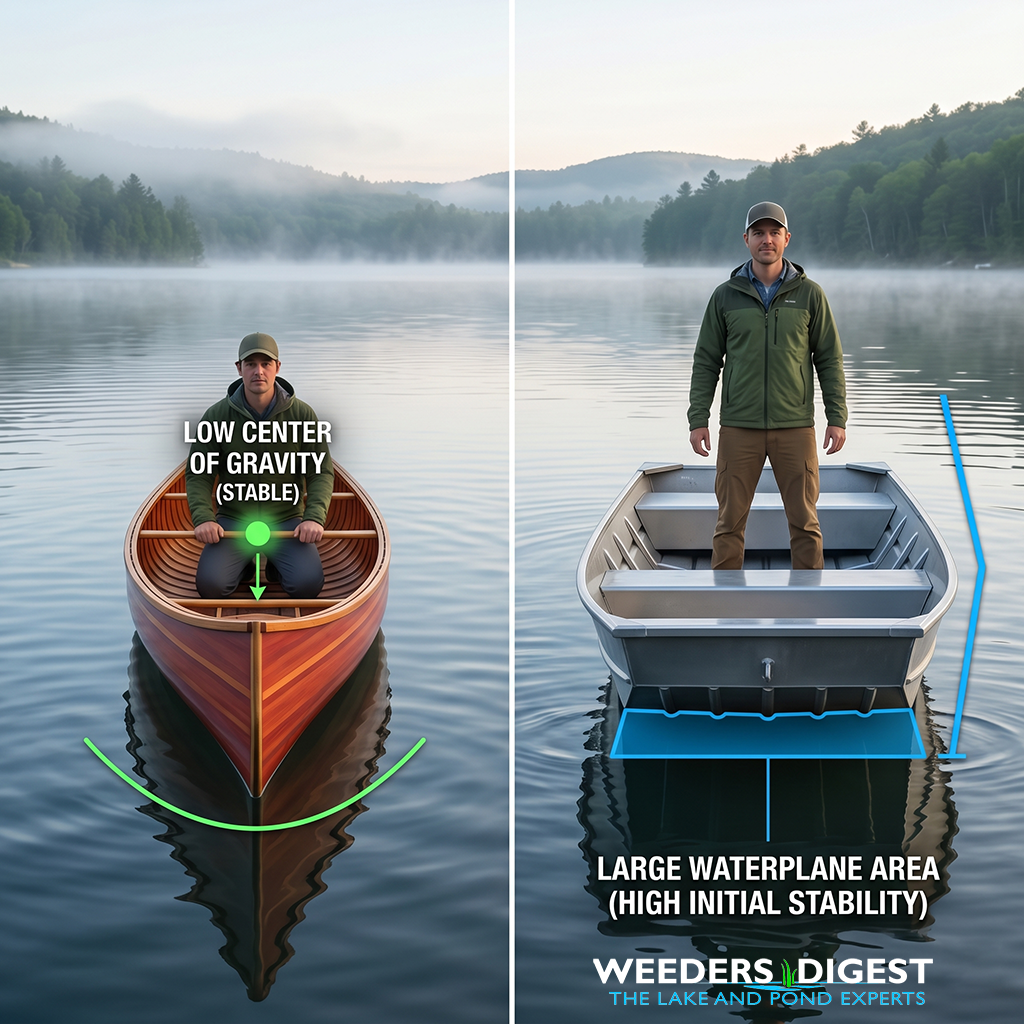
Whenever I’m out on the water, the difference between a canoe and a flat-bottom boat is instantly noticeable. If I try to stand up in my canoe, it feels like the boat is actively trying to toss me into the lake. This happens because canoes are designed for efficiency and speed, often featuring a rounded or "V-shaped" hull that slices through the water with minimal resistance. However, that sleek shape means there is very little surface area pushing back against the water to keep the boat level when weight shifts.
A flat-bottom boat, like a jon boat, feels much more like standing on a floating sidewalk. This is because the entire bottom of the boat is in contact with the water’s surface. When you stand up or move toward the side of a flat-bottom boat, the wide, flat shape creates immediate "buoyant support" across a large area. The boat resists tipping because it would have to push a massive amount of water out of the way to tilt, whereas a canoe simply rolls along its curved axis.
The main reason my canoe tips so easily when I stand is that I am raising the center of gravity. In a narrow, rounded boat, my body weight acts like a long lever. The higher up that weight goes, the more leverage it has to rotate the hull. In a flat-bottom boat, the stability provided by the hull's shape—what we call "initial stability"—is so high that it can compensate for a person standing up much more effectively than the narrow frame of a canoe.
Understanding this helps me stay safe and dry. In a canoe, I keep my weight low and centered because the boat lacks the physical footprint to counteract the tipping force of a standing human. A flat-bottom boat offers a trade-off: it is much harder to tip over while sitting or standing still, but it can be much more difficult to paddle through choppy waves or over long distances compared to the nimble, albeit twitchy, canoe.
The Science Behind It:
The disparity in stability between a canoe and a flat-bottom boat is governed by the principles of hydrostatics, specifically the relationship between the Center of Gravity (CG) and the Center of Buoyancy (CB). In any floating vessel, the Center of Buoyancy is the geometric center of the underwater portion of the hull. When a person stands in a canoe, the CG of the entire system rises significantly. According to research on vessel dynamics published by the Journal of Marine Science and Engineering, as a vessel heels (tilts), the CB shifts toward the submerged side. In a narrow, round-bottomed canoe, this shift is minimal, providing very little "righting arm" to pull the boat back to a level position.
The concept of "Initial Stability" vs. "Secondary Stability" is critical here. Flat-bottom boats possess high initial stability because their wide beam and flat hull create a large waterplane area. As noted in naval architecture fundamentals often cited by university engineering extensions like MIT Sea Grant, a wide waterplane ensures that even a small degree of tilt results in a massive displacement of water on the tilting side, creating a powerful upward force that resists further tipping. This allows the vessel to remain stable even when a passenger’s vertical Center of Gravity is elevated by standing.
Conversely, canoes are often designed with high secondary stability but low initial stability. The rounded or "V" hull shapes have a narrow waterplane, meaning they offer very little resistance to the first few degrees of tilt. However, as the canoe tips further and more of the flared sides enter the water, the buoyant force increases. This design is mathematically optimized for kinetic efficiency and reduced wetted surface area, which minimizes skin friction drag. While this makes the canoe faster and more maneuverable, it decreases the "Metacentric Height" (GM), a measurement of initial stability. A lower or negative GM when standing indicates that the vessel is in an unstable equilibrium.
When a person stands in a canoe, they create a "Capsizing Moment." Because the canoe acts as a pivot point with very little lateral resistance, the torque generated by the weight of a standing human easily overcomes the negligible righting moment provided by the narrow hull. In contrast, the geometry of a flat-bottom boat ensures the metacenter remains well above the center of gravity, maintaining a positive GM. This geometric resistance to rotation is why the flat-bottom boat remains stable under loads that would immediately invert a traditional canoe hull.