

Why My Lake-Bottom Probe Proves That Dissolved Oxygen Is Your Best Defense Against Choking Weed Overgrowth
 |

Summary:
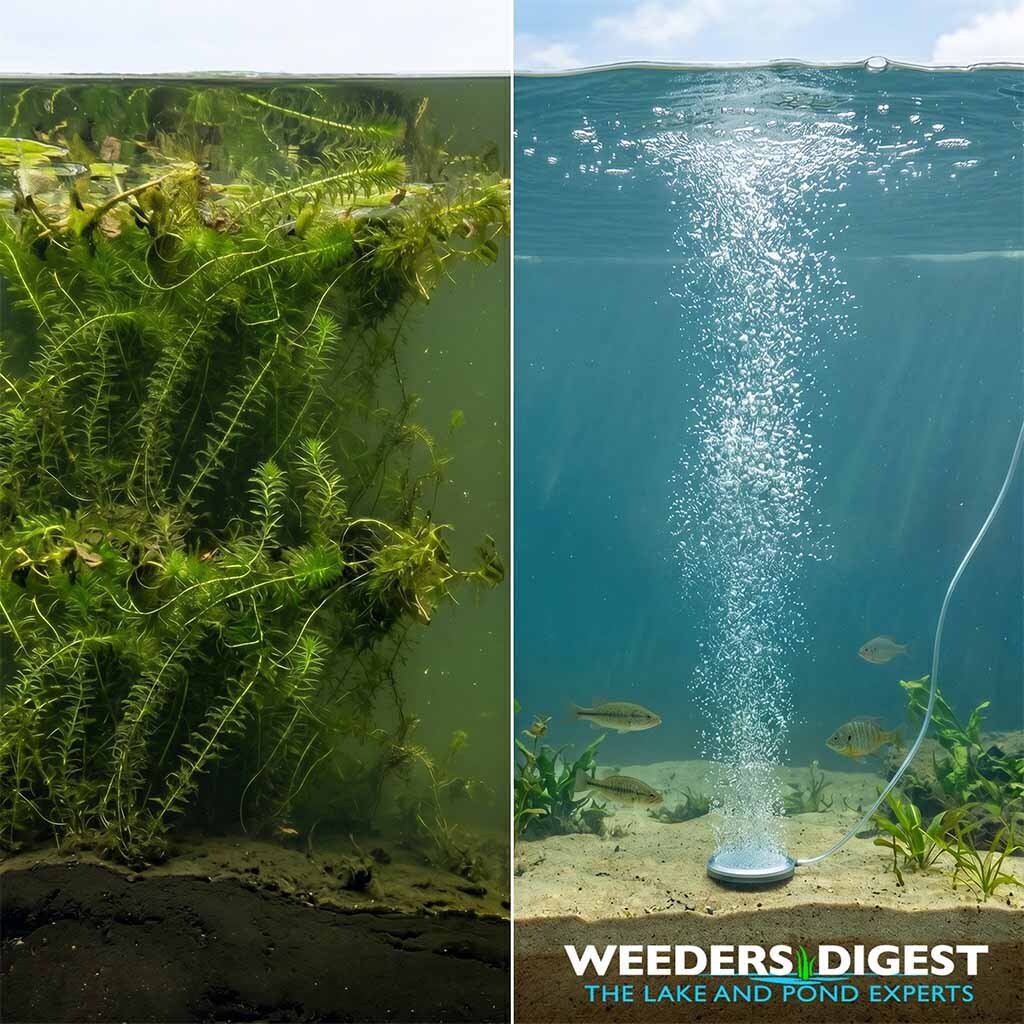
Dissolved oxygen does not directly kill or suppress the growth of established aquatic weeds; rather, maintaining high dissolved oxygen levels indirectly controls weed overgrowth by shifting the entire lake ecosystem balance away from conditions that favor aggressive plant and algal colonization. In a healthy water body, rich dissolved oxygen reserves fuel aerobic bacteria that aggressively break down organic muck and lock up key nutrients like phosphorus in the bottom sediment. When a pond loses its oxygen, this protective cycle breaks down, unlocking massive amounts of chemical fertilizer from the mud that accelerates weed growth.
As a Certified Lake Manager, I regularly step onto properties where a frustrated homeowner complains that their pond turned into a choked, green soup seemingly overnight. When I drop a multi-parameter water probe into these stagnant waters, the reading frequently confirms my suspicion: dissolved oxygen levels near the bottom mud are sitting at zero. This total absence of oxygen creates a chemical gateway, essentially fast-tracking the release of historic nutrient loading straight to the roots of invasive weeds.
Once these dense weed canopies establish, they trigger a brutal, self-sustaining loop. The plants photosynthesize and saturate the surface water with oxygen during peak daylight hours, but the story flips completely at night. During the dark hours, the massive biomass switches to respiration, sucking vast amounts of oxygen out of the water column. Adding a continuous, deep-water aeration system to break up thermal stratification and keep oxygen levels high from top to bottom is the single most effective way to short-circuit this cycle, starving the weeds of their internal nutrient supply.
The Science Behind It:
The mechanical relationship between dissolved oxygen ($DO$) and aquatic macrophyte overgrowth is rooted in benthic biogeochemistry and the phenomenon of internal nutrient loading. In an un-aerated or stratified lake, the water column separates into a warm, oxygen-rich upper layer (the epilimnion) and a cold, dense, oxygen-depleted bottom layer (the hypolimnion). When the hypolimnion becomes anoxic (defined as $DO$ concentrations falling below $0.5 \text{ mg/L}$), the redox potential at the sediment-water interface drops sharply. This reduction in redox potential alters the chemical binding capacity of benthic sediments, transforming the lake bed from a nutrient sink into an active nutrient source.
Under oxic conditions, ferric iron binds tightly with soluble reactive phosphorus ($SRP$) to form insoluble ferric phosphate compounds, locking the nutrient safely in the mud. However, research published in Applied Ecology and Environmental Research demonstrates that during severe water eutrophication and anoxia, microbial decomposition and chemical reduction break these iron-phosphorus bonds. The sediment then releases high concentrations of bioavailable phosphorus and ammonium into the water column. This internal loading acts as a continuous, high-potency liquid fertilizer that fuels the rapid elongation and biomass accumulation of submersed macrophytes and filamentous algae.
Furthermore, dense macrophyte stands exert an extraordinary influence over the diurnal gas dynamics of the ecosystem. A study published in PMC / Water Ecology examining wind exposure and oxygenation within dense hydrophyte stands highlights that high plant density creates a severe nycthemeral (24-hour) fluctuation. During peak solar radiation, macrophyte photosynthesis drives oxygen levels into extreme supersaturation, often exceeding $140\%$ saturation in the upper canopy. Conversely, at night, photosynthetic activity ceases while both plant respiration and the biological oxygen demand ($BOD$) of heterotrophic sediment bacteria continue unabated. This net consumption causes $DO$ levels to crash aggressively before dawn, frequently dropping below the critical threshold of $2.0 \text{ mg/L}$.
The physical presence of a thick weed canopy also acts as a mechanical barrier to natural atmospheric re-aeration. According to mathematical modeling published by ResearchGate / Modeling the depletion of dissolved oxygen, dense mats of surface-floating and submerged macrophytes physically dampen wind-driven wave action and reduce the surface area available for air-water gas exchange. This restriction prevents atmospheric oxygen from diffusing deeper into the water column. By utilizing mechanical aeration to maintain continuous water movement and high benthic dissolved oxygen, lake managers can prevent the chemical reduction of iron, keep phosphorus permanently bound in the sediment matrix, and effectively interrupt the feedback loop that sustains aggressive aquatic weed populations.
Sources / References:
- US EPA CADDIS - Dissolved Oxygen: https://www.epa.gov/caddis/dissolved-oxygen
- Applied Ecology and Environmental Research (Fish Trajectories & Eutrophication Data): https://www.aloki.hu/pdf/1701_653666.pdf
- PMC / Water Ecology (Wind Exposure & Water Oxygenation in Hydrophytes): https://pmc.ncbi.nlm.nih.gov/articles/PMC8309138/
- ResearchGate (Modeling the Depletion of Dissolved Oxygen due to Submerged Macrophytes): https://www.researchgate.net/publication/259471948_Modeling_the_depletion_of_dissolved_oxygen_in_a_lake_due_to_submerged_macrophytes