

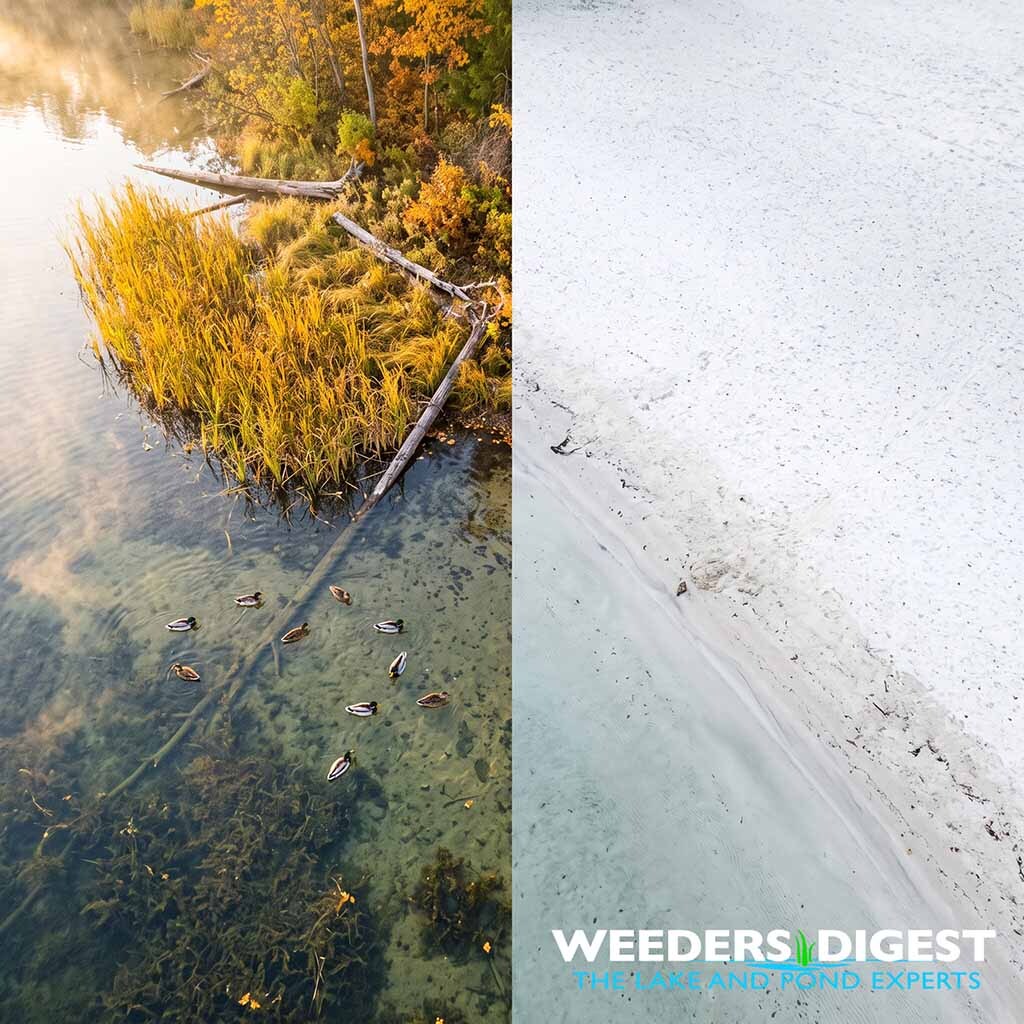
Why Our Natural Shorelines Turn Into Fall Wildlife Magnets (While Manicured Beaches Go Barren)
 |

Summary:
Natural shorelines attract significantly more wildlife in October because they provide vital thermal stability, rich energetic forage, and continuous protective cover during the critical autumn transition, whereas manicured sand beaches become ecological dead zones. As air temperatures drop and autumn migrations peak, migratory waterfowl, staging songbirds, amphibians, and resident fish gravitate toward the structural complexity that only an unaltered littoral zone and vegetated riparian buffer can offer. Manicured beaches lack the essential seeds, emergent vegetation, and benthic macroinvertebrates necessary for animals to fuel up for freezing temperatures or southward flights.
Our lake and pond experts observe this stark contrast every October during late-season shoreline evaluations. While manicured sand plots sit empty, barren, and battered by cold autumn wind and wave action, nearby naturalized waterfronts are bustling with life. We regularly find schools of juvenile panfish tucking into remnant native plant stems, while migrating dabbling ducks actively feed among native arrowhead, sedges, and softstem bulrush.
The Science Behind It:
The ecological disparity between naturalized banks and barren sand beaches hinges on the littoral ecotone—the biologically dynamic boundary where terrestrial and aquatic ecosystems converge. In temperate freshwater lakes, the upper littoral zone generates an outsized portion of total lake productivity. Research by Brauns et al. demonstrated that lakeshore modification directly compromises littoral food webs; benthic macroinvertebrate secondary production in the upper littoral zone was found to be dramatically lower along cleared sand beaches compared to structurally intact natural shorelines. In fact, whole-lake modeling indicated that replacing natural shorelines with barren sand beaches could slash overall lake secondary benthic production by roughly 24%. When landowners remove native macrophyte beds to establish artificial sand beaches, they eliminate the primary detrital and periphyton base that autumn foragers require.
Furthermore, a landmark study by Radomski and Goeman across Minnesota lakes quantified that residential shoreline development resulted in a 66% average reduction in emergent and floating-leaf vegetation compared to natural shorelines. In October, this vegetation loss proves catastrophic for local wildlife. Intact emergent plants—such as cattails, bulrushes, and native pondweeds—produce dense seed heads and provide attachment surfaces for chironomids, amphipods, and aquatic snails. These organisms deliver the lipid- and protein-rich caloric surplus that migratory birds must consume to survive multi-thousand-mile migrations. A manicured sand beach provides virtually zero caloric return, leaving foraging wildlife with no incentive to visit.
Coarse woody habitat and submerged plant canopies also regulate microclimates during rapid seasonal temperature swings. Christensen et al. recorded that undeveloped lakes average 893 logs of coarse deadwood per mile of shoreline, whereas cabin-occupied developed shorelines drop to an average of just 92 logs per mile. This submerged timber, paired with standing terrestrial riparian buffers, creates windbreaks that reduce convective heat loss from surface water. Research shows that vegetated riparian zones buffer water temperature fluctuations and prevent high-energy autumn wind-wave action from scouring the lake bed.
Finally, seasonal bioenergetics dictate that young-of-the-year fishes must conserve energy before winter ice-cover establishes. In undisturbed littoral margins, juvenile centrarchids and minnows find refuge within the deep stem matrices of native perennials, where wind exposure and predatory sightlines are minimized. Conversely, manicured sand beaches offer an entirely featureless substrate where wind-induced turbulence suspends inorganic sand particles, degrading gill efficiency and offering zero predation protection. Wildlife avoids manicured shorelines in October because, from an evolutionary and metabolic standpoint, exposed sand represents an energy sink with no shelter or fuel.
Our Recommendation for Managing Shoreline Usability and Ecological Balance:
Balancing an accessible, usable waterfront with a thriving aquatic ecosystem requires addressing the physical mechanisms of sedimentation and weed dominance without stripping the entire shoreline bare. Complete sand blankets often disrupt the natural littoral food chain, yet leaving recreation areas entirely unmanaged allows stagnant, decaying organic material to build up into foul-smelling muck.
The scientific solution is targeted, dynamic water circulation rather than wholesale habitat destruction. To maintain clear swimming corridors, docks, and boat lifts without sterilizing your entire waterfront, we recommend establishing designated activity lanes while leaving adjacent natural buffer zones intact. For those designated recreation areas, continuous water circulation breaks the cycle of sediment accumulation. Installing automated water movers like the AquaThruster Muck & Weed Blower collection generates directional flow that replicates natural riverine currents. This continuous movement prevents organic muck, leaves, and nuisance weeds from settling into the substrate while keeping your high-use areas clean—allowing you to enjoy an open shoreline without destroying the crucial native littoral boundaries next door. For manual maintenance of designated navigation paths, pairing circulation with our lake weed cutters and shoreline clearing tools gives you precise control over your waterfront footprint without compromising regional water health.
Sources / References:
- Brauns, M., Gonsiorczyk, T., & Mehner, T. "Lakeshore modification reduces secondary production of littoral macroinvertebrates in a lowland lake." Freshwater Biology / CoreScholar. https://corescholar.libraries.wright.edu/cgi/viewcontent.cgi?article=1773&context=biology
- Radomski, P., & Goeman, T. J. "Consequences of Human Lakeshore Development on Emergent and Floating-Leaf Vegetation Abundance." North American Journal of Fisheries Management. https://www.canr.msu.edu/michiganlakes/uploads/files/stresses_and_threats.PDF
- Christensen, D. L., Herwig, B. R., Schindler, D. E., & Carpenter, S. R. "Impacts of lakeshore residential development on coarse woody debris in north temperate lakes." Ecological Applications. https://www.canr.msu.edu/michiganlakes/uploads/files/stresses_and_threats.PDF
- Penn State Extension. "Riparian Buffers for Wildlife." https://extension.psu.edu/riparian-buffers-for-wildlife