

Why Your Boat's Hull Design Might Be Reshaping My Shoreline
 |

Summary:
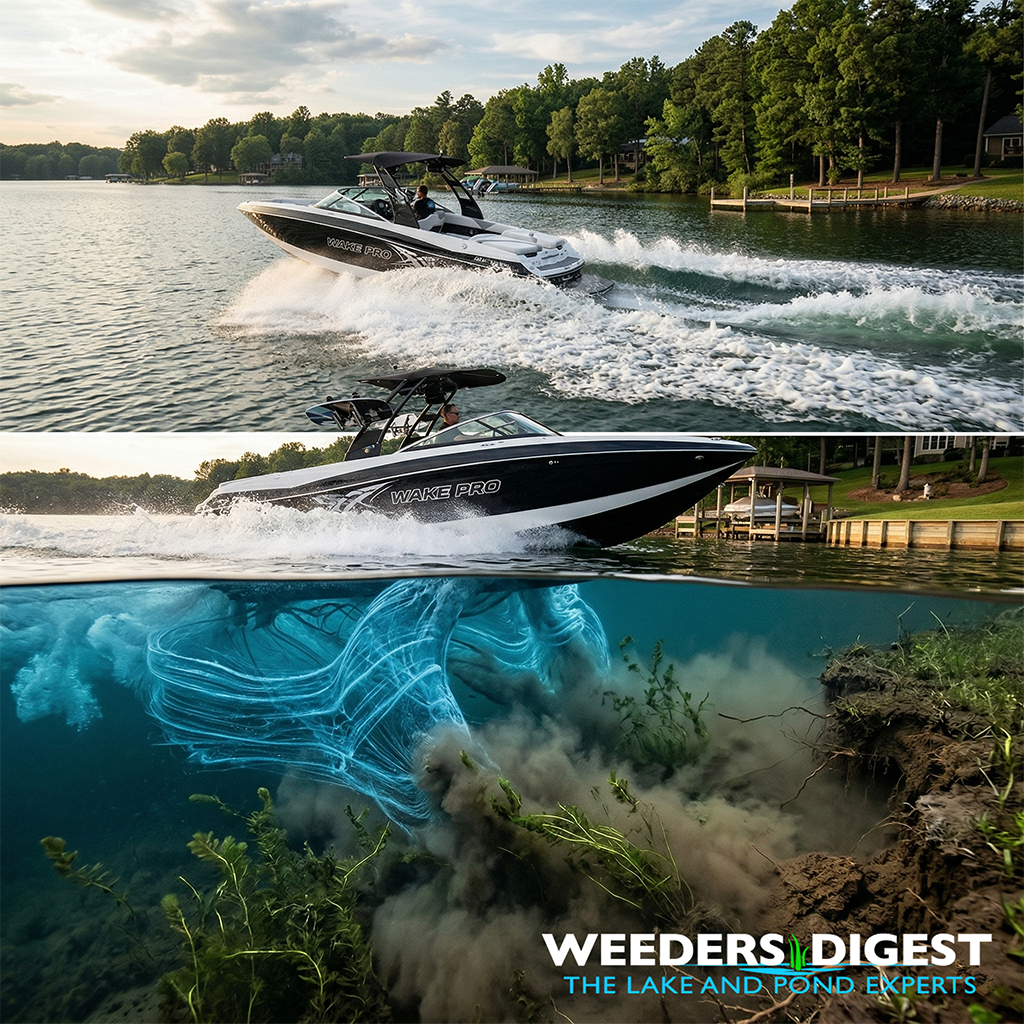
When you are out on the water, it is easy to focus on the speed and the spray, but the hidden shape of your boat’s hull is actually dictating how much energy hits the shore long after you have passed. The way a boat sits in and moves through the water creates a wake, which is essentially a series of waves carrying energy. Depending on whether your boat has a flat bottom, a deep V-shape, or a specialized hull for wakesurfing, those waves will behave very differently when they finally reach the land.
Deep-drafting boats or those designed to displace a lot of water create much larger, more powerful waves that can travel long distances without losing strength. For homeowners, this means that a single pass from a heavy wake boat can cause more impact than dozens of passes from a small fishing boat or a flat-bottomed skiff. Understanding these differences is the first step in realizing how our choice of watercraft directly affects the health and stability of the lakes we love.
The impact isn't just about the height of the wave, but also how deep that wave reaches into the water column. As these waves approach the shallow areas near the shore, they begin to "feel" the bottom, churning up sediment and battering the bank. This process can strip away soil, destroy aquatic plants, and ruin the natural balance of the shoreline, often leading to costly erosion problems for property owners.
The Science Behind It:
The morphological characteristics of a boat hull—specifically its displacement and deadrise angle—are the primary determinants of wake wave energy ($E_w$). In fluid dynamics, as a hull moves through a medium, it displaces a volume of water equal to its weight. A deep-V hull or a heavy displacement hull, common in wake-sports vessels, creates a significant "pressure bulb" at the bow and a deep trough at the stern. Research by Goudey and Gadd (1977) and subsequent studies on inland waterways indicate that the wave height ($H$) and period ($T$) are functions of the hull's Froude number, which relates the boat's speed to the water depth and the length of the waterline.
When a displacement hull operates at sub-planing speeds, it maximizes the "plowing" effect, transferring massive amounts of kinetic energy into the water column. Unlike shallow-draft or planing hulls that rise above the water to minimize drag, these specialized hulls use ballast and hull geometry to stay deep, producing waves with long wavelengths. As these waves propagate toward the littoral zone, the orbital motion of water particles within the wave begins to interact with the benthic substrate. This interaction increases shear stress on the lake bed, leading to the resuspension of sediments and the uprooting of emergent macrophytes.
The impact on the shoreline is governed by the total wave energy flux. According to studies published in journals such as Journal of Coastal Research, the energy contained in a wake is proportional to the square of the wave height ($E \propto H^2$). Therefore, a wake that is twice as high as a standard wind-driven wave actually carries four times the erosive power. As the wake enters shallow water, a process known as shoaling occurs; the wave speed decreases while the wave height increases, eventually leading to a high-energy "breaking" event against the shoreline.
Furthermore, the frequency of these high-energy events prevents the natural settling of fine-grained particles. This constant turbidity limits light penetration, which inhibits the growth of submersed aquatic vegetation (SAV) that would otherwise act as a natural buffer against erosion. In narrow channels or smaller inland lakes, the "wake train" produced by heavy hulls does not have sufficient distance to dissipate via geometric spreading, resulting in nearly 100% of the generated energy being delivered directly to the terrestrial-aquatic interface.