

Why Your Lake Bottom is Turning into Muck: My Take on Aerobic vs. Anaerobic Decomposition
 |

Summary:
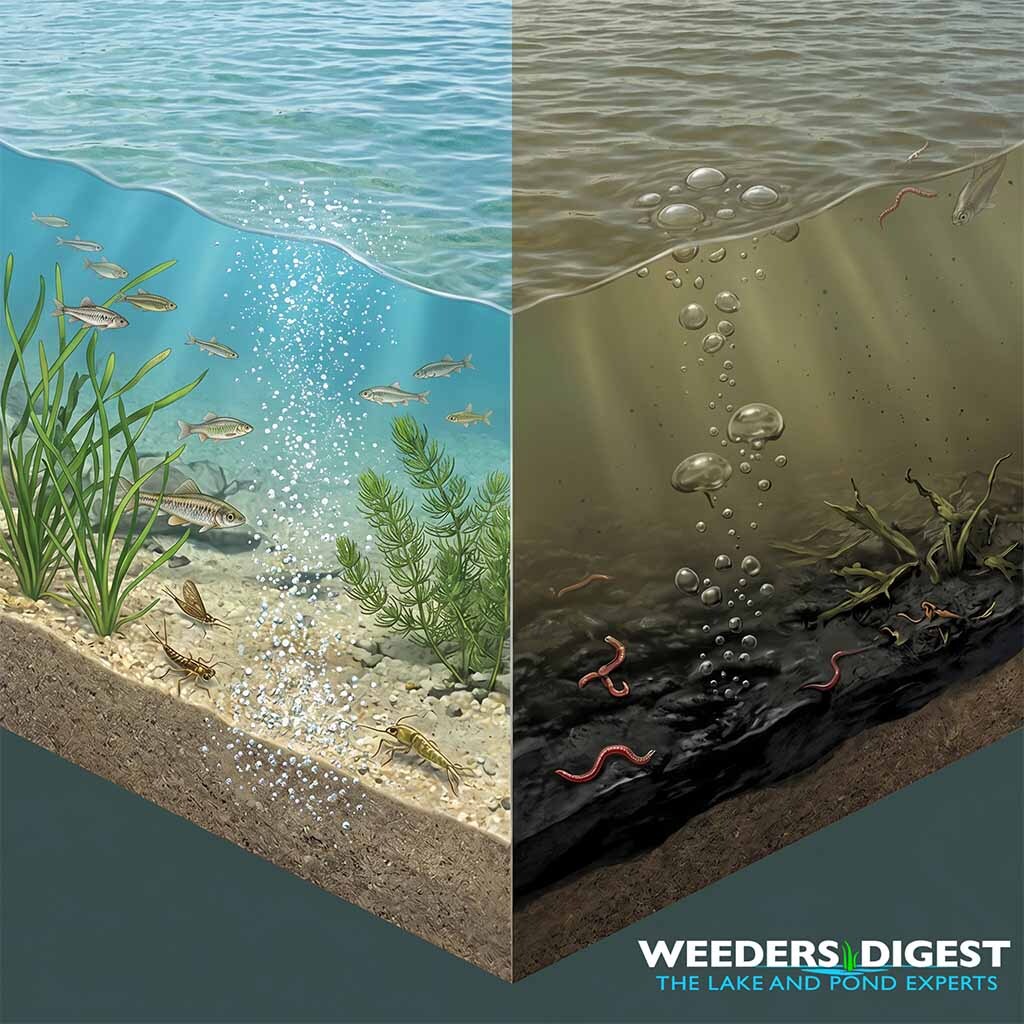
The difference between aerobic and anaerobic decomposition in bottom sediments comes down to the presence of oxygen, which fundamentally dictates how fast organic matter breaks down and whether toxic byproducts are released into your water. Aerobic decomposition utilizes oxygen to rapidly and efficiently break down leaves, algae, and fish waste into harmless carbon dioxide and water, leaving a cleaner, firmer lake bottom. In contrast, anaerobic decomposition occurs when oxygen is completely depleted, relying on a different set of bacteria that digest organic matter very slowly while producing noxious byproducts like methane and hydrogen sulfide.
When a pond or lake loses its bottom oxygen, the organic matter piles up much faster than it can be digested, creating that thick, black layer of "muck" that so many waterfront homeowners despise. As a Certified Lake Manager, I often pull up sediment core samples that instantly smell like rotten eggs—a dead giveaway that anaerobic bacteria have entirely taken over the benthic zone. This shift not only causes foul odors but also triggers a dangerous chain reaction that degrades overall water quality, suffocates beneficial aquatic life, and fuels nuisance algae blooms.
Understanding this biological switch is the key to reclaiming your shoreline. As long as the bottom sediments remain starved of oxygen, the waterbody is trapped in a cycle of slow decay and continuous internal nutrient recycling. By recognizing the physical signs of an anaerobic bottom, such as persistent muck accumulation and bubbling gases breaking the surface, you can better understand the underlying biology of your pond. Promoting highly efficient aerobic bacteria is the natural path forward to digest that organic buildup and restore the health of your aquatic ecosystem.
The Science Behind It:
The fundamental mechanics distinguishing aerobic from anaerobic decomposition in lacustrine environments revolve around the terminal electron acceptors utilized by microbial communities during the oxidation of organic carbon. In oxygen-rich (oxic) environments, aerobic bacteria utilize molecular oxygen as the primary electron acceptor, a highly efficient metabolic pathway that yields maximum adenosine triphosphate (ATP) and results in the rapid mineralization of detritus into carbon dioxide and water. When dissolved oxygen concentrations plummet at the sediment-water interface, the ecosystem shifts to anoxic conditions, forcing the microbial consortium to rely on alternative, thermodynamically less favorable electron acceptors such as nitrates, sulfates, and carbon dioxide. This anaerobic pathway is significantly slower, leading to the rapid accumulation of organic sediment and the release of metabolic byproducts including methane and hydrogen sulfide.
The depletion of oxygen fundamentally alters the sediment's oxidation-reduction (redox) potential, which serves as a critical driver for internal nutrient loading. Redox potential, or Eh, is a measure of the tendency of a chemical species to acquire electrons. As the sediment environment becomes progressively anaerobic, the redox potential drops precipitously. Research published in PLOS One demonstrates that this reduction in Eh accelerates the chemical reduction of ferric iron, Fe(III), to its soluble ferrous form, Fe(II). Because phosphorus is strongly adsorbed onto oxidized iron complexes in the sediment, the dissolution of these iron complexes releases highly bioavailable orthophosphate directly into the overlying water column.
The scale of this chemically driven internal phosphorus loading under anaerobic conditions is mathematically substantial. In a simulative temperature and decomposition study examining eutrophic lake sediments, the breakdown of algal residues drove down redox potentials, and the subsequent reduction in sodium hydroxide-extractable aluminum and iron-bound phosphorus accounted for a staggering 79.3% of the total reduction in sediment phosphorus. This dynamic highlights how anoxic, anaerobic conditions physically unbind legacy nutrients from the benthic substrate, creating a self-sustaining feedback loop where released phosphorus fuels excessive primary production, which in turn dies, settles, and further drives benthic oxygen depletion.
Furthermore, the overall rate of organic matter mineralization is starkly partitioned by the prevailing dissolved oxygen regime, largely dictated by the trophic state of the aquatic system. Investigations into shallow-water bottom sediments reveal the immense metabolic shift that occurs in nutrient-rich environments. For example, research evaluating decomposition rates in differing aquatic zones demonstrated that in heavily polluted, highly productive mesotrophic lakes, total organic matter decomposition can exceed 420 Joules per square centimeter annually, with anaerobic processes driving up to 70% of this total mineralization. Conversely, in unpolluted, oxygenated sectors of the same waterbodies, the total decomposition rate was substantially lower, approximately 170 Joules per square centimeter annually, with anaerobic processes comprising merely 22% of the total decomposition activity.
Ultimately, the suppression of aerobic metabolism in the benthic zone creates a biogeochemical bottleneck. The complex structural polymers comprising aquatic plant and algal detritus require diverse enzymatic processes for complete hydrolysis. While specific anaerobic taxa, such as sulfate-reducing bacteria and methanogens, are capable of degrading these complex polymers, their processing rates are fundamentally restricted by the thermodynamics of anoxic environments. This microbial inefficiency, coupled with the persistent release of iron-bound phosphorus and dissolved organic carbon, underscores the critical importance of maintaining oxic sediment-water interfaces for optimal lake metabolism and eutrophication control.