

Why Your Lake’s Hidden Chemistry Dictates Everything From Algae Blooms to Fishing Success
 |

Summary:
Limnology and water quality chemistry are the structural backbones that determine the health, clarity, and biological viability of your private lake or backyard pond. Every aquatic ecosystem behaves like a living, breathing chemical reactor where physical properties—like sunlight and temperature—interact directly with chemical elements like dissolved oxygen, pH, and nutrients. When these chemical parameters shift even slightly, they trigger immediate, cascading transformations across the entire ecosystem, altering everything from the color of your water to the survival rates of your fish.
For the average waterfront property owner, a lake might look like a static body of water, but beneath the surface lies a highly dynamic and delicate balancing act. Rainwater runoff, decomposing organic matter, and solar radiation constantly alter the underlying chemistry. If nutrients like phosphorus and nitrogen rise too high, they fuel sudden algae explosions; if dissolved oxygen drops too low, it can lead to devastating, overnight fish kills. Understanding this invisible chemistry is the absolute key to transitioning from reactive, expensive crisis management to proactive pond stewardship.
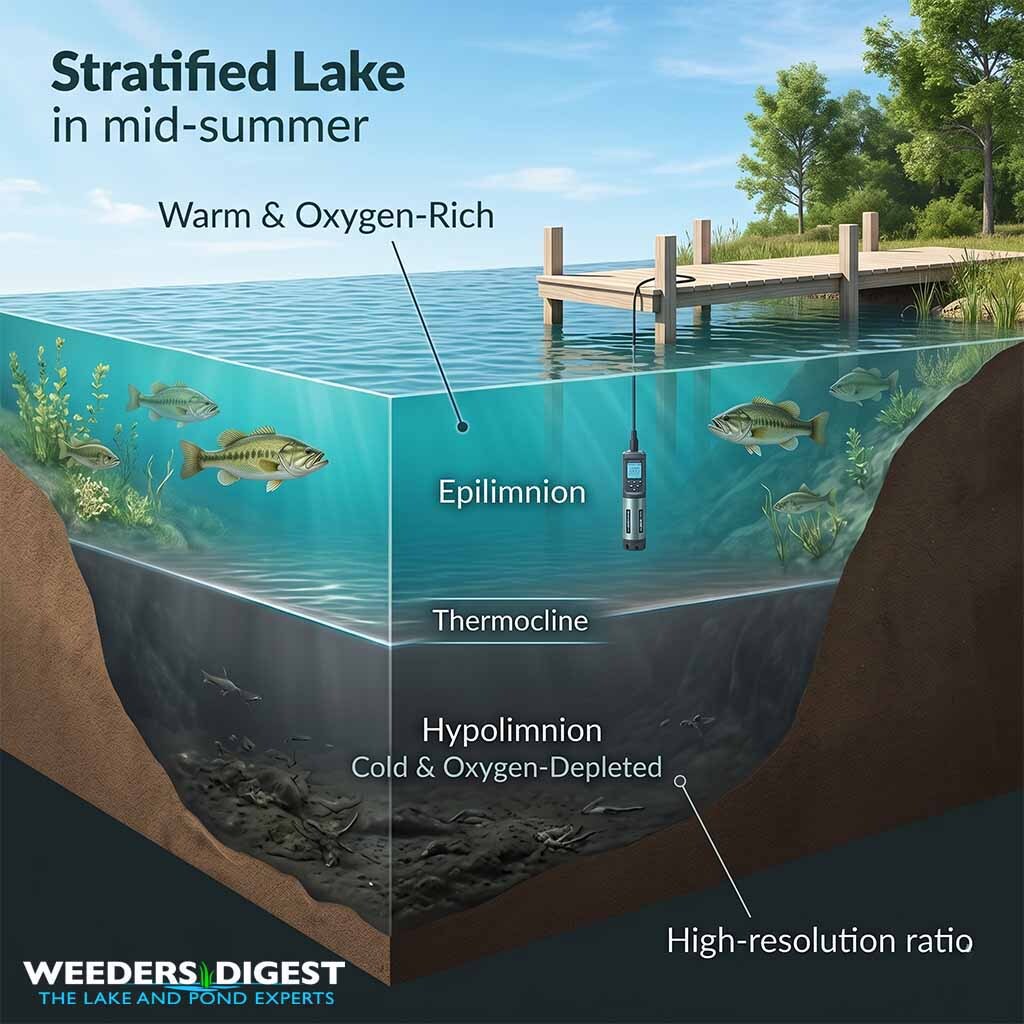
In my years managing private waterways, I have frequently stepped out onto a client’s dock in mid-July to find the surface water crystal clear and registering a warm, comfortable temperature, only for my multi-parameter digital probe to reveal a completely different story just six feet below. Dropping the probe down into the darker, cooler layers often shows a dropped pH and a dissolved oxygen level hovering near zero milligrams per liter. This stark vertical divide is a classic real-world manifestation of thermal stratification, a invisible seasonal wall that locks vital oxygen at the surface and traps toxic gases at the bottom, proving that what you see on the surface rarely reflects the true chemical health of your water body.
The Science Behind It:
The functional dynamics of standing inland waters, or lacustrine environments, are governed by the core principles of limnology—the study of inland aquatic ecosystems—and the fundamental mechanics of aqueous chemistry. Water exhibits a unique physical property: its maximum density occurs at 3.98°C (39.16°F). As solar radiation warms the upper layer of a water body during summer, this water expands and becomes less dense, floating atop the colder, denser water below. This physical disparity creates three distinct thermal zones: the warm upper epilimnion, the transitional metalimnion (containing the sharp temperature gradient known as the thermocline), and the cold, isolated bottom layer known as the hypolimnion.
According to limnological data published by the Alberta Lake Management Society (ALMS), a formal thermocline is structurally defined when the water temperature shifts by more than 1°C per single meter of depth (1.8°F per 3.28 feet). This rapid thermal transition creates a highly effective physical barrier that prevents ambient atmospheric wind from mixing the upper and lower water columns. Because the isolated hypolimnion is completely cut off from atmospheric aeration and photosynthetic oxygen production, ongoing microbial decomposition of organic "muck" on the benthic floor rapidly consumes the remaining oxygen, causing severe hypolimnetic anoxia.
This physical stratification exerts direct, profound control over water quality chemistry, specifically regarding hydrogen ion concentration (pH), dissolved oxygen (DO), and nutrient cycling. As microbes decompose organic materials in anoxic environments, they release carbon dioxide (CO_2), which reacts with water to form carbonic acid (H_2CO_3), driving down benthic pH levels. Research published in Water Quality Parameters confirms that a single unit change on the pH scale represents a precise 10-fold shift in hydrogen ion concentration. This shift significantly alters chemical toxicity; for instance, while a high pH converts ammonium (NH_4^+) into highly toxic un-ionized ammonia (NH_3), a low benthic pH facilitates the rapid dissolution of heavy metals and bound nutrients from the sediment into the water column.
The absolute rate at which these chemical shifts alter an ecosystem is profoundly governed by a metric known as hydraulic retention time, or water residence time. As detailed in global geostatistical assessments published by organizations like the Nature Publishing Group, the median hydraulic residence time for natural global lakes is approximately $456 days ($1.25 years), whereas shallow, polymictic ponds may flush in just a matter of days or weeks. In water bodies with long hydraulic retention times, nutrients like total phosphorus and nitrogen cannot be physically flushed out of the system. Instead, they continually accumulate and recycle internally between the sediments and the water column, compounding eutrophication and fueling perpetual toxic cyanobacteria blooms.
Sources / References:
- Alberta Lake Management Society (ALMS) Lakewatch Program: https://alms.ca/wp-content/uploads/2017/11/Lakewatch-Report-Limnology-Section.pdf
- Water Quality Parameters (IntechOpen Chapter): https://www.intechopen.com/chapters/69568
- PubMed Central (PMC) Global Lake Volume and Residence Time Study: https://pmc.ncbi.nlm.nih.gov/articles/PMC5171767/