

Why Your Lake's Shallow-Water Weeds Keep Coming Back: The Engineering Behind True Eradication Tools

Summary:
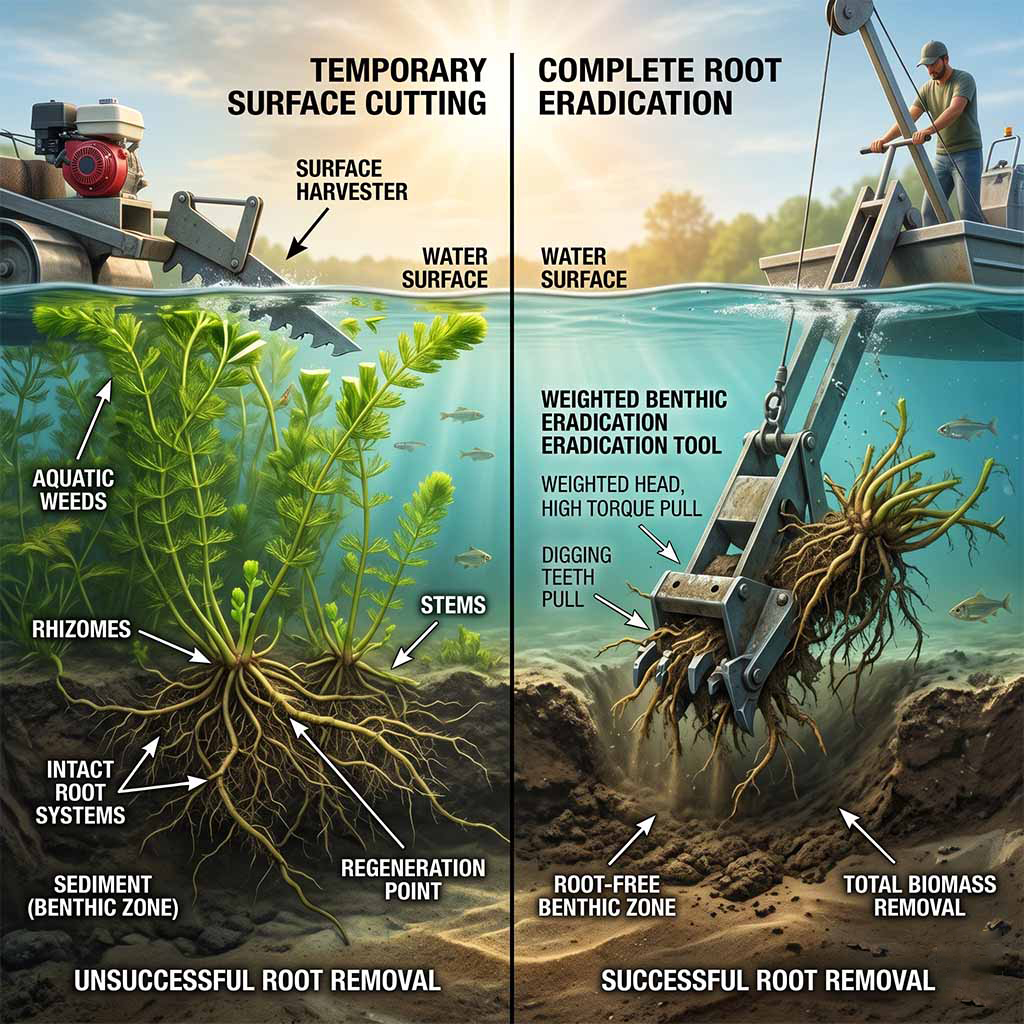
The engineering behind shallow-water aquatic weed eradication tools relies on physically disrupting the plant's root system, blocking sunlight, or cutting below the sediment line rather than just trimming the surface vegetation. When property owners attempt to clear their shorelines, they often rely on tools that simply shear the top of the plant. While this offers temporary cosmetic relief, the submerged root structures remain perfectly intact and ready to rapidly regenerate. To truly eliminate the nuisance, eradication devices must be designed to either excavate the root bed or completely smother the aquatic environment to halt photosynthesis.
As a Certified Lake Manager, my daily field observations reveal a recurring frustration among lakefront homeowners: those who only use surface cutters find that their weeds grow back thicker within weeks, much like mowing a lawn. True eradication only happens when we deploy tools engineered to extract the benthic root crowns or block light entirely. The most effective equipment is weighted and designed to dig into the heavy bottom muck, pulling the weed completely out of the soil matrix so that it cannot reproduce through fragmentation.
This physical removal process is highly dependent on the design of the tool's teeth, its weight distribution, and the angle of extraction. Shallow-water eradication requires machinery or hand-tools that conquer the water's natural buoyancy, which constantly tries to lift the tool away from the dense sediment where the actual problem lies.
The Science Behind It:
The fundamental challenge in managing nuisance aquatic macrophytes—visible, structurally complex aquatic plants—lies in their highly adapted benthic root systems and reproductive strategies. The benthic zone, which is the ecological region at the very bottom of a water body including the sediment surface, houses the extensive rhizomes and root crowns of these plants. Rhizomes are modified subterranean stems that send out both roots and shoots from their nodes, allowing aquatic plants to aggressively propagate and store immense starch reserves. Consequently, any tool engineered merely to shear the stems in the water column fails to address the foundational biomass buried within the anaerobic sediment layer.
The mechanical engineering of standard aquatic harvesters often relies on reciprocating blades that slice vegetation above the hydrosoil, a process that inadvertently exacerbates weed proliferation through fragmentation. According to a comprehensive environmental impact study conducted by the Lahontan Regional Water Quality Control Board (2020) at the Tahoe Keys Lagoons, nearly two decades of mechanical harvesting failed to limit the spread of invasive species. The research noted that the volume of aquatic weeds harvested from the lagoons increased 100-fold since 1984, culminating in a staggering 10,125 cubic yards of removed biomass in 2016 alone. This quantitative data emphasizes that surface-cutting tools do not achieve eradication; rather, they stimulate compensatory growth and lateral spread.
To achieve genuine eradication, equipment must be engineered for benthic excavation or complete light attenuation. Mechanical excavation tools utilize specialized rakes or dredging buckets to penetrate the substrate, physically uprooting the macrophyte rhizomes. However, this aggressive engineering approach has immediate ecological consequences on the micro-habitat. A 2002 study published by the New Zealand Department of Conservation evaluating mechanical excavation in spring-fed drains found that while plant material was initially removed, aquatic plant cover rapidly returned to 80% of pre-excavation levels within six months. Furthermore, the physical disturbance of the sediment severely impacted native benthic invertebrates, reducing the population density of species such as the Gyraulus snail by 90%.
Because of the high regrowth rates and collateral ecological damage associated with mechanical excavation, modern eradication engineering has shifted toward benthic barriers. These tools are high-density geotextile mats deployed directly over the weed beds to induce artificial aphotic (zero light) conditions. By physically suppressing the plants and preventing the penetration of photosynthetically active radiation, benthic barriers exhaust the plant's rhizomic carbohydrate reserves over several months. The engineering focus here is on material density, permeability to allow gas escape from decomposing organic matter, and weight mechanisms to prevent the barrier from billowing in the water current.