

Why Your Lake Turns Green Before Everyone Else's: Understanding Curly-Leaf Pondweed's Over-Wintering Turions
 |

Summary:
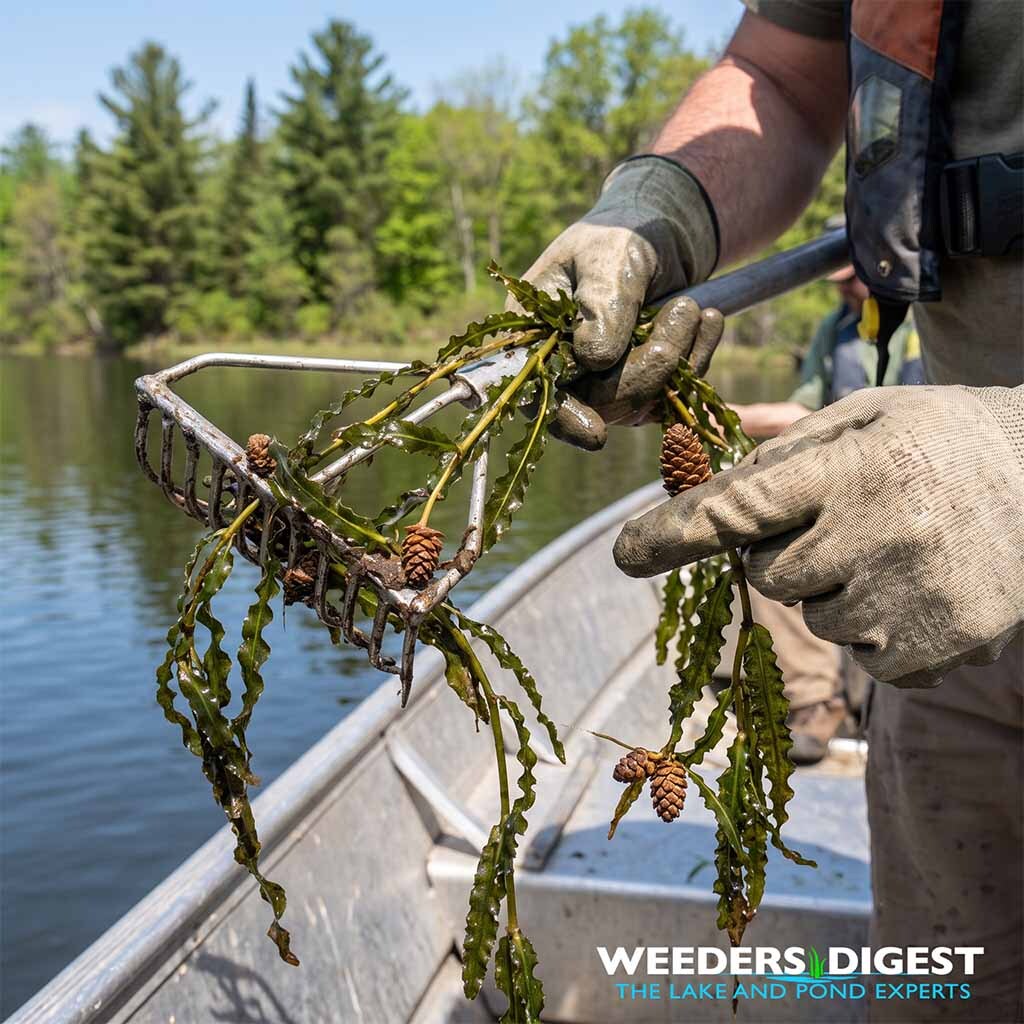
Curly-leaf pondweed overwinters through the production of turions, which are compact, pinecone-like vegetative buds that drop to the lake bottom in summer and uniquely sprout in the fall to grow under the winter ice. These structures are the ultimate survival mechanism for this invasive aquatic plant. Instead of relying on traditional seeds, curly-leaf pondweed drops thousands of these hardy buds into the muck before it dies back in the heat of mid-summer. When water temperatures begin to drop in late summer and early fall, these turions wake up. While native lake plants are shutting down for the winter season, curly-leaf pondweed is just getting started, establishing a strong root system and shoots beneath the ice.
As a Certified Lake Manager, I often get calls from panicked homeowners in early May wondering why their shoreline is already choked with thick, lasagna-like weeds before they have even put their boats in the water. When I pull a rake toss through these early blooms to survey the area, I almost always find the dark, decaying remnants of last year's turions still clinging to the base of the stems. Because these plants get a massive head start under the snow-covered ice, they easily outcompete the beneficial native species that are just beginning to wake up in the spring.
Understanding this backward life cycle is the most important step in reclaiming your water. If you wait to address the plant in late June when it completely covers the surface, you are already too late, as the plant has likely already dropped its next generation of turions into the mud to repeat the cycle next year.
The Science Behind It:
Curly-leaf pondweed (Potamogeton crispus) is an invasive submersed aquatic macrophyte—a plant that grows entirely underwater—that utilizes a highly specialized reproductive and survival strategy centered around turions. A turion is an overwintering bud composed of tightly overlapped, modified leaves packed with starch and carbohydrates. While most aquatic plants undergo senescence, or natural biological death and decay, in the autumn months, Potamogeton crispus undergoes senescence in mid-summer. Just prior to this die-off, the plant generates hundreds of turions at the apical tips (the very ends of the growing stems) and within the leaf axils, which are the junctions where the leaf meets the main stem. As the parent plant decomposes, these hardened, bur-like structures detach and sink into the benthic zone, or lake bottom sediment, forming a dense reproductive seed bank.
The competitive advantage of Potamogeton crispus lies within the extraordinary density and viability of this turion bank. Research documenting the phenology and reproductive capacity of the species demonstrates extreme fecundity. According to an ecological study by Woolf and Madsen (2003) evaluating populations in freshwater lakes, turion production ranged from 725 to an astounding 2,713 turions per square meter of lakebed. Furthermore, data compiled by Rutgers University researchers and the Adirondack Watershed Institute indicates that these vegetative structures boast a remarkable germination rate of 60 to 80 percent. This combination of prolific production and high germination ensures that even a small pioneering patch of curly-leaf pondweed can rapidly monopolize the littoral zone, the shallow nearshore area where sunlight penetrates to the sediment.
Environmental triggers for turion germination are fundamentally opposed to those of native North American flora. While native seeds and rhizomes require the warming temperatures of spring to break dormancy, curly-leaf pondweed turions are triggered by the cooling waters of late summer and early autumn. Once the water temperature drops to optimal thresholds, the starch reserves within the turion fuel rapid radicle (embryonic root) and shoot development. The plant is then capable of performing photosynthesis at exceedingly low temperatures and low light conditions, allowing it to actively accumulate biomass beneath heavy winter ice and snow cover.
By the time ice-out occurs and water temperatures reach 10 degrees Celsius, Potamogeton crispus is already well established in the water column. This rapid early-season growth creates a dense canopy that physically shades out newly germinating native macrophytes. When the curly-leaf pondweed finally reaches maturity and senesces in late June or July, the sudden influx of decomposing biomass releases a massive pulse of phosphorus into the water column. This sudden nutrient loading, combined with increasing summer water temperatures, frequently acts as a catalyst for severe cyanobacteria (blue-green algae) blooms, further degrading the ecological stability and dissolved oxygen levels of the aquatic ecosystem.