

Why Your Local Spillway is More Dangerous Than It Looks: Understanding the "Drowning Machine"
 |

Summary:
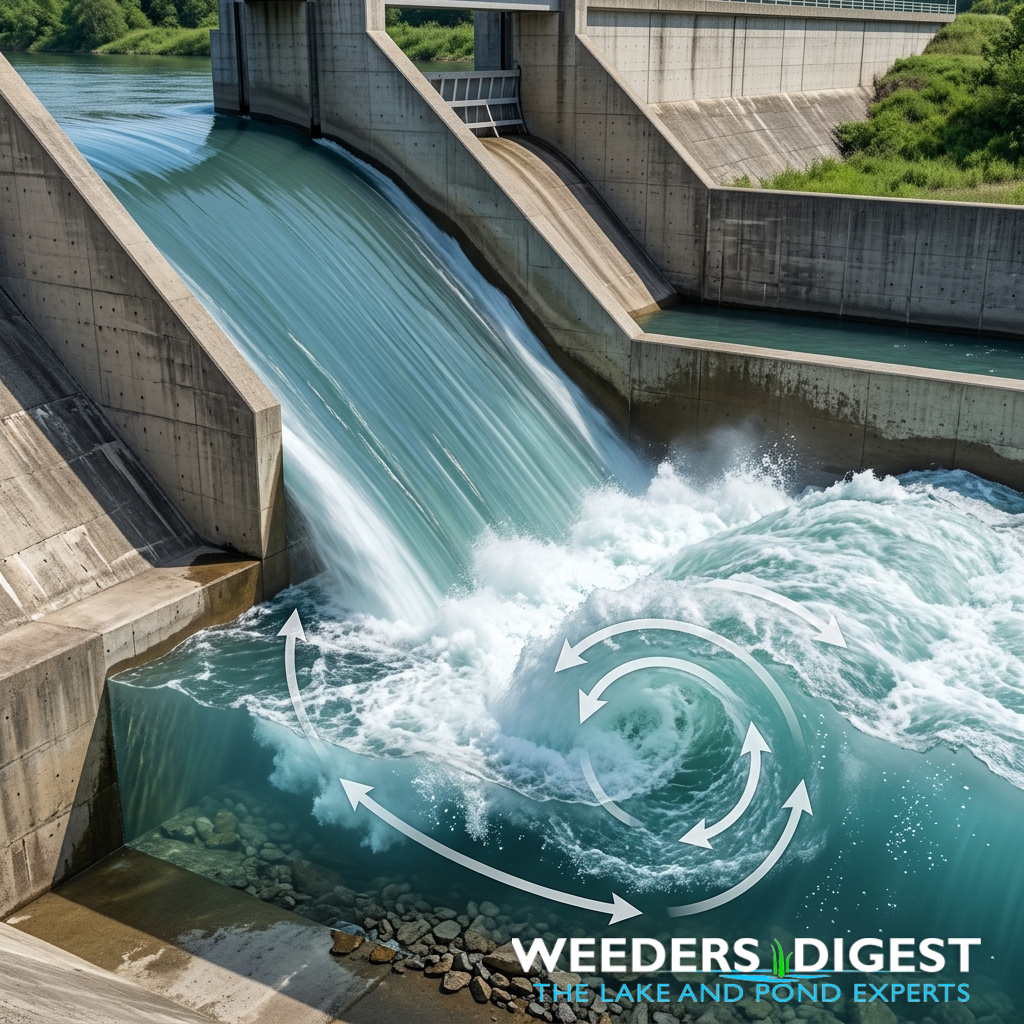
When you look at water flowing over a dam or spillway, it often looks like a smooth, peaceful slide. However, the area right at the bottom is one of the most violent and deceptive environments in nature. The extreme turbulence you see is caused by a massive amount of energy being released all at once as the water drops from a high point to a lower one. This creates a powerful, recirculating current that acts like a giant liquid treadmill, constantly pulling objects back toward the wall of the dam.
This phenomenon is often called a "recirculation pit" or a "boil." To someone standing on the shore, it might look like the water is bubbling up and moving away, but beneath the surface, the water is actually rotating in a tight, vertical circle. Because the falling water traps so much air, it becomes highly aerated—filled with bubbles—which makes the water much less dense. This means that even with a life jacket, it is nearly impossible for a person to stay buoyant or swim out of the trap.
The danger is amplified by the "undertow" or backwash. As the heavy flow hits the bottom, it creates a high-pressure zone that forces water to flow upstream, back toward the falling curtain. This creates a continuous loop where anything caught in the flow is dragged under, pushed along the bottom, and then surfaced only to be pulled back into the falling water again. Understanding this cycle is the first step in respecting the immense power of hydraulic structures.
The Science Behind It:
The extreme turbulence observed at the base of a spillway is a physical manifestation of a "hydraulic jump." When water descends a spillway, its potential energy is converted into kinetic energy, resulting in supercritical flow characterized by high velocity and low depth. Upon reaching the basin at the base, this high-velocity water must transition to a subcritical state—deeper and slower—to match the downstream conditions. This transition is not gradual; it occurs abruptly, resulting in a violent surge of energy dissipation known as the hydraulic jump. According to research published by the United States Bureau of Reclamation (USBR), this process involves intense internal friction and air entrainment, which creates the visible "boil" and white-water turbulence.
The lethal mechanism within this turbulence is the formation of a "submerged rotor" or "recirculation zone." As the supercritical jet enters the tailwater, it creates a low-pressure area near the face of the spillway. This pressure gradient draws the downstream water back toward the dam. A study by the American Society of Civil Engineers (ASCE) details how this "back roller" creates a closed-loop system of circulation. The shear force between the incoming fast-moving jet and the slower, recirculating water generates massive eddies and vortices. These vortices are responsible for the "undertow" effect, where the downward momentum of the spillway flow carries submerged objects to the bottom of the basin before the rotor pulls them back toward the hydraulic jump.
Aeration plays a critical role in the physics of spillway turbulence. The plummeting water entrains atmospheric gases, creating a mixture of water and air bubbles that significantly reduces the bulk density of the fluid. Fluid mechanics principles dictate that buoyancy is a function of the weight of the fluid displaced; therefore, when the density of the water-air mixture drops by upwards of 30% to 50%, the buoyant force acting on an object—including a human body or a flotation device—is halved. This "soft water" makes it impossible for even skilled swimmers to maintain head position above the surface, leading to rapid exhaustion and drowning within the recirculation zone.
The geometry of the spillway and the tailwater depth are the primary variables determining the intensity of the undertow. If the tailwater is too shallow, the energy may sweep downstream, but at specific "critical" depths, the hydraulic jump becomes "submerged" or "drowned." In a submerged jump, the surface of the water appears deceptively calm, yet the high-energy jet continues to flow along the bottom while a massive, heavy surface roller moves upstream. Research from the Journal of Hydraulic Engineering emphasizes that these conditions create a persistent trap where the drag forces of the recirculating current exceed the propulsion capabilities of most motorized watercraft and all human swimmers.