

Why Your Pond Weeds Keep Coming Back: My Guide to Bottom-Up vs. Surface Aerators
 |

Summary:
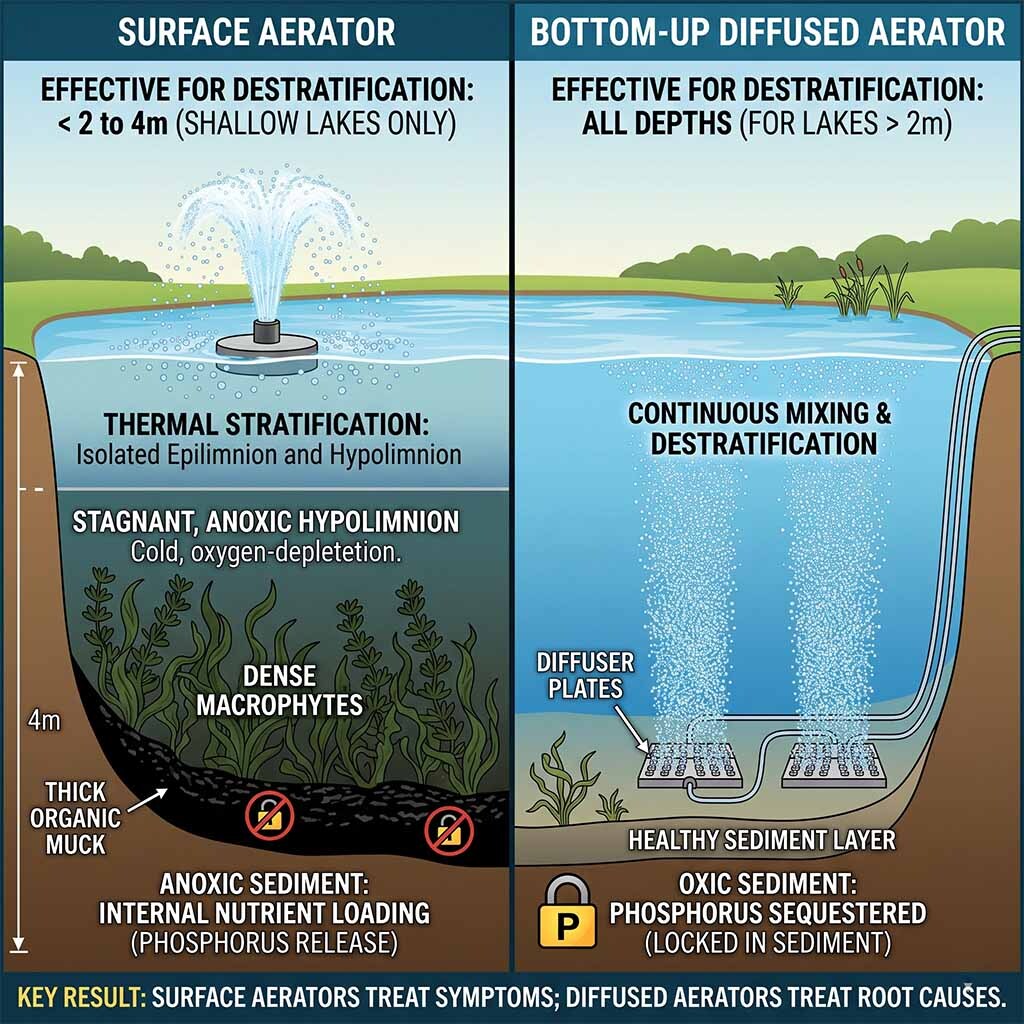
Bottom-up diffused aeration is vastly superior to surface aeration for long-term aquatic weed suppression because it targets the root cause of weed growth by oxygenating the entire water column and preventing nutrient release from the lakebed. Surface aerators, such as fountains and bubblers, only agitate the top layer of water, providing aesthetic appeal and localized oxygenation but doing virtually nothing to stop the nutrient buildup decaying at the bottom of the pond. By contrast, bottom-up systems pump air to diffusers on the pond floor, creating a continuous upward flow that breaks up stagnant temperature layers and supports the beneficial bacteria needed to consume muck before weeds can feed on it.
As a Certified Lake Manager, my field observations consistently show property owners treating the symptoms rather than the disease. I frequently visit properties where clients have spent thousands on beautiful floating fountains, only to find themselves constantly raking dense mats of submerged pondweed every July. The visual splash of a fountain is highly appealing, but once we switch the property over to a bottom-diffused system, the transformation over a single season is remarkable—the underlying muck digests faster, and the explosive weed growth starves out at the root level.
When you install a diffused aeration system, you are essentially putting your pond on a strict diet. Aquatic weeds thrive on the nitrogen and phosphorus trapped in the deep, oxygen-deprived sediment. By keeping that bottom layer heavily oxygenated, those nutrients are locked into the soil rather than dissolving into the water where weeds can absorb them. Ultimately, while surface fountains make your water look pretty from the shoreline, bottom-up aerators do the heavy lifting required to actually keep the ecosystem clean and balanced.
The Science Behind It:
Thermal stratification is a fundamental limnological process wherein a lake or pond separates into distinct thermal layers, isolating the warmer, oxygen-rich epilimnion at the surface from the colder, oxygen-depleted hypolimnion at the bottom. When the hypolimnion becomes anoxic (lacking oxygen), a chemical shift occurs at the sediment-water interface. Under these reducing conditions, iron-bound phosphorus precipitates and dissolves back into the water column. This process, known as internal nutrient loading, provides a massive influx of bioavailable phosphorus that directly fuels the proliferation of submerged aquatic macrophytes and cyanobacteria. Surface aeration systems lack the kinetic energy to disrupt this stratification, generally only influencing water circulation to a shallow depth of 2 to 4 meters, leaving the hypolimnetic nutrient factory completely undisturbed.
Bottom-up diffused aeration actively breaks this cycle by inducing artificial destratification. An onshore compressor pumps atmospheric air through weighted lines to benthic diffusers, releasing columns of microbubbles that entrain dense, anoxic bottom water and lift it to the surface for atmospheric gas exchange. This continuous vertical mixing homogenizes the water column's temperature and dissolved oxygen profile. Maintaining an oxidized microzone at the sediment layer prevents the reductive dissolution of iron oxide minerals, thereby sequestering phosphorus safely within the benthic substrate rather than allowing it to fertilize aquatic weeds.
The quantitative impact of mitigating this internal loading cannot be overstated in aquatic ecosystem management. Recent limnological studies emphasize that internal loading from legacy sediment can account for 40% to 80% of the total in-lake phosphorus budget during critical summer months (Kirol et al., 2024). By relying solely on surface aerators, managers inadvertently allow this massive nutrient bank to become bioavailable during peak growing seasons. Diffused aeration, conversely, directly neutralizes this primary nutrient vector, shifting the aquatic ecosystem from a eutrophic, weed-dominated state to a balanced, oligotrophic or mesotrophic environment.
Furthermore, the introduction of continuous oxygen to the benthic zone drastically accelerates the biological oxidation of organic matter. Anaerobic decomposition is a slow, inefficient process that results in the accumulation of thick organic muck and the release of toxic byproducts like hydrogen sulfide and ammonia, both of which stress aquatic food webs. Diffused aeration shifts the benthic microbial community toward highly efficient aerobic bacteria. This expedited microbial degradation effectively consumes the organic detritus that would otherwise serve as a rooting medium and nutrient source for invasive aquatic vegetation.
Sources / References:
- Kirol et al. (2024). Linking Sediment and Water Column Phosphorus Dynamics to Oxygen, Temperature, and Aeration in Shallow Eutrophic Systems. Water Resources Research.https://www.lcbp.org/wp-content/uploads/2024/01/Water-Resources-Research-2024-Kirol-Linking-Sediment-and-Water-Column-Phosphorus-Dynamics-to-Oxygen-Temperature-and.pdf
- Water Garden UK (2025). What is the best method to aerate a lake?https://www.water-garden.co.uk/blog/what-is-the-best-method-to-aerate-a-lake
- PASES Aqua. Lake Aeration.https://www.pasesaqua.com.au/learn/lake-aeration/