

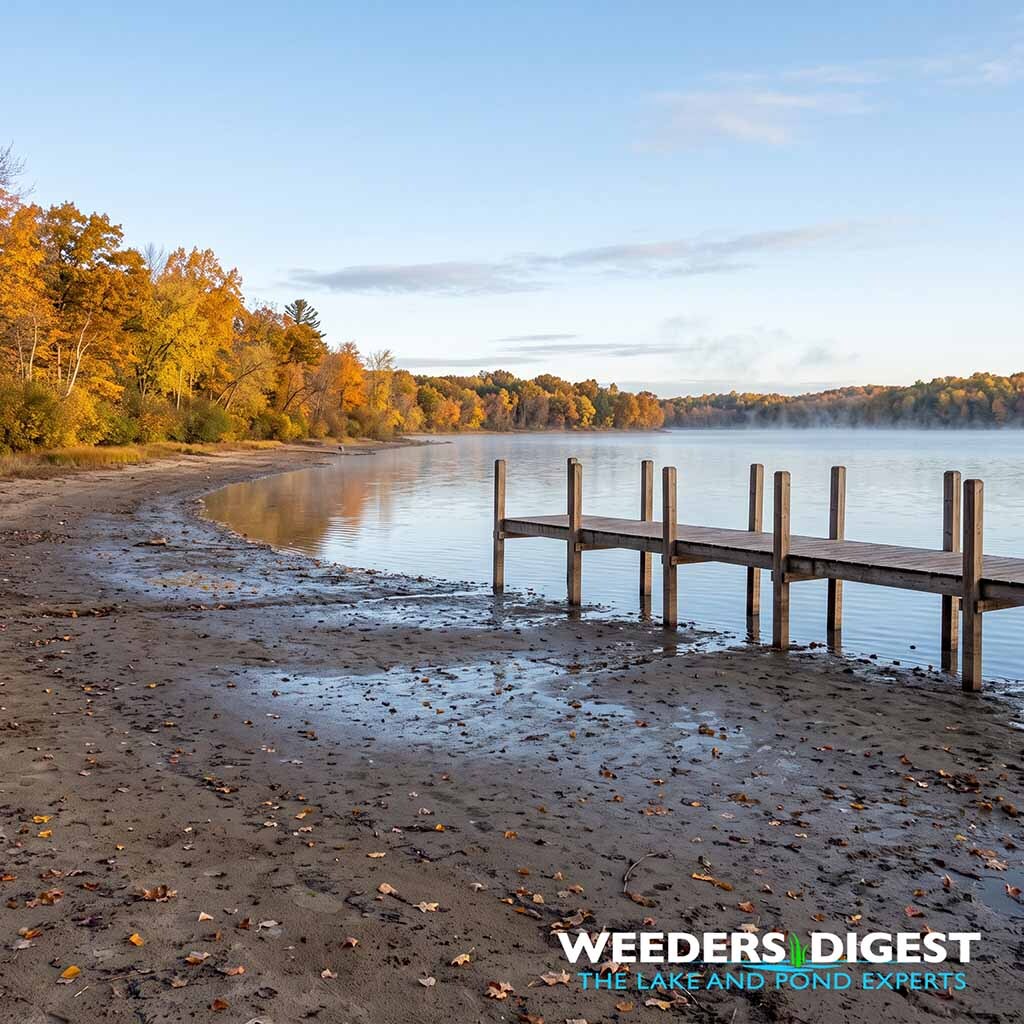
Why Your Shoreline Recedes Further in October Than in Mid-Summer
 |

Summary:
Your shoreline recedes further in October than in mid-summer because cumulative seasonal water deficits reach their annual peak in autumn, driven by an atmospheric phenomenon where lake evaporation surges as cool fall air moves over warm summer water. While many waterfront owners assume the blazing heat of July removes the most moisture, lakes store immense thermal energy throughout summer and slowly release it as autumn arrives. When crisp, dry October winds blow across these warm surface layers, the dramatic vapor pressure gradient accelerates latent heat flux, stripping massive volumes of moisture from the basin through condensation-driven evaporation.
At the same time, regional hydrology experiences a multi-month lag. Inflows from surrounding tributaries and precipitation are frequently at their lowest, while regional water tables have been depleted by an entire summer of high vegetation uptake and low recharge. Because natural outflows and evaporation continue unchecked while incoming supply dries up, lake volume contracts, pulling the water's edge significantly farther away from docks and retaining walls than during the peak recreation months.
During routine autumn lakebed surveys and seasonal dock pull-outs, our lake experts routinely find docks stranded on exposed dry flats that had deep, navigable water in early July. Property owners often assume a sudden upstream dam malfunction or an unexplained structural leak occurred overnight. In reality, we observe this dramatic seasonal setback across nearly all natural basins as autumn unmasks the compound moisture deficit that quietly accumulated over the entire preceding summer.
The physical consequence of this October retreat is a newly exposed littoral zone. Soft organic sediment, decaying summer plant biomass, and uncompacted silt—normally held under hydrostatic pressure beneath the water column—are suddenly left exposed to the open air. This dry exposure accelerates anaerobic decomposition and concentrates organic muck right along the perimeter of the waterfront.
The Science Behind It:
The fundamental driver of October shoreline recession is the lag in the lake’s hydrologic water balance equation (S=P+Qin-E-Qout-Gout), where net storage (S) reflects the cumulative difference between inputs (precipitation P and surface inflow Qin) and outputs (evaporation E, surface outflow Qout, and groundwater discharge Gout). In open-water limnology, evaporation is not governed strictly by ambient air temperature; rather, it is dictated by the latent heat flux and the atmospheric vapor pressure deficit (es-ea), where es represents the saturation vapor pressure at the water surface temperature and ea is the vapor pressure of the overlying air.
Because water possesses a high specific heat capacity (approximately 4,184 J/kg·°C), lakes exhibit thermal inertia, absorbing radiation all summer and remaining comparatively warm well into autumn while surface air temperatures drop rapidly. According to a landmark global study published in Nature Communications (Zhao et al., 2022), open-water bodies lose approximately 1,500 (150) cubic kilometers of water annually to evaporation—accounting for an evaporative loss roughly 58% higher than previously estimated by historical climate models. This research confirms that widening atmospheric vapor pressure deficits accelerate evaporative loss dramatically as water-air temperature gradients expand.
Research synthesized by the Great Lakes Integrated Sciences and Assessments (GLISA) at the University of Michigan demonstrates that peak evaporative water loss in temperate inland waters often occurs not in mid-summer, but during autumn and early winter. Their quantitative modeling indicates that when cold, dry continental air masses sweep across warm water surfaces, evaporation rates can spike to over 0.5 to 1.0 inches of lake depth lost per day during high-wind fall events. This steep thermodynamic gradient turns the lake into a massive evaporative engine, pulling vertical inches of the water column directly into the atmosphere long after peak summer has ended.
Simultaneously, the watershed experiences an acute deficit in baseflow and groundwater influx. Throughout June, July, and August, terrestrial vegetation across the drainage basin extracts substantial soil moisture via transpiration, creating high soil moisture deficits. According to hydrologic monitoring from the United States Geological Survey (USGS), shallow groundwater levels in temperate regions routinely reach their annual seasonal minimums between September and November. When autumn rains finally arrive, dry terrestrial soils act as a sponge, retaining the moisture to replenish regional soil capacity rather than yielding surface runoff or shallow aquifer recharge to the lake basin. Consequently, Qin approaches annual minimums precisely while E surges.
Furthermore, subterranean interactions reverse the local hydraulic gradient. In many glacial and kettle lakes functioning as seepage or flow-through basins, the unconfined regional water table drops below the lake's stage elevation by early autumn. Rather than the aquifer recharging the water body, hydrostatic pressure forces water outward and downward through the porous benthic floor (Gout) to balance the depressed surrounding water table. This simultaneous convergence of peak latent evaporative flux, depleted catchment inflows, and subterranean outseepage produces the lowest annual lake stage, manifesting on shorelines as the pronounced October drawdown.
Our Recommendation for Managing Receded Shorelines:
When water recedes in October, it exposes previously submerged organic muck, rotting weed remnants, and accumulated sediment along your beachfront. Leaving this exposed bed untouched allows dense organic silt to compact and establish an ideal nutrient-rich bed for explosive aquatic weed germination when water returns the following spring. Scientifically, halting this cycle requires breaking the sediment deposition chain by mobilizing organic matter before it can settle permanently into a thick muck layer.
To clear away loose silt and prevent organic debris from cementing along your swimming area, continuous directional water velocity is required. Utilizing high-efficiency underwater blowers—such as our AquaThruster Muck & Weed Blower collection—leverages hydrodynamic thrust to sweep loose silt and decayed vegetative waste off your shoreline and into the deeper basin. Coupling high-velocity aeration with mechanical shoreline clearing tools during low-water autumn months ensures your beach remains firm, sandy, and ready for clean navigation the moment lake levels rebound.
Sources / References:
- Zhao, G., Gao, H., Cai, X., et al. (2022). Evaporative water loss of 1.42 million global lakes. Nature Communications, 13, 3686. https://doi.org/10.1038/s41467-022-31125-6
- Great Lakes Integrated Sciences and Assessments (GLISA), University of Michigan. Lake Levels Overview: Climate Drivers of Seasonal Water Loss. https://glisa.umich.edu/sustained-assessment/lake-levels/
- United States Geological Survey (USGS). Groundwater and Drought: Seasonal Water Table Fluctuations and Baseflow Depletion. https://www.usgs.gov/mission-areas/water-resources/science/groundwater-and-drought