

Will Adding Sand or Gravel Over Lake Muck in the Fall Actually Fix Your Waterfront?
 |

Summary
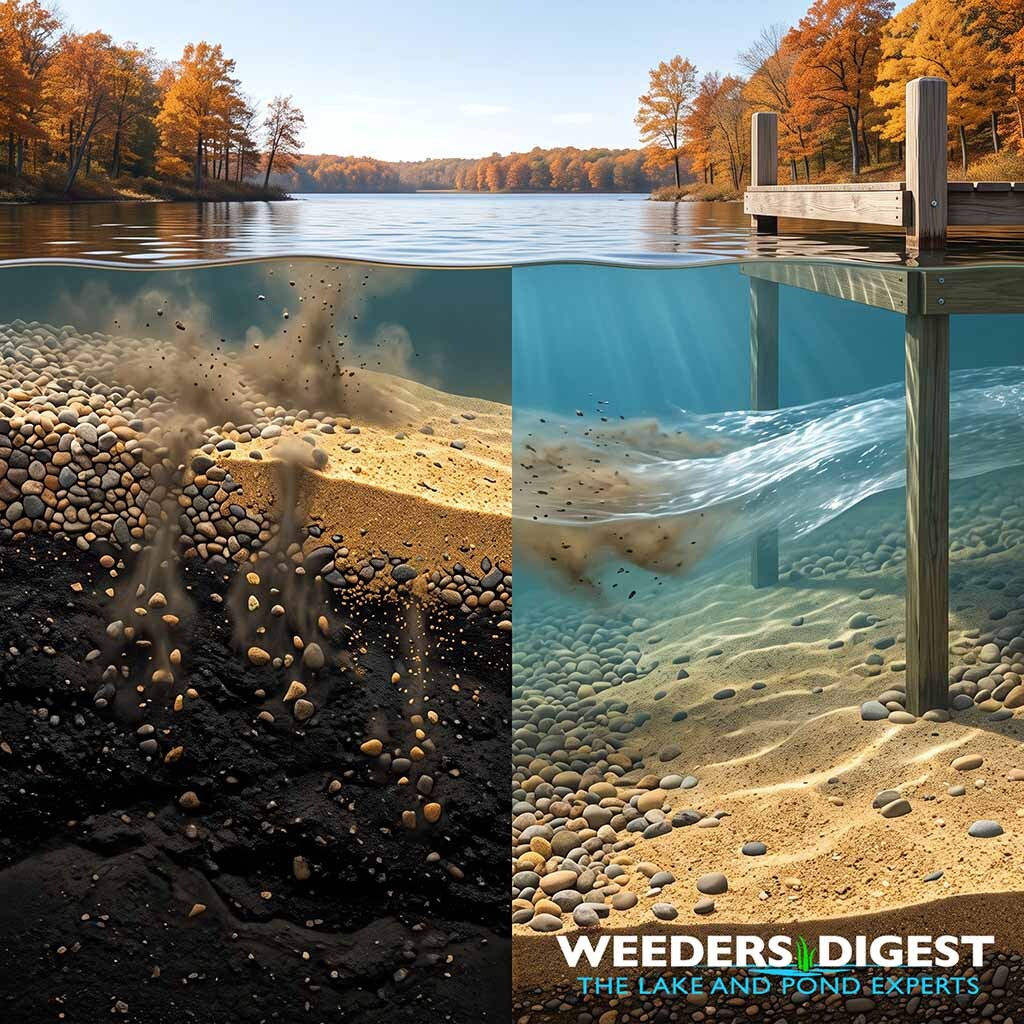
Adding gravel or sand over lake muck in the fall will not solve the problem; instead, the heavy aggregate will inevitably sink directly into the unconsolidated organic sediment and disappear from the surface. Many shoreline owners attempt this practice hoping that winter freezing and physical weight will create a stable, sandy lake bottom by spring. However, lake muck is composed of semi-buoyant organic matter and water rather than a solid soil bed, meaning any dense material introduced above it will rapidly migrate downward while displaced organic silt rises over the top.
In our field evaluations across regional lakes every autumn, we routinely inspect waterfronts where owners dumped tons of clean pea gravel or beach sand directly over soft bottom zones the previous season. In nearly every case, sediment core samplers reveal that the added aggregate has settled several inches to several feet beneath the mud line, leaving the surface just as squishy, silty, and prone to weed growth as before. Applying sand or gravel without eliminating the underlying muck simply wastes time and budget while failing to establish a permanent swim area.
The Science Behind It
The failure of direct sand and gravel blanketing over lake muck comes down to fundamental principles of sediment mechanics, bulk density differentials, and benthic geotechnics. In limnology, lake muck is classified as sapropel or gyttja—an unconsolidated, flocculent matrix dominated by decomposing aquatic macrophytes, microscopic algae, and fine clastic particles. Laboratory analyses of littoral organic sediments demonstrate that active lake muck often exhibits a water content exceeding 85% to 95% by volume and an exceptionally low in-situ dry bulk density typically ranging between 0.05 and 0.25 grams per cubic centimeter. In stark contrast, standard quartz beach sand possesses a bulk density of approximately 1.60 grams per cubic centimeter, while washed landscaping gravel exceeds 1.50 to 1.75 grams per cubic centimeter.
When high-density aggregate is broadcast over low-density, high-porosity sediment, classical geotechnical failure occurs via bearing capacity collapse and differential settling. Because unconsolidated gyttja lacks meaningful shear strength, it behaves rheologically more like a high-viscosity non-Newtonian fluid than a load-bearing subgrade. The weight of the gravel generates downward point loads that rupture what minimal tensile integrity the sediment matrix maintains, initiating a process known in sediment capping as "subduction." As the sand particles penetrate downward through the interstitial pore spaces, they physically displace the lighter, highly buoyant organic solids upward around them, an inversion mechanism analogous to Rayleigh-Taylor instability in fluid mechanics.
Environmental and regulatory research further underscores why this technique routinely fails in natural water bodies. The Minnesota Department of Natural Resources (MNDNR) notes in its shoreline alteration assessments that when beach blankets are installed over soft, organic-rich lakebeds, the added material uniformly sinks into the muck rather than creating a lasting beach. Moreover, U.S. Army Corps of Engineers subaqueous sediment capping research shows that without deliberate intermediate geotextile stabilization or geogrid confinement, heavy granular caps applied over high-water-content sediments undergo extensive mixing and localized settlement rather than forming an isolated barrier. Fall placement does not bypass this reality; while surface ice sheets might temporarily delay mixing if material is placed directly on ice, the spring thaw drops the entire unconsolidated aggregate load in an uneven pulse, accelerating deep gouging into the soft sediment layer.
Beyond physical disappearance, capping muck with mineral aggregates exacerbates localized benthic anoxia. Depositing an impenetrable blanket of gravel over biological matter compresses active organic decomposition into a closed, anaerobic state. Without dissolved oxygen exchange from the water column, anaerobic bacteria metabolize sulfur and carbon compounds, triggering elevated outputs of hydrogen sulfide gas and soluble phosphorus release. When summer temperatures return, emergent and submergent aquatic vegetation easily root through the displaced, nutrient-rich muck layer that now blankets your sunken aggregate, leaving you with identical muck depths alongside an irregular, rock-laden lake bottom.
Our Recommendation for Managing Lake Muck
Dumping inert sand or gravel directly onto a soft lakebed is an attempt to bury a biological problem with weight—and the physics of sediment density guarantees that weight will lose every time. To restore a firm, clean, and sandy lake bottom, you must target the unconsolidated organic sediment itself rather than trying to compress it into submission.
Scientifically, clearing muck requires continuous, high-volume water velocity aimed at the sediment-water interface. Generating laminar water movement creates localized bottom scour that lifts low-density organic silt and suspended vegetative debris into the current, carrying it away from your high-traffic dock or swim area before it can consolidate into anaerobic gyttja. Automated, directional sediment displacement systems like our AquaThruster Muck & Weed Blower collection reintroduce vital dissolved oxygen to the benthic zone while actively sweeping the substrate back down to the original hard-packed sand, rock, or marl foundation. For property owners seeking a firm swim area over persistent soft lake bottoms without excavation, pairing active water current sweeps with targeted lake weed and sediment removal tools addresses the root ecological mechanism, delivering lasting shoreline stability that no load of sunken gravel can replicate.
Sources / References
- Minnesota Department of Natural Resources (MNDNR). Shoreline Alterations: Beach Blanket Guidelines and Sediment Regulations. https://www.dnr.state.mn.us/waters/shoreline-alteration-beach-blanket.html
- U.S. Army Corps of Engineers (USACE) Engineer Research and Development Center. Guidance for Subaqueous Dredged Material Capping (Technical Report DOER-1). https://dots.el.erdc.dren.mil/guidance/10.1.1.138.6148.pdf
- University of Wisconsin-Stevens Point Extension Lakes Program. The Lake in Your Community: Lake Ecology, Benthic Processes, and Shoreland Management. https://www.uwsp.edu/cnr-ap/UWEXLakes/Documents/ecology/shoreland/background/the_lake_in_your_community_g3216.pdf