

Your Guide to Choosing the Right Herbicide for Your Lake's Aquatic Weed Management
 |

Summary:
When taking on overgrown weeds in your lake or pond, the first step is always knowing exactly what you are trying to control. Aquatic plants fall into distinct categories—floating, submerged, or emergent—and there is no single chemical that acts as a magic bullet for all of them. Properly identifying the nuisance plant ensures you don't waste time and money on a treatment that simply won't work for your specific situation.
Once you know the plant, you have to decide how you want to tackle it. Herbicides generally work in one of two ways. Contact herbicides act quickly to burn off the parts of the plant they touch, which is great for fast relief but might leave the roots intact. Systemic herbicides, on the other hand, absorb into the plant's tissue and travel all the way down to the roots. They take a bit longer to show results, but they offer a much more permanent solution by eliminating the entire plant from the inside out.
You also need to think about your water body as a whole. Fast-acting treatments can cause a massive die-off of vegetation, and as those dead plants decay, they can drain the oxygen from your water, putting your fish at risk. Managing aquatic vegetation is never completely hassle-free and often requires significant effort, careful planning, and sometimes treating the water in sections to keep your pond's ecosystem balanced and safe for wildlife.
The Science Behind It:
The efficacy of aquatic herbicides is fundamentally governed by the specific biochemical pathways they disrupt and the morphological characteristics of the target vegetation. Chemical interventions are categorized primarily by their mobility within plant vascular systems. Contact herbicides, such as diquat and endothall, act rapidly by disrupting cell membranes and inhibiting photosystem I, leading to acute cellular desiccation and necrosis. These compounds bind tightly to organic matter and suspended clay particulates, rendering them highly effective in clear water environments but limiting their translocation to benthic root systems. Consequently, rapid vegetative regeneration can occur if the meristematic tissues are not sufficiently exposed to the chemical agent.
Conversely, systemic herbicides like fluridone, glyphosate, and 2,4-D utilize the plant's own phloem and xylem networks to translocate active ingredients to the roots, achieving complete mortality. These compounds typically target specific enzymes crucial for plant survival, such as EPSP synthase for amino acid synthesis or phytoene desaturase, which disrupts protective carotenoid production and causes chlorophyll photodegradation. Because systemic herbicides require active metabolic processes for distribution throughout the plant, they exhibit a significantly slower mode of action compared to contact alternatives. According to the Mississippi State University Extension Service, systemic applications can take a month or more to fully eliminate the target organism, though they carry a much lower risk of acute environmental destabilization.
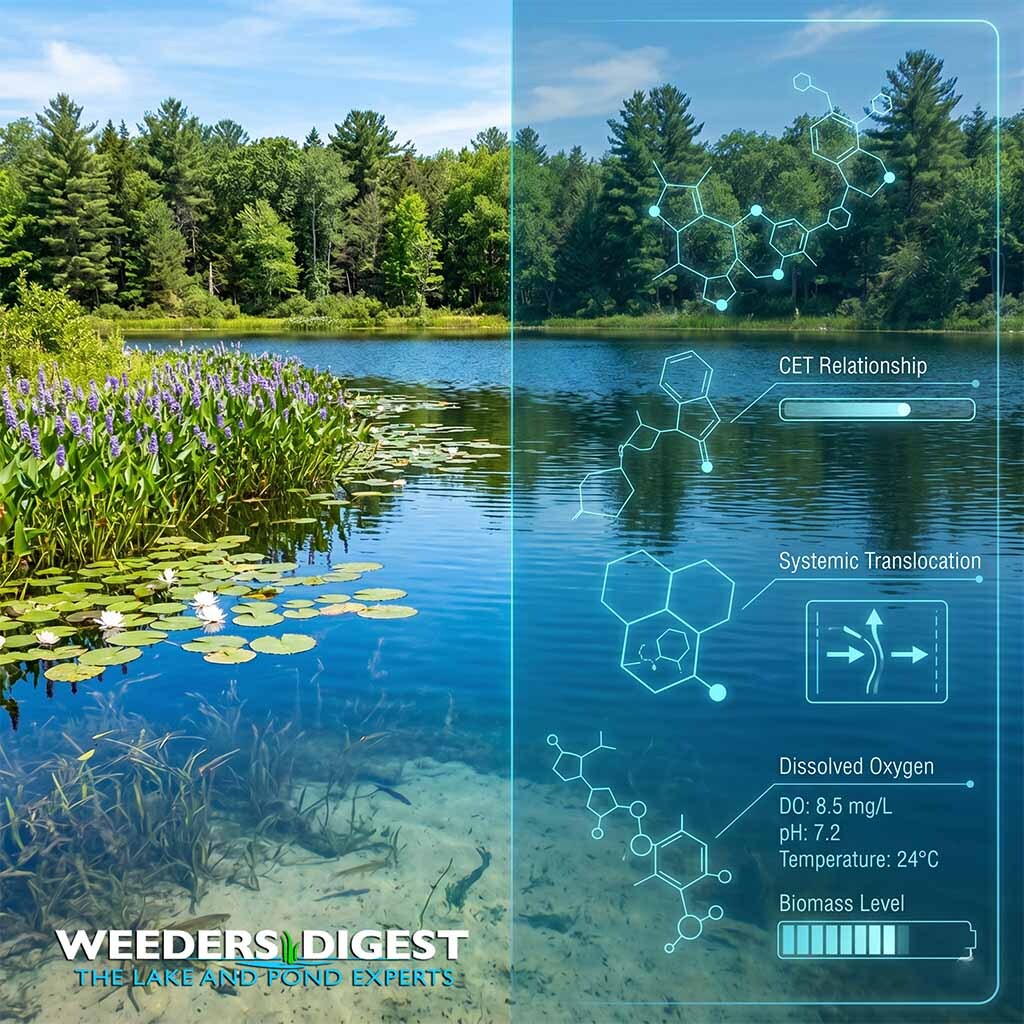
Environmental pharmacokinetics, specifically the concentration-exposure time (CET) relationship, dictate the success of any aquatic herbicide application. Aquatic environments are highly dynamic; water flow, thermal stratification, and microbial degradation constantly dilute or break down active ingredients. A systemic herbicide demands a prolonged exposure period at a specific concentration threshold to be effectively absorbed and translocated. If hydrodynamics reduce the concentration prematurely, the target plant will only experience sub-lethal phytotoxicity, leading to survival and potential resistance. Accurate volumetric calculations based on acre-feet, rather than simple surface area, are paramount for achieving the necessary CET without exceeding toxicological thresholds established by the EPA.
Ecological stability must also be considered, particularly concerning dissolved oxygen (DO) dynamics and biological oxygen demand (BOD). When a significant biomass of aquatic vegetation is eradicated simultaneously, heterotrophic bacteria rapidly colonize the detritus. The ensuing decomposition process is highly oxidative, stripping the water column of dissolved oxygen faster than atmospheric diffusion or residual photosynthesis can replenish it. Oklahoma State University researchers note that treating a pond during hot summer months exacerbates this risk, as warmer water intrinsically holds less DO and supports higher weed biomass. To mitigate hypoxia and subsequent fish kills, aquatic biologists mandate treating no more than one-quarter to one-third of the water body at a time, allowing unimpacted zones to serve as oxygen refuges.
Implementing an Integrated Pest Management (IPM) approach remains the most sustainable protocol for long-term aquatic weed management. Herbicide application should not be viewed in isolation but rather as one component of a broader strategy that includes nutrient load reduction, benthic barriers, and mechanical harvesting. While mechanical weed cutters effectively reduce biomass by cutting vegetation at the roots without uprooting them entirely, chemical treatments provide necessary targeted control for invasive species that easily reproduce via fragmentation. By rotating herbicide mechanisms of action and integrating non-chemical controls, lake managers can prevent herbicide resistance and maintain ecological homeostasis within the limnological system.