

How the Hidden Carbon Cycle in Your Pond Can Suffocate Fish Overnight
 |

Summary:
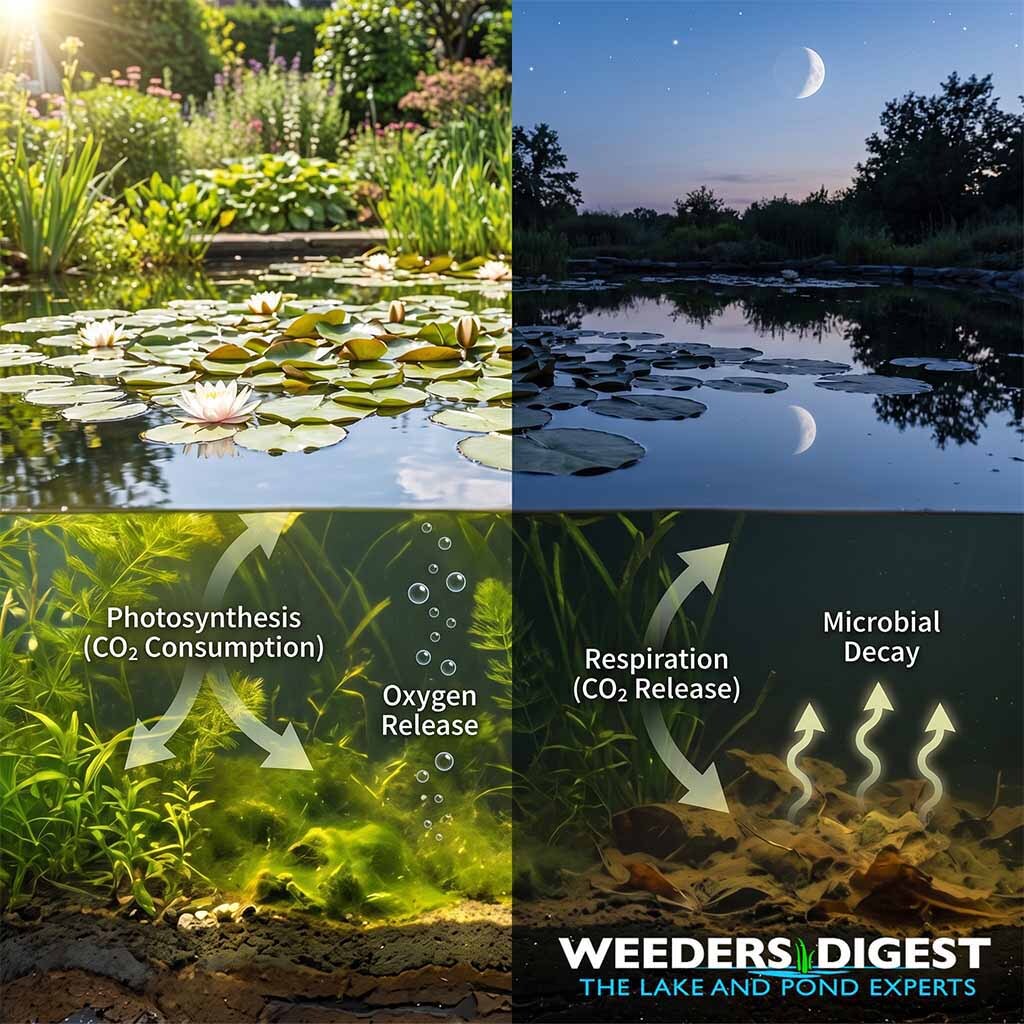
The carbon cycle in your pond is a continuous, dynamic loop where subaquatic plants act as both a sink and a source of carbon, primarily driving gas exchanges through daytime photosynthesis, nighttime respiration, and late-season decay. During the day, abundant pond weeds and algae pull dissolved carbon dioxide out of the water to create energy, temporarily storing carbon within their tissues and releasing oxygen. At night or when plants die and rot, this process flips entirely; the vegetation consumes vital dissolved oxygen and pumps immense volumes of carbon right back into the water and the atmosphere.
Understanding this cycle is crucial because an imbalance—often caused by excessive weed growth—can rapidly degrade water quality. When large volumes of pond weeds die off simultaneously, the sudden surge in bacterial decomposition demands massive amounts of oxygen, threatening fish and driving the pond into a highly acidic, carbon-supersaturated state. Managing the balance between living vegetation and decaying organic material is the secret to keeping your pond clear, healthy, and stable.
In my years serving as a Certified Lake Manager, I have frequently stood at the edge of backyard ponds at dawn, witnessing the physical manifestation of this invisible cycle. Homeowners often call me panicked by a sudden, overnight fish kill, unaware that a massive, unmanaged bed of submerged weeds spent the dark hours undergoing heavy respiration and accelerating decay. Testing the water in those early hours invariably reveals a steep drop in pH and a crushing deficit of dissolved oxygen—a textbook signature of a carbon cycle heavily tilted toward decomposition.
The Science Behind It:
Small freshwater ecosystems and floodplain ponds play an unexpectedly large role in regional carbon budgets, acting as highly active sites for carbon transformation and transport (Rulík et al., 2023). Within these bodies of water, carbon exists primarily as Dissolved Inorganic Carbon (DIC)—such as dissolved carbon dioxide, carbonic acid, bicarbonate, and carbonate—and Dissolved Organic Carbon (DOC) derived from living and decomposing tissue. The balance between these chemical states is mediated continuously by the metabolic pathways of aquatic primary producers and heterotrophic microbes (Schmitz et al., 2013).
During periods of high solar irradiance, aquatic plants and benthic mats preferentially utilize the lighter isotope of carbon (Carbon-12) during primary productivity, shifting the isotopic balance and temporarily depleting available DIC pools (MacDonald et al., 2014). This intense photosynthetic demand can cause significant variations in day-to-day water chemistry. However, because small ponds possess a high ratio of sediment-to-water contact and frequently accumulate dense vegetative biomass, their carbon cycles are heavily weighted toward cellular respiration and microbial decay.
When photosynthetic activity ceases at night, autotrophic respiration dominates. Plants consume oxygen to break down stored carbohydrates, converting organic carbon back into inorganic carbon dioxide. Research tracking small inundated freshwater bodies indicates that this metabolic shift results in a profound state of carbon supersaturation. In a comprehensive study of floodplain ponds, the mean carbon dioxide saturation ratio was found to be 37.5-fold supersaturated relative to atmospheric equilibrium (Rulík et al., 2023). This remarkable internal loading drives a continuous diffusive flux of greenhouse gases into the air, with average daily emissions reaching 7.64 grams of carbon dioxide-equivalent per square meter per day (7.64 g CO2-eq m-2 d-1) (Rulík et al., 2023).
The terminal and most impactful phase of this subaquatic cycle occurs during plant senescence and subsequent microbial decay. As submerged macrophytes die, heterotrophic bacteria and fungi break down the complex organic matter, utilizing extracellular enzymes to degrade cellular structures (Frutos-Aragón et al., 2026). This decomposition requires significant oxygen consumption, often inducing localized hypoxia or anoxia. In anoxic conditions, plant respiration and energy pathways fail, dropping internal cellular pH from a normoxic 7.5 down to a highly stressed 6.0 (Jethva et al., 2022). Simultaneously, the sediment-water interface transforms into a severe carbon source; even during dry or draw-down phases when pond sediments are exposed to the open air, the accelerated aerobic degradation of remaining organic material yields a massive mean carbon dioxide efflux of 1,398 milligrams of Carbon per square meter per day (1,398 mg C m-2 d-1) (Frutos-Aragón et al., 2026).
Sources / References:
- Frutos-Aragón, V., et al. (2026). Drivers of CO2 emissions during the dry phase in Mediterranean and Temperate ponds. Biogeosciences, 23(1), 181–195. https://bg.copernicus.org/articles/23/181/2026/
- Jethva, J., Schmidt, R. R., Sauter, M., & Selinski, J. (2022). Try or Die: Dynamics of Plant Respiration and How to Survive Low Oxygen Conditions. Plants, 11(2), 205. https://doi.org/10.3390/plants11020205
- MacDonald, L. A., et al. (2014). Avian-Driven Modification of Seasonal Carbon Cycling at a Tundra Pond in the Hudson Bay Lowlands (Northern Manitoba, Canada). Arctic, Antarctic, and Alpine Research, 46(1), 206-217. https://doi.org/10.1657/1938-4246-46.1.206
- Rulík, M., Weber, L., Min, S., & Šmíd, R. (2023). CO2 and CH4 fluxes from inundated floodplain ponds: role of diel variability and duration of inundation. Frontiers in Environmental Science, 11, 1006988. https://doi.org/10.3389/fenvs.2023.1006988
- Schmitz, O. J., et al. (2013). Animating the Carbon Cycle. Ecosystems, 17(2), 344-359. https://doi.org/10.1007/s10021-013-9715-7