

Long-Term Aquatic Weed Control: The Definitive Lake Management Guide
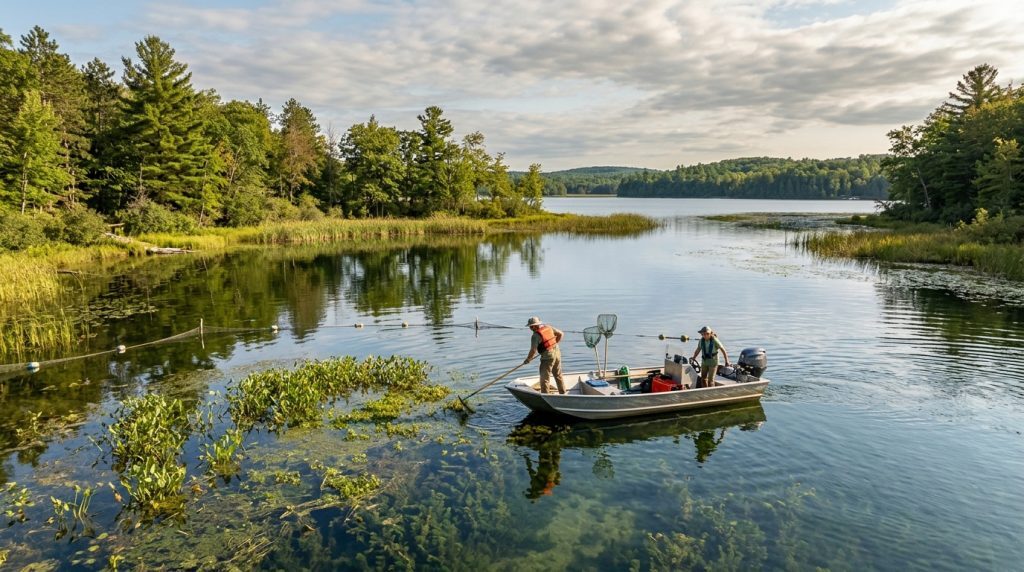
Effective long-term control of invasive aquatic weeds like Eurasian Watermilfoil (Myriophyllum spicatum) and Hydrilla (Hydrilla verticillata) in large lakes demands a sophisticated, integrated approach that prioritizes ecological balance, sustained efficacy, and cost-effectiveness.
Quality in this category is defined not by the eradication of a single species, but by the restoration and maintenance of a healthy, diverse aquatic ecosystem through adaptive management strategies.
This guide establishes the authoritative framework for understanding and implementing solutions that transcend temporary fixes, offering a comprehensive perspective on what constitutes truly successful, enduring lake management.
Understanding Milfoil & Hydrilla: The Large Lake Challenge
Eurasian Watermilfoil and Hydrilla represent two of the most aggressive and ecologically damaging invasive aquatic plants in North American large lakes. Eurasian Watermilfoil, identifiable by its feathery leaves typically arranged in whorls of four, forms dense subsurface mats that can impede recreation, alter fish habitat, and outcompete native vegetation. Its primary reproductive strategy involves fragmentation, where small pieces of the plant can root and establish new colonies, making mechanical disturbance a potential vector for spread.
Hydrilla, often mistaken for native elodea, is distinguished by its leaves in whorls of three to eight, often with serrated margins and small spines on the underside of the midrib. It exhibits an even more aggressive growth habit than milfoil, forming incredibly dense mats from the lake bottom to the surface, severely impacting water flow, oxygen levels, and biodiversity. Hydrilla reproduces through fragmentation, tubers (underground storage organs), and turions (winter buds), granting it remarkable resilience and making its control particularly challenging in extensive water bodies.
The sheer scale and connectivity of large lakes amplify the difficulty of managing these species, as localized treatments often fail to address the broader infestation and re-infestation vectors.
The Integrated Lake Management Framework: Defining Long-Term Success in Aquatic Weed Control
Achieving sustainable control of invasive aquatic weeds in large lakes necessitates a structured, multi-faceted approach. The Integrated Lake Management Framework (ILMF) provides the definitive standard for developing and evaluating long-term solutions, emphasizing ecological health, cost-effectiveness, and recurrence prevention. This framework moves beyond singular treatment methods to embrace a holistic strategy.
- Comprehensive Assessment & Goal Setting: This initial phase involves detailed mapping of weed distribution and density, identification of native species, water quality analysis, and understanding lake hydrology. Goals must be specific, measurable, achievable, relevant, and time-bound (SMART), focusing on ecological restoration rather than mere eradication.
- Multi-Method Strategy Development: Based on the assessment, a combination of control methods is selected, leveraging their synergistic effects. This avoids over-reliance on any single technique and addresses different aspects of the weed's life cycle and distribution.
- Regulatory Compliance & Permitting: Navigating federal, state, and local regulations is crucial. This includes securing necessary permits, conducting environmental impact assessments, and ensuring all actions adhere to environmental protection standards.
- Implementation & Monitoring: The chosen strategies are executed, followed by rigorous, ongoing monitoring to track efficacy, observe non-target impacts, and detect early signs of re-infestation. This data forms the basis for future adjustments.
- Adaptive Management & Community Engagement: Lake management is an iterative process. Data from monitoring informs adjustments to the strategy, ensuring the plan remains effective and responsive to changing conditions. Active involvement of stakeholders and the community fosters shared responsibility and long-term commitment.
The ILMF defines 'best' as the strategy that delivers sustained ecological improvement with minimal adverse impacts, and 'long-term' as a commitment to ongoing stewardship and flexible adaptation. It is the blueprint for truly successful aquatic weed management.
Advanced Control Methodologies for Large Lakes: A Comparative Analysis
Effective long-term control of milfoil and hydrilla in large lakes often requires a combination of advanced methodologies, each with specific applications, advantages, and limitations. Understanding these nuances is critical for developing an integrated strategy.
A) Biological Controls
Biological controls utilize natural enemies to suppress weed populations. For Eurasian Watermilfoil, the native milfoil weevil (Euhrychiopsis lecontei) can provide some localized control by feeding on the plant. However, in large, complex lake systems, weevil populations often struggle to keep pace with widespread milfoil growth, and their efficacy can be inconsistent.
Triploid Grass Carp (Ctenopharyngodon idella) are sometimes used for hydrilla control, as they consume a wide range of aquatic vegetation. Their use in large lakes requires careful consideration and strict permitting, as their non-selective grazing can impact desirable native plants and alter the ecosystem if not precisely managed.
B) Targeted Chemical Treatments
Herbicides offer a powerful tool for large-scale control, but their application in large lakes demands precision and environmental stewardship. Systemic herbicides, such as fluridone, are absorbed by the plant and translocated throughout its system, providing long-term control by inhibiting growth. Contact herbicides, like diquat, act quickly on the plant tissue they touch.
For extensive infestations, targeted applications using specialized equipment (e.g., airboats, GPS-guided systems) are essential to ensure even distribution and minimize off-target effects.
Environmental impact assessments and adherence to strict label instructions are paramount to protect water quality and non-target organisms. For specific guidance on managing milfoil, exploring resources on controlling watermilfoil can provide further insights.
C) Mechanical Harvesting & Dredging
Mechanical harvesting involves cutting and removing aquatic vegetation, offering immediate relief from dense surface mats. While effective for creating navigation channels and recreational areas, it is a labor-intensive and costly method for large lakes. Furthermore, milfoil's fragmentation can lead to spread if not carefully managed, and harvesting does not address the root systems.
Dredging, the removal of bottom sediments, can eliminate weed propagules and alter habitat, but it is an extremely disruptive and expensive process, typically reserved for specific, smaller areas or when muck accumulation is severe.
D) Habitat Modification
Habitat modification aims to alter environmental conditions to make them less favorable for invasive weeds. Benthic mats (bottom barriers) can be deployed in smaller, high-use areas to block sunlight and prevent plant growth, offering a chemical-free solution.
Water level manipulation, where feasible, can expose and dry out shallow areas, killing emergent and shallow-water submerged vegetation. However, this method requires careful ecological assessment to avoid negative impacts on native species and shoreline stability, and its applicability in very large lakes is often limited to specific zones or during drought conditions.
Navigating the Regulatory Landscape: Permits, Compliance, and Environmental Stewardship
Implementing aquatic weed control in large lakes is not merely a technical challenge; it is also a complex regulatory undertaking. Projects must comply with a myriad of federal, state, and local environmental laws and permitting requirements. At the federal level, the Clean Water Act often mandates permits for activities that discharge pollutants or alter navigable waters, including the application of herbicides or mechanical disturbance.
State environmental protection agencies and local municipalities typically have their own permitting processes, which may require detailed project plans, environmental impact assessments, public notification, and consultation with various stakeholders. These regulations are designed to protect water quality, native species, and overall ecosystem health.
Successful long-term projects are characterized by proactive engagement with regulatory bodies, thorough documentation, and a commitment to best management practices that minimize ecological disruption and ensure long-term environmental stewardship. Understanding the distinction between natives vs. invasive aquatic weeds is often a key component of these regulatory discussions.
Case Studies in Sustainable Lake Management: Real-World Successes
The principles of the Integrated Lake Management Framework are best illustrated through real-world applications. Consider Lake George in New York, a large, oligotrophic lake that has battled Eurasian Watermilfoil for decades. Initial efforts focused on mechanical harvesting, which provided temporary relief but failed to halt the spread.
Through an adaptive management approach, the Lake George Park Commission transitioned to a strategy combining targeted diver hand-harvesting (for small, new infestations), benthic mats in high-use areas, and limited, highly targeted herbicide applications in dense, established beds.
Rigorous monitoring of milfoil biomass and native plant communities has allowed for continuous refinement of the strategy, leading to a significant reduction in milfoil coverage and a resurgence of native species, demonstrating the power of a sustained, integrated effort.
Another compelling example is the ongoing management of Hydrilla in the St. Johns River system in Florida. This vast, interconnected system presented immense challenges due to the scale and rapid growth of Hydrilla.
Here, a combination of biological control (triploid grass carp in specific, contained areas) and large-scale, precision herbicide applications has been employed. The success hinges on continuous, extensive monitoring to detect new outbreaks early, allowing for rapid, localized treatments before the weed can re-establish widespread dominance.
Community education and engagement have also been vital, ensuring public understanding and support for the long-term commitment required to manage such an aggressive invasive species in a large, dynamic aquatic environment.
Beyond Control: Monitoring, Adaptive Management, and Community Engagement for Lasting Results
Achieving long-term control of aquatic weeds like milfoil and hydrilla in large lakes is not a one-time intervention but an ongoing process of vigilance and adaptation. Continuous monitoring is the backbone of any successful long-term strategy. This includes regular biomass surveys, mapping of weed distribution, water quality testing, and assessment of native plant and animal populations. Such data provides critical insights into the effectiveness of control methods and signals the need for adjustments.
Adaptive management is the iterative process of refining strategies based on monitoring results. If a particular method proves less effective, or if environmental conditions change, the plan must be flexible enough to incorporate new approaches or modify existing ones. This dynamic approach ensures that resources are allocated efficiently and that the management strategy remains aligned with the overarching goals of ecological health.
Furthermore, active community and stakeholder engagement is indispensable. Educating lake users, property owners, and local officials about the challenges and solutions fosters a shared sense of responsibility and ensures sustained support for the long-term financial and logistical commitments required for successful lake management. Weeders Digest emphasizes that lasting results stem from a commitment to continuous learning, adaptation, and collaborative stewardship.
Long-Term Aquatic Weed Control in Large Lakes
Long-term aquatic weed control in large lakes encompasses comprehensive strategies for managing invasive species like Eurasian Watermilfoil and Hydrilla, extending beyond immediate removal to sustained ecological restoration. Quality in this domain is defined by the implementation of an Integrated Lake Management Framework (ILMF) that prioritizes ecological health, cost-effectiveness, and the prevention of recurrence.
The most critical standards for evaluating solutions include: 1) a comprehensive, data-driven assessment, 2) the development of multi-method strategies tailored to the specific lake ecosystem, 3) strict adherence to regulatory compliance and environmental stewardship, 4) robust implementation coupled with continuous monitoring, and 5) an adaptive management approach supported by active community engagement. These standards collectively ensure that interventions are not only effective in the short term but contribute to the enduring health and biodiversity of large lake environments.