


My Battle with the Midge: Why These Tiny Flies Are Swarming Your Shoreline
 |

Summary:
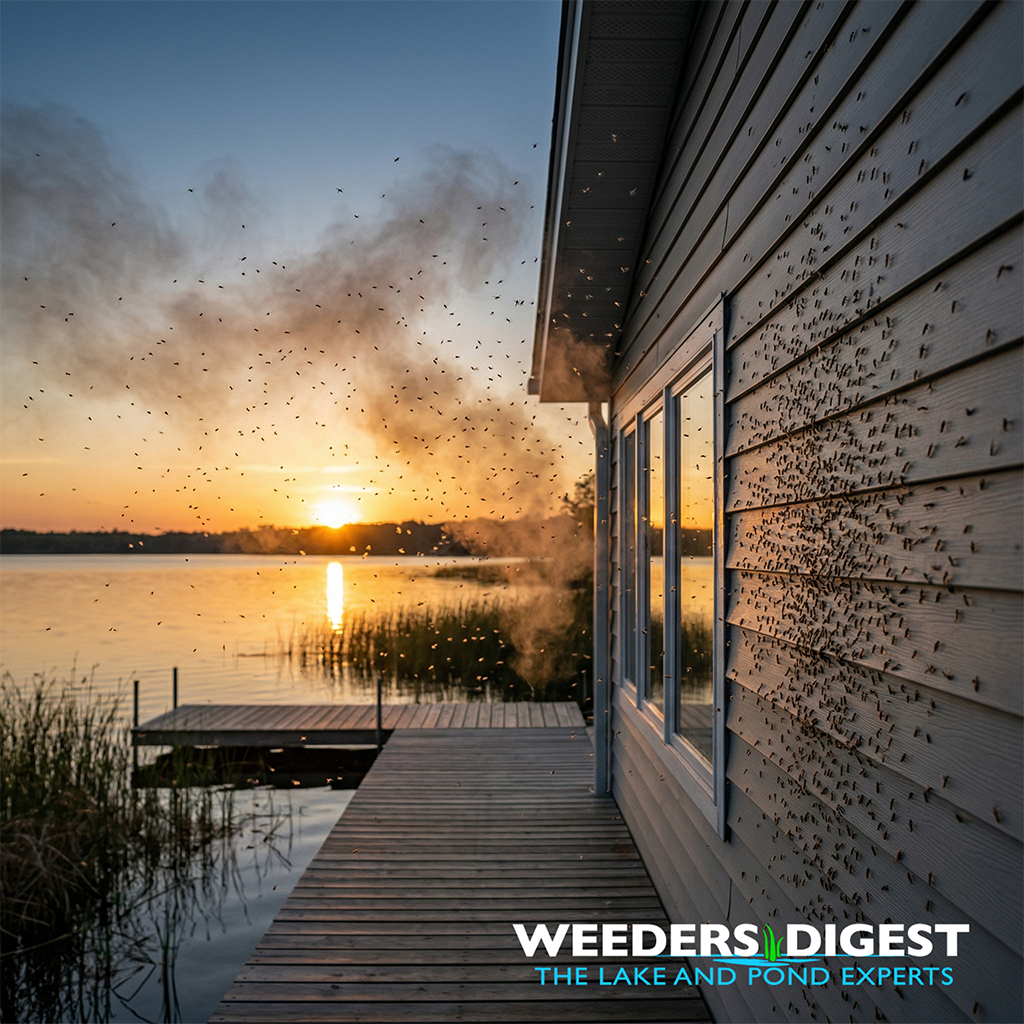
If you live near a lake or pond, you’ve likely stepped outside to find your siding, windows, and patio furniture blanketed by clouds of small, mosquito-like insects. While they don’t bite, these swarms—often called "blind mosquitoes" or midges—can be overwhelming. I’ve seen them get so thick that they look like smoke rising from the water’s edge. These massive gatherings aren't random; they are a sign of a very specific biological event happening right in your backyard.
The midges you see are the adult stage of an aquatic insect that spends most of its life at the bottom of your lake. They emerge all at once in a "synchronized hatch" to find mates. Because they only live for a few days as adults and cannot eat, their entire existence is a race against time to reproduce. Your house becomes a prime resting spot because it’s close to their birthplace and often features bright lights that attract them during the night.
Understanding why they chose your specific shoreline usually comes down to the health and nutrient levels of the water. When a lake has a lot of organic "muck" or fertilizer runoff, it creates a massive food source for the larvae. This leads to a population explosion that eventually takes flight and ends up on your front porch. It’s a frustrating phenomenon, but it is a natural part of the aquatic lifecycle driven by the environment beneath the surface.
The Science Behind It:
The phenomenon of massive midge aggregations is primarily driven by the life cycle of the family Chironomidae. These insects undergo complete metamorphosis, with the majority of their lifespan spent in the larval stage within benthic sediments. In many eutrophic or hypereutrophic water bodies, high levels of phosphorus and nitrogen fuel significant algal blooms. As this organic matter dies and settles, it creates a nutrient-rich substrate that supports immense densities of chironomid larvae, sometimes exceeding several thousand individuals per square meter. Research published in Freshwater Science indicates that larval success and subsequent adult emergence rates are directly correlated with the availability of high-quality organic detritus and dissolved oxygen levels in the sediment-water interface.
The synchronized emergence observed by homeowners is a survival strategy known as predator satiation. By emerging in such vast numbers simultaneously, the midges ensure that local predators—such as birds, bats, and dragonflies—cannot possibly consume the entire population, thereby guaranteeing that enough individuals survive to mate. According to studies found in the Journal of the American Mosquito Control Association, temperature serves as the primary trigger for these events. A sudden increase in water temperature often signals the larvae to pupate and rise to the surface, leading to the "swarms" that appear overnight on shoreline structures.
Once the adults emerge, they are driven by a behavior called "lekking." Male midges form large aerial swarms, often using tall landmarks or shoreline vegetation as visual markers to attract females. Shoreline houses, with their vertical profiles and contrast against the horizon, serve as accidental "markers" for these mating clouds. Furthermore, Chironomids are highly phototactic. Artificial light sources on piers and houses disrupt their natural navigation, drawing them away from the water and toward human habitations where they aggregate on surfaces to rest and conserve energy.
The sheer volume of these swarms is often an indicator of "cultural eutrophication," where human activity has accelerated the nutrient loading of a water body. When a lake’s ecosystem is out of balance—specifically when there is a lack of predatory fish like bluegill or a lack of diverse aquatic life to compete for resources—the midge population can grow unchecked. This results in the massive, nuisance-level hatches that coat siding and windows. While the adults lack functional mouthparts and do not pose a direct health threat, their decomposition can contribute to localized nutrient cycling back into the terrestrial environment.