


My Lakefront Oasis: Why Your Shoreline Feels So Different Than Your Lawn

Summary:
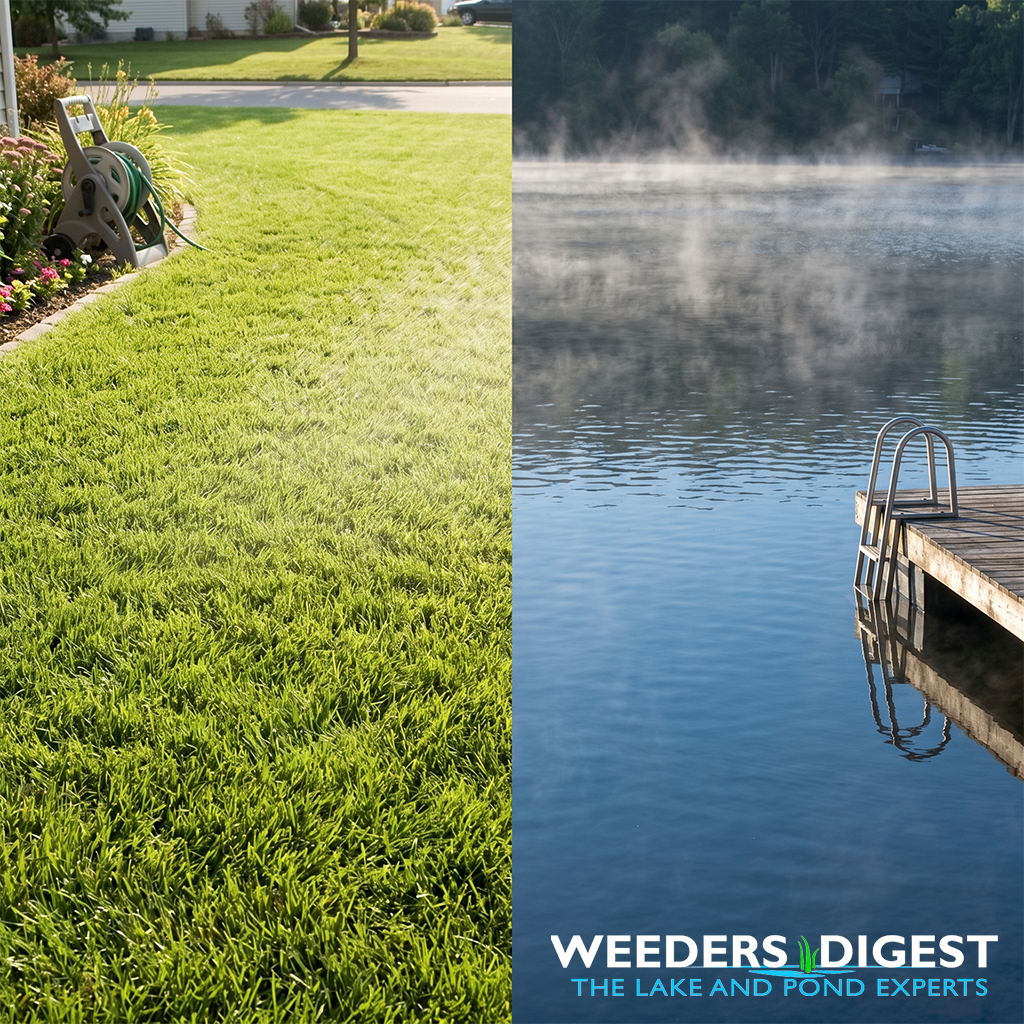
If you have ever walked from your back porch down to the edge of your dock, you have likely noticed a sudden change in the air. It feels heavier, cooler, and somehow "thicker" than the air over your grass. This isn't just your imagination; it is the result of a microclimate created by your lake. Because water evaporates constantly from the surface of a lake or pond, the air sitting directly above it becomes saturated with moisture, creating a pocket of high humidity that stays trapped near the surface.
Your lawn, while it does release some moisture through the grass blades, is a much drier environment. The soil doesn't give off water nearly as fast as an open pool of liquid does. Furthermore, the grass and the ground heat up much faster in the sun than the deep, cool water of the lake. This temperature difference changes how the air moves, often keeping that moist lake air hugging the shoreline while the air over your lawn remains relatively dry and crisp.
Understanding this difference is key to why certain plants thrive at the water's edge but wither on the upland lawn. The "lake breath" you feel is actually a localized dome of water vapor. This humidity acts as a buffer, keeping the immediate shoreline cooler in the summer and slightly more protected from sudden temperature swings. It is a fundamental part of what makes lakefront living feel so distinct from a standard suburban lot.
The Science Behind It:
The disparity in humidity between a lacustrine environment and a terrestrial lawn is governed by the principles of vapor pressure deficit and the latent heat of vaporization. On an open body of water, evaporation occurs at the air-water interface at a rate determined by the temperature of the surface water and the wind speed. According to research published in the Journal of Hydrology, the air layer immediately tangential to the water surface, known as the benthic boundary layer, often approaches a state of 100% relative humidity. This creates a localized "vapor dome" where the partial pressure of water vapor is significantly higher than in surrounding terrestrial areas.
In contrast, the humidity over a lawn is primarily driven by evapotranspiration—a combination of soil evaporation and plant transpiration. While turfgrass does release water vapor through stomatal conductance, the volume is restricted by the biological regulation of the plants and the limited surface area of the soil. A study from the University of Minnesota Extension notes that terrestrial surfaces heat up more rapidly due to lower specific heat capacity compared to water. This increased sensible heat flux over the lawn raises the air temperature, which in turn increases the air's capacity to hold moisture and lowers the relative humidity percentage, even if some moisture is present.
Thermal stability also plays a critical role in maintaining this humidity gradient. Large bodies of water exhibit high thermal inertia, meaning they remain cooler than the land during daylight hours. This creates a temperature inversion where the cool, dense, moist air sits low over the lake surface. This stable atmospheric layering prevents the moisture from mixing upward into the atmosphere as quickly as it does over a warm lawn, where convective currents (thermal plumes) carry moisture away from the ground and into the higher atmosphere.
Furthermore, the aerodynamic roughness of a lawn—comprised of grass blades and landscaping—creates more turbulence than the relatively smooth surface of a calm lake. This turbulence over the land promotes the rapid mixing of air masses, effectively diluting any accumulated moisture with drier air from above. Consequently, the lake maintains a persistent, high-humidity microclimate that is physically and chemically distinct from the drier, more volatile air profile found just a few meters inland over the turfgrass.