

My Secret Tactics for Rescuing Dropped Tools From a Murky Lake
 |

Summary:
It happens to the best of us. You’re working on the dock or adjusting a bubbler, and suddenly, your favorite wrench or a heavy pair of pliers slips from your grip, disappearing into the dark, silt-filled depths. When you are dealing with ten feet of water—especially the murky kind where visibility is zero—you can't simply dive in and hope to find it by touch. The bottom of a pond is often covered in "muck," a soft layer of decomposing organic matter that can swallow a heavy metal tool in seconds, making it feel like finding a needle in a very wet haystack.
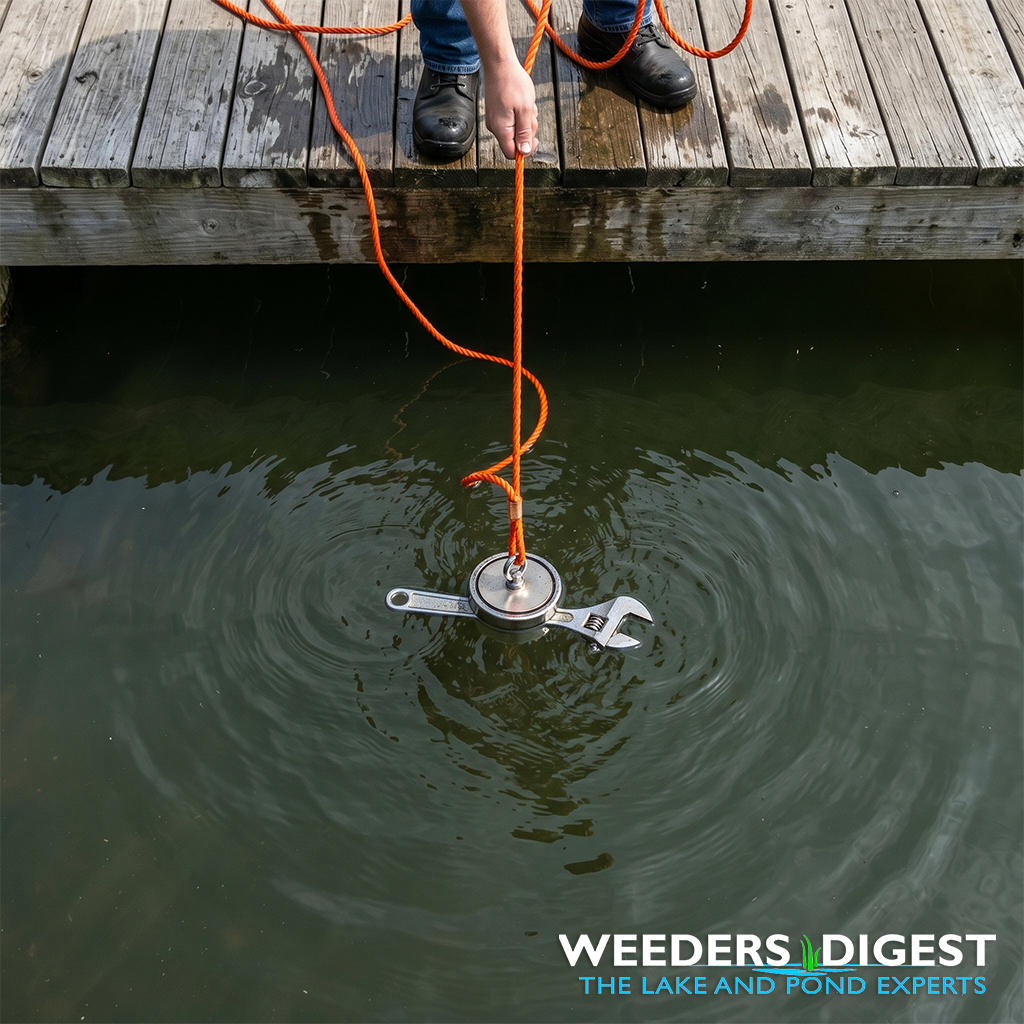
The most effective way to retrieve your gear without turning the lake bed into a cloudy mess is to use a systematic search pattern combined with a high-pull neodymium magnet. Because most hand tools are made of steel or iron alloys, a magnet designed for "magnet fishing" is your best friend. By lowering the magnet on a nylon rope and dragging it in a grid pattern, you increase your surface area coverage. If the tool is non-ferrous, like high-grade stainless steel or aluminum, your best bet is a specialized pond rake or a long-handled "grabber" tool, though this requires a bit more patience and a steady hand.
I always recommend staying on the dock or a stable boat rather than entering the water. In murky conditions, the sediment on the lake floor is easily disturbed; as soon as you step down, you create a "cloud" of silt that can take hours to settle, effectively blinding any further recovery efforts. By staying above the surface and using the right retrieval tools, you can successfully recover your equipment without ever getting your hair wet.
The Science Behind It:
The primary challenge in sub-aquatic tool retrieval within a lentic ecosystem—such as a pond or lake—is the presence of unconsolidated benthic sediments, commonly referred to as sapropel or "muck." According to research regarding sediment oxygen demand and physical composition, these layers are often composed of highly porous organic matter and fine-grained silts. When a dense object, such as a carbon steel wrench, enters this medium at velocity, it penetrates the flocculent layer and may become buried beneath several centimeters of sediment. This sequestering makes visual identification impossible and physical retrieval difficult due to the lack of tactile feedback through the muck.
The efficacy of using neodymium (NdFeB) magnets for retrieval is grounded in the ferromagnetic properties of most industrial tools. Neodymium magnets are permanent magnets made from an alloy of neodymium, iron, and boron, creating a high-energy product measured in Mega-Gauss Oersteds (MGOe). These magnets exert a powerful magnetic flux that can penetrate thin layers of silt to latch onto a buried tool. However, the success of this method depends on the material composition of the lost item; while carbon steel is highly permeable to magnetic fields, certain austenitic stainless steels (like 304 or 316) exhibit low magnetic permeability and may not respond to magnetic retrieval.
When magnetic retrieval is not viable, mechanical intervention via a grid search is necessary. This process involves the use of specialized benthic sampling equipment or modified pond rakes. The limitation here is the "turbidity current" created by the search itself. According to studies on sediment resuspension, physical disturbance of the benthos releases fine particulate matter into the water column, increasing total suspended solids (TSS) and drastically reducing light penetration. This phenomenon is governed by Stokes' Law, which dictates that smaller silt and clay particles will remain suspended for significantly longer durations than heavier sands, prolonging the period of zero visibility.
Furthermore, the depth of ten feet introduces pressure variables and safety concerns for manual retrieval. At this depth, the ambient pressure is approximately $1.3$ atmospheres. While not extreme, the lack of visibility in a murky environment increases the risk of entanglement in submerged aquatic vegetation (SAV) or submerged structures. Therefore, the application of remote retrieval technology—ranging from high-strength magnets to telescopic mechanical grabbers—is the scientifically preferred method to maintain the integrity of the benthic zone while ensuring the successful recovery of the lost artifact.