

My Struggle with the Muck: How I Safely Extract a Buried Boat Lift
 |

Summary:
Dealing with a boat lift that has sunk three feet into the lakebed muck is a common but incredibly frustrating challenge for any waterfront homeowner. When those large foot pads disappear into deep sediment, the muck creates a powerful suction effect that can make the lift feel like it is bolted to the center of the earth. If you try to force it out using only a winch or raw muscle power, you risk bending the aluminum frame or, worse, injuring yourself.
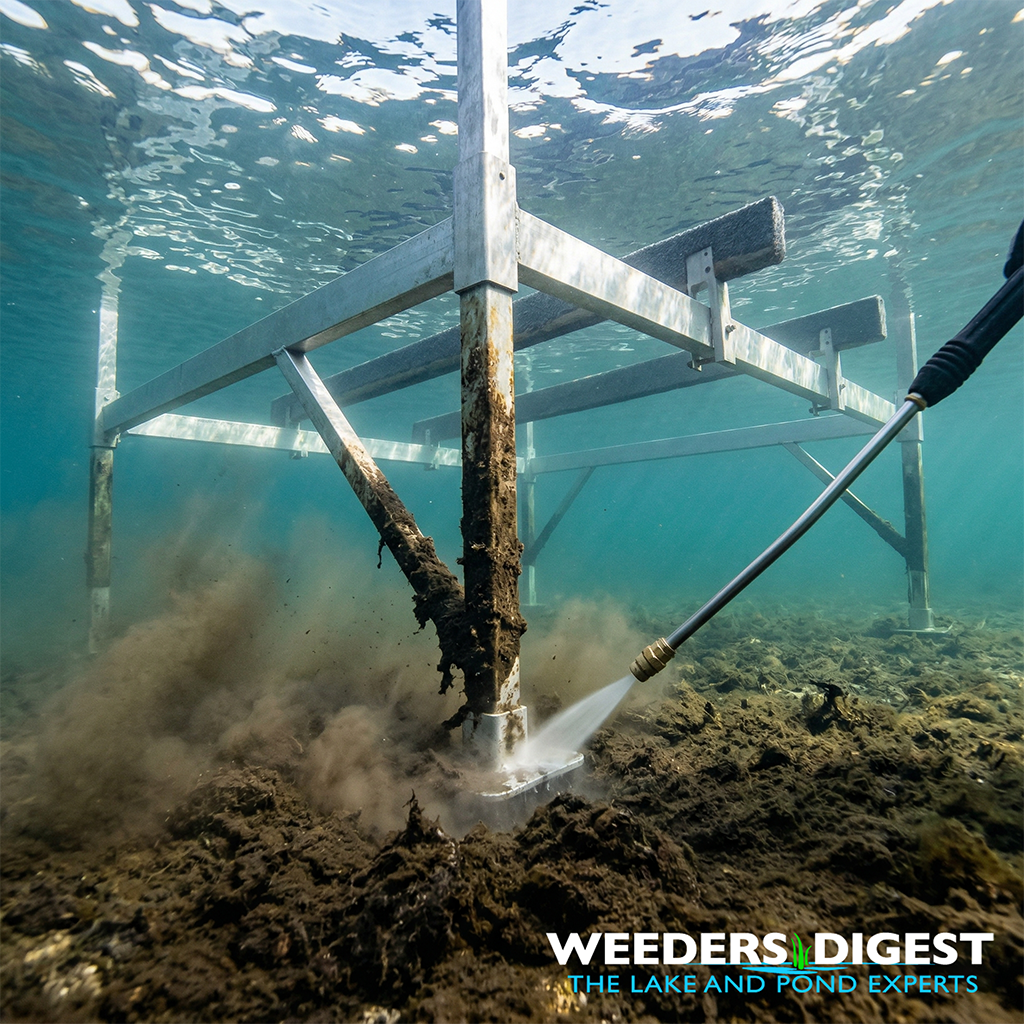
To get your lift back on dry land, you have to break the vacuum seal between the foot pads and the clay or organic silt. This is usually done by introducing water or air underneath the pads to equalize the pressure. My preferred method involves using a high-pressure water pump or "muck jet" to liquefy the sediment around the feet while applying steady, gentle upward pressure.
Safety is the most important part of this process. You must never stand directly on the lift or under a cable while it is under high tension. By working slowly and letting the water do the heavy lifting for you, you can slide the lift out of its muddy grave without ruining your equipment or your back.
The Science Behind It:
The primary physical obstacle in extracting objects from deep lacustrine sediment is the combination of hydrostatic pressure and the cohesive forces of the "muck," which is often a mixture of unconsolidated organic matter, silts, and clays. When a boat lift foot pad settles into these fine-grained sediments, the water is squeezed out from beneath the pad, creating a high-tension seal. According to research on the geotechnical properties of lake sediments, these materials often exhibit thixotropic behavior, meaning they are relatively stable when undisturbed but become fluid under shear stress or increased pore water pressure (University of Wisconsin-Extension, 2021).
To overcome this suction, one must employ the principle of fluidization. By utilizing a high-velocity water stream directed at the interface of the lift foot and the sediment, the pore water pressure is localized and increased. This process reduces the effective stress of the soil to zero, essentially turning the solid muck into a liquid slurry. This transition eliminates the vacuum seal and allows the buoyant force of the water and the mechanical advantage of the extraction tools to lift the structure.
Furthermore, the structural integrity of aluminum boat lifts is a significant concern during extraction. Aluminum alloys (typically 6061-T6) have high tensile strength but are susceptible to deformation when subjected to point-loading or uneven torque. Research into hydraulic extraction methods emphasizes that incremental lifting is necessary to prevent structural "racking," where the frame twists because one corner is free while another remains anchored in high-density silt (Michigan State University Extension, 2019).
The use of air-filled lift bags or "tunnelling" water jets provides a controlled upward vector. Unlike a winch, which provides a static pull that can snap cables if the resistance is too high, pneumatic and hydraulic methods provide a constant, adjustable force. This scientific approach ensures that the "breakout force" required to overcome the initial sediment adhesion does not exceed the yield strength of the lift’s structural members.