

Solar Charging Station for Boat Lift & Dock





Description
Solar Boat Lift Charging Station & Solar Panel Kit for Your Dock
Keep your boat lift battery charged with sunlight using the Solar Charging Station for Boat Lift & Dock, a complete boat lift solar charging kit designed for compatible 12V and 24V DC battery systems.
A solar boat lift setup lets waterfront owners use renewable solar energy to help recharge the batteries that operate their DC boat lift motors. Whether your boat lift is at a cabin, marina, private dock or remote waterfront property, the boat lift solar panel offers a convenient charging solution without running a conventional electrical extension cord to the water.
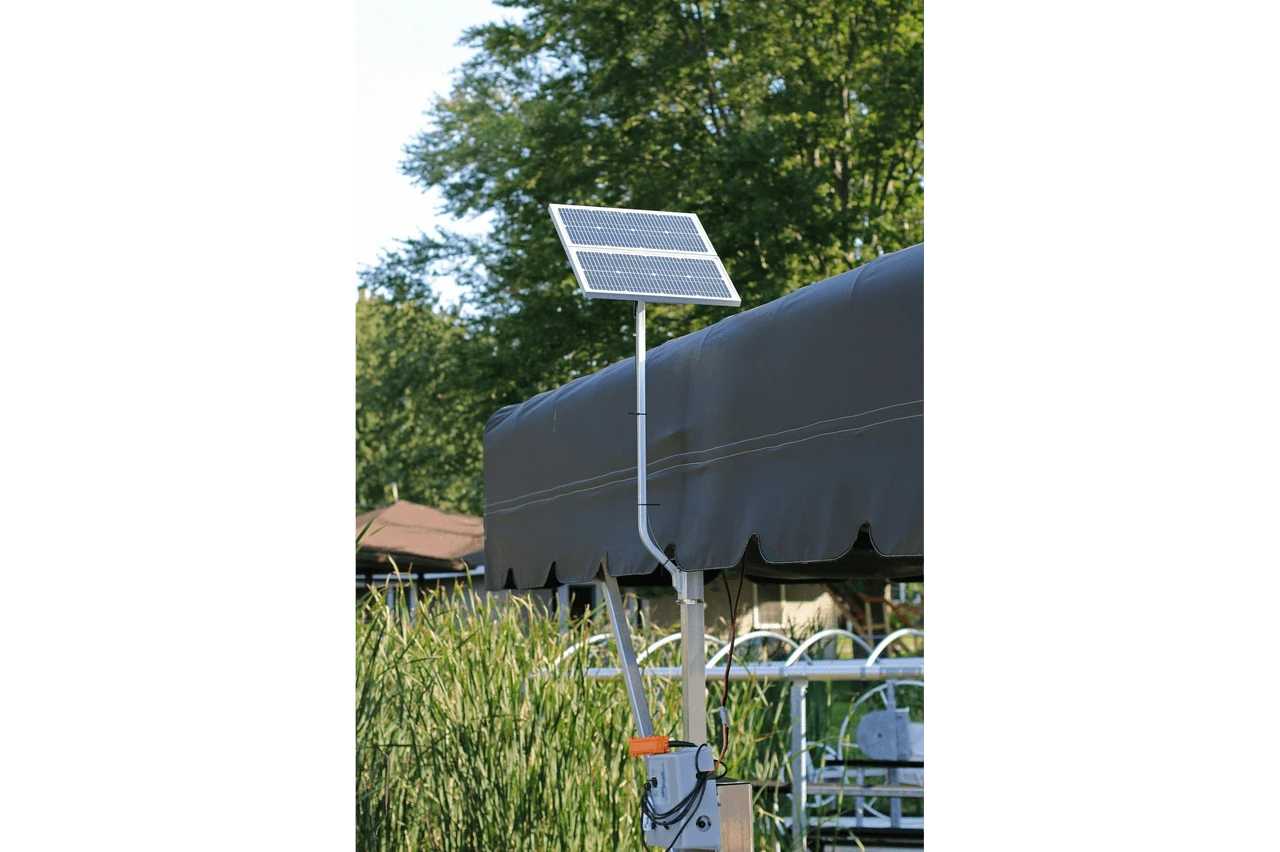
Each solar kit combines a high-efficiency monocrystalline solar panel with an adjustable anodized-aluminum mounting arm, a quick-connect wiring system and mounting accessories designed for waterfront environments. The panel converts available sunlight into DC electrical energy that charges a compatible marine battery through the appropriate charging equipment, and the battery then supplies the energy needed by the boat lift motor.
Choose the appropriate solar panel wattage and 12V or 24V charging configuration based on your motor voltage, battery arrangement, boat size, lift usage and expected sunlight exposure.
- 12V & 24V options
- Monocrystalline solar panel
- Adjustable 36" mounting arm
- 20 ft quick-connect wiring
- Battery tray and status indicator included

How Does a Solar Powered Boat Lift Work?
Capture Sunlight
The monocrystalline solar panel converts available sunlight into DC electrical energy.
Charge the Battery
The properly configured solar charging system delivers energy to your compatible 12V or 24V battery bank.
Power the Boat Lift
The battery supplies electricity to the compatible DC boat lift motor when raising or lowering your boat.
Recharge Between Uses
The panel helps replenish energy used during previous lift cycles whenever sufficient sunlight is available.
This product is intended for compatible DC battery charging applications. Confirm your boat lift motor voltage, battery arrangement, battery chemistry and charging regulator requirements. It is not a direct solar power supply for a 110V/120V AC boat lift motor.
Why Choose a Solar Boat Lift Charging Kit?
No Shore Power Needed for Charging
Use available sunlight to recharge a compatible DC battery without installing a conventional AC charging outlet at the dock.
High-Efficiency Solar Cells
Monocrystalline cells provide efficient sunlight conversion and useful charging performance in varied daylight conditions.
Adjustable Solar Panel Position
The mounting arm allows panel angle adjustments to help capture more sunlight as the seasons change.
Marine-Oriented Construction
Anodized aluminum framing and mounting components are intended to withstand ordinary waterfront exposure.
Quick-Connect Wiring
Replaceable wiring components and quick connections simplify seasonal setup and servicing.
Mounting Accessories Included
Includes a mounting arm, battery tray, straps, brackets, bolts and cable ties for suitable installations.
This product includes solar charging and mounting components. It does not include a boat lift motor, boat hoist, lift frame or marine battery. It is intended to work with a separately purchased compatible battery-powered lift system.
Built for Waterfront Solar Charging
Boat lifts operate outdoors, exposed to sunlight, humidity, rain and seasonal weather. This charging station combines a weather-resistant panel design with an anodized aluminum frame and mounting arm.
Tempered Glass & Aluminum
Monocrystalline cells are enclosed behind low-iron tempered glass and supported by an anodized aluminum alloy frame. The 20+ year panel lifetime rating reflects intended service life, not a guaranteed warranty period.
36" Standard Arm
The standard mounting arrangement includes a 36-inch arm. A 48-inch arm is available for selected 30W and 40W configurations by contacting Weeders Digest.
Charging, Not Lifting
For a solar powered boat hoist, the hoist must already have a compatible DC motor and battery arrangement. The charging station provides battery charging, not the lifting mechanism.
Need Help Choosing a 12V or 24V Solar Charging Kit?
Electrical safety: solar panels, batteries and charging systems must be connected with correct polarity, suitable charge regulation and appropriate electrical protection. Never connect a solar panel directly to an incompatible battery or bypass charging equipment required by the manufacturer.
Call Weeders Digest at 877-224-4899.
Features
Solar Boat Lift Charging Station Features & Benefits
Components built for dockside DC battery charging.
High-Efficiency Monocrystalline Cells
Single-crystal silicon solar cells designed for efficient charging performance.
Anodized Aluminum Frame
Corrosion-resistant frame construction intended for outdoor waterfront environments.
Adjustable Solar Panel Angle
Tilt the panel for improved sunlight exposure.
Universal-Style Mounting Hardware
Designed to accommodate many suitable dock and boat lift arrangements.
20+ Year Panel Lifetime Rating
The published lifetime rating reflects the panel’s intended longevity, not its warranty duration.
12V & 24V Charging Options
Select the configuration appropriate for your compatible DC boat lift battery system.
Quick-Connect Wiring
Replaceable wiring and quick-connect fittings help simplify installation and servicing.
20 ft Color-Coded Cable
Includes red and black 18AWG wiring with quick-connect hardware.
Battery Status Indicator
Monitor battery status using the included indicator.
Battery Tray Included
A universal-style battery tray supports suitable mounting arrangements for the separately purchased battery.
Stainless Steel Mounting Straps
Help secure mounting components to compatible dock and boat lift structures.
Regulator on Specified Models
The 30W and 40W solar kits list an included 12V, 5A regulator. Confirm the requirements for your selected voltage and wattage.
What’s Included
What’s Included in the Boat Lift Solar Charging Kit?
Components, details and purpose.
| Solar Panel | High-efficiency monocrystalline panel with anodized aluminum frame · generates electricity from sunlight |
|---|---|
| Solar Panel Wiring | 20 ft red/black color-coded 18AWG wire · connects the panel and charging arrangement |
| Quick-Connect Hardware | Compatible quick-connect fittings · simplifies electrical connections |
| Battery Ring Terminals | 3/8-inch ring terminals with quick-connect hardware · connects wiring to battery terminals |
| Universal Battery Tray | Mounting tray included · supports suitable battery mounting |
| Mounting Straps | Stainless steel straps · secures mounting components |
| Solar Panel Mounting Arm | Standard 36-inch arm · positions the panel for sunlight exposure |
| Brackets and Bolts | Installation hardware included · supports panel and arm mounting |
| Cable Ties | Included · organizes installed wiring |
| Battery Status Indicator | Included · displays battery status information |
| Installation Documentation | Instructions and wiring diagram · guides system installation |
| Technical Support | Product support available · installation and compatibility questions |
| Charging Regulator | 12V, 5A regulator listed for 30W and 40W models · regulates battery charging on applicable configurations |
A 48-inch mounting arm is available for selected 30W and 40W kits by special request. Call Weeders Digest to confirm availability and pricing.
The solar kit does not include a marine battery, boat lift motor or complete boat hoist. Choose compatible components for your intended installation.
12V vs. 24V
12V vs. 24V Solar Boat Lift Charging Systems
Choosing the correct solar charging system starts with the lift’s operating voltage and the battery arrangement used by the motor.
12V Solar Boat Lift Charging
Designed for compatible 12V DC battery arrangements. Verify that the selected solar panel and charging regulator are approved for the battery voltage and chemistry.
24V Solar Boat Lift Charging
Designed for compatible 24V DC battery arrangements, including correctly configured dual-battery systems. Confirm all charging and battery connections.
| Target System | 12V: compatible 12V DC battery arrangement · 24V: compatible 24V DC battery arrangement |
|---|---|
| Battery Requirement | 12V: battery or bank configured for 12V · 24V: bank configured for 24V |
| Charging Hardware | Must be approved for the specific 12V or 24V system |
| Motor Compatibility | Compatible 12V or 24V DC boat lift motors |
| Battery Included | No |
| AC Motor Operation | Does not directly power 110V/120V AC motors |
Do not use a 12V-only regulator for a 24V battery bank unless expressly approved by its manufacturer. Match the panel, controller, wiring and battery configuration to the required voltage.
Charging needs depend on battery capacity, lift motor consumption, daily lift cycles and available sunlight, not boat weight alone.
Solar Panel Sizing
What Size Boat Lift Solar Panel Do I Need?
It depends on how much battery energy you use between charging periods and how much sunlight the installation receives. A frequently operated lift, a shaded dock or a heavily used battery may need more charging capacity than a sunny, lightly used installation.
Boat Lift Solar Charging Sizing Chart
Use the Weeders Digest solar charging sizing chart as a starting point when comparing wattage and voltage options. Confirm the final configuration for your lift motor, battery bank and intended use.

What Affects Solar Boat Lift Charging Performance?
Battery Capacity
Larger battery banks store more energy but may require longer charging periods.
Boat Lift Usage
More lift cycles consume more battery energy and increase charging demand.
Sun Exposure
Direct sunlight generally produces more charging energy than shade or heavy cloud cover.
Solar Panel Wattage
Higher-rated panels have greater potential output under comparable conditions.
Season & Location
Daylight hours, sunlight angle, weather and geography affect solar energy production.
Charging Efficiency
Wiring losses, battery condition, controller efficiency and temperature influence usable energy.
A panel’s rated wattage reflects standardized test conditions. Actual battery charging varies with sunlight, mounting angle, charging electronics and battery condition.
How It Works
How Solar Power Boat Lift Charging Works
The panel charges the battery bank and the stored energy powers the DC boat lift motor when needed.
-
The Solar Panel Captures Sunlight
Monocrystalline solar cells convert available sunlight into DC electrical energy.
-
The Charging Circuit Manages Battery Input
Correctly selected charging components deliver electricity to the battery according to its approved charging requirements.
-
The Marine Battery Stores Energy
The compatible battery or battery bank stores electricity for later use.
-
The Boat Lift Motor Draws Power
When operating the lift, the DC motor draws energy from the battery system.
-
The Solar Charger Replenishes the Battery
Available sunlight helps restore energy consumed by previous lift operations.
Solar panels generate less electricity in low light and no useful charging energy at night. Stored battery power operates the lift when sunlight is unavailable.
Installation Instructions
Solar Boat Lift Panel & Charging Kit Installation Guide
The kit includes instructions and a wiring diagram. These steps are a general overview; always follow the documentation for your voltage, wattage, regulator and battery type.
-
Confirm Your Electrical System
Identify the motor voltage, battery arrangement, battery chemistry and required solar charge regulation.
-
Select a Mounting Location
Choose a dock, post or boat lift location with suitable sunlight exposure and structural support.
-
Install the Mounting Hardware
Attach the mounting arm, brackets, stainless steel straps and fasteners according to the supplied instructions.
-
Mount and Angle the Solar Panel
Secure the panel to its arm and adjust its position for sunlight exposure without interfering with boat lift operation.
-
Install the Battery Tray
Mount the included battery tray securely and install a separately purchased compatible marine battery.
-
Route the Electrical Wiring
Position the 20-foot color-coded cable away from sharp edges, moving equipment, pinch points and walkways.
-
Connect the Charging Components
Use the wiring diagram to connect the correctly rated charging equipment and battery terminals with proper polarity and electrical protection.
-
Verify Charging Operation
Inspect the completed system and check charging status using approved test methods or the included battery indicator.
-
Secure and Monitor the Installation
Recheck the mounting hardware, wiring, battery connections and panel orientation after initial use.
Incorrect polarity, incompatible charging electronics, unprotected wiring or improper battery charging can cause equipment damage, fire or injury. Follow the wiring diagram and use qualified electrical assistance when needed.
A 12V, 5A regulator is specifically listed for 30W and 40W kits. Confirm the correct charging controller and included components for the exact kit and voltage selected.
Mounting & Positioning
Boat Lift Solar Panel Mounting Arm & Dock Installation
The adjustable mounting arm helps position the panel for available sunlight. A properly supported location with minimal shade matters for both charging performance and durability.
36-Inch Standard Mounting Arm
An adjustable panel mounting position for suitable dock and boat lift installations.
Optional 48-Inch Mounting Arm
Available for selected 30W and 40W kits by contacting Weeders Digest.
Adjustable Panel Tilt
Change the panel angle as seasonal conditions change.
Anodized Aluminum Construction
Made for corrosion resistance in outdoor waterfront conditions.
Stainless Steel Mounting Straps
Help attach mounting components to appropriately sized structures.
High-Wind Design
The J-arm is promoted for strength in windy conditions, but proper installation and structural compatibility remain essential.
Tips for Better Solar Panel Performance
- Select a mounting position with minimal shading from trees, canopies or nearby structures.
- Angle the panel for seasonal sunlight exposure.
- Keep leaves, dirt and other debris off the panel surface.
- Make sure the panel does not interfere with moving boat lift components.
- Inspect brackets and hardware after severe weather.
- Check for snow and ice accumulation during winter.
- Keep electrical wiring properly secured and protected.
Universal-style hardware does not guarantee a fit on every dock, post, lift canopy or structural member. Confirm fit and strength before installation.
Battery Compatibility
Solar Powered Boat Lift Battery Compatibility
A solar powered boat lift depends on its battery system. The kit helps replenish that battery but does not include one.
| Nominal Battery Voltage | Must match the selected 12V or 24V charging configuration |
|---|---|
| Battery Chemistry | Lead-acid, AGM, gel and lithium batteries may require different charging profiles |
| Battery Capacity | Determines available stored energy and influences recharge time |
| Motor Requirements | The motor must receive correct voltage and sufficient operating current |
| Charging Regulator | Must be approved for the battery chemistry, voltage and solar panel |
| Electrical Protection | Wiring and battery circuits must meet appropriate protection requirements |
| Installation Location | The battery must be securely installed and maintained according to its safety instructions |
The product recommends a suitable deep-cycle marine battery. Confirm its capacity, terminals, voltage and charging compatibility with your boat lift motor.
Follow the motor and battery manufacturers’ requirements for matching and connecting batteries in a 24V arrangement. Do not improvise a 24V system with incompatible batteries or chargers.
Charging Performance
What to Expect From Your Solar Boat Lift Charger
A correctly selected kit replenishes battery energy when sunlight is available. Output varies with weather, shade, panel angle, battery condition and lift usage.
Sunny Conditions
Direct sunlight generally allows greater charging output.
Cloudy Conditions
Cloud cover reduces available sunlight and can lower charging performance.
Nighttime Operation
The panel does not charge at night; your battery supplies the lift’s operating power.
Frequent Lift Use
More cycles increase energy consumption and charging demand.
Shade & Tree Coverage
Partial shading can significantly reduce solar panel output.
Winter Conditions
Shorter days, lower sun angles and snow buildup may reduce energy production.
A solar charger replenishes energy over time. It does not guarantee the battery will be completely charged every day, especially with heavy usage, shade or extended cloudy weather.
Care & Storage
Solar Boat Lift Charging Station Maintenance & Storage
Routine checks keep the system charging safely.
- Clean the panel surface. Remove dirt, leaves and bird droppings using an appropriate cleaning method.
- Inspect mounting hardware. Check bolts, straps, brackets and the adjustable arm for looseness or damage.
- Check wiring. Look for abrasion, corrosion, worn insulation or strained connections.
- Inspect quick connectors. Keep contacts and seals in good condition.
- Monitor the battery. Use the status indicator and follow the battery manufacturer’s maintenance recommendations.
- Review sunlight exposure. Adjust the panel angle when appropriate.
- Inspect after storms. Check mounting security following significant wind or severe weather.
- Manage winter conditions. Prevent damaging snow and ice buildup where safe and practical.
- Service electrical equipment safely. Isolate charging components per the manufacturer’s instructions before removal or maintenance.
Although the panel is designed for outdoor installation, heavy snow and ice may require additional protection or seasonal removal.
Troubleshooting
Solar Boat Lift Battery Charger Troubleshooting
Issue, possible cause and what to check.
| Battery is not charging | Shade, wiring issue, incompatible or failed charging component · inspect sunlight exposure and use approved charging-system diagnostics |
|---|---|
| Battery charges slowly | Limited sunlight, heavy use, undersized panel, aging battery · review panel wattage, battery health and lift frequency |
| Solar panel produces less power | Dirt, shade, incorrect angle, weather · clean the panel safely and review mounting orientation |
| Battery discharges overnight | Normal load use, battery deterioration or charging issue · verify battery condition and charging operation |
| Status indicator seems incorrect | Battery state, wiring or indicator problem · consult documentation and verify with approved equipment |
| Panel or arm changes position | Loose or incompatible mounting hardware · inspect hardware and stop use if the mount is unsafe |
| Charging electronics become unusually hot | Possible wiring or component fault · stop use and seek qualified inspection |
Do not short wires, bypass the regulator, or connect incompatible batteries in an attempt to diagnose charging problems.
Specifications
Solar Charging Station for Boat Lift & Dock Specifications
Confirm the voltage, wattage, regulator and electrical ratings for the selected variation.
| Product Name | Solar Charging Station for Boat Lift & Dock |
|---|---|
| Product Type | Boat lift solar charging kit for compatible DC battery systems |
| Solar Cell Technology | Monocrystalline silicon |
| Solar Module Cover | Low-iron tempered glass |
| Panel Frame | Anodized aluminum alloy |
| Battery System Choices | 12V and 24V configurations |
| Solar Panel Wattage | Selectable by product option; confirm available ratings before ordering |
| Panel Lifetime Rating | 20+ years as stated in the product description |
| Standard Mounting Arm | 36 inches |
| Optional Mounting Arm | 48 inches for selected 30W and 40W units; contact Weeders Digest |
| Mounting Arm Material | Anodized aluminum |
| Solar Panel Angle | Adjustable |
| Solar Wiring | 20 ft red/black 18AWG wire |
| Wiring Connections | Quick-connect system |
| Battery Terminals | 3/8-inch ring terminals with quick connect |
| Battery Tray | Universal-style battery tray included |
| Mounting Hardware | Stainless steel straps, brackets, bolts and cable ties |
| Battery Status Indicator | Included |
| Charging Regulator | 12V, 5A regulator listed for 30W and 40W configurations; verify other configurations |
| Documentation | Installation instructions and wiring diagram included |
| Battery Included? | No |
| Boat Lift Motor Included? | No |
| Complete Boat Hoist Included? | No |
| Primary Application | Compatible DC boat lift battery charging |
| Direct 110V/120V AC Motor Operation? | No |
| Technical Support | Available through Weeders Digest |
| Warranty | Confirm applicable panel and kit warranty terms before ordering |
The published 20+ year panel lifetime rating is not a 20-year warranty.
Related Tools
Related Solar Boat Lift Chargers, Motors & Dock Accessories
This solar kit does not include a boat lift motor. Contact Weeders Digest with your lift model, motor voltage and battery requirements to identify compatible components.
FAQs
Solar Boat Lift & Boat Lift Solar Charging Kit FAQs
Answers about compatibility, contents, installation and performance.
What is a solar boat lift?
A solar boat lift typically uses a solar charging system to replenish the batteries that power a compatible DC boat lift motor. The panel charges the battery, while the battery operates the lifting mechanism.
What comes in the boat lift solar charging kit?
A monocrystalline solar panel, adjustable mounting arm, mounting hardware, wiring, battery terminals, battery tray and battery status indicator. A 12V, 5A regulator is specifically listed for the 30W and 40W options. Confirm contents for the selected configuration.
What is a solar powered boat lift?
One that uses stored battery energy to operate a compatible DC motor, while a solar panel and charging circuit help recharge the battery between lifting cycles.
Can solar power boat lift equipment without shore electricity?
Yes. A correctly configured system can replenish a compatible DC boat lift battery without an AC outlet at the dock, provided the panel produces enough energy for the system’s needs.
What is a boat lift solar panel?
A panel that converts sunlight into DC electricity used to charge the battery that powers a compatible boat lift motor, working with the appropriate controller and battery arrangement.
What is a boat lift solar panel mounting arm?
The support that positions the panel on a suitable dock or lift structure. This kit includes a standard 36-inch adjustable anodized-aluminum arm, with a 48-inch option for selected configurations.
Can I use this product for a solar power dock setup?
Yes. It can be part of a dock-based battery charging arrangement for a compatible DC boat lift. Other solar dock accessories may require separate electrical systems.
What is included in a solar kit for a boat lift?
This product includes the panel, mounting arm, wiring, battery tray and related hardware. It does not include the marine battery or boat lift motor.
Can I use this charger with a solar powered boat hoist?
Potentially, if the hoist uses a compatible DC battery-powered motor and the system is correctly sized. This product is the charging equipment, not the hoist itself.
Is this a complete solar boat lift motor kit?
No. It supplies the solar charging components only. A compatible DC boat lift motor, lift mechanism and marine battery must be obtained separately.
What is a boat lift solar charging station?
A solar charging kit designed to replenish energy in a compatible battery system that powers a DC boat lift motor.
How does a boat lift solar charger work?
The panel generates DC electricity from sunlight. Charging equipment manages delivery to a marine battery, which then supplies power to the lift motor.
What kinds of boat lifts are compatible?
Compatible 12V and 24V DC boat lift battery systems. Confirm motor voltage, battery chemistry and charging requirements before choosing a kit.
Can I use it with a Boat Lift Boss motor?
Potentially, if your Boat Lift Boss operates from a compatible DC battery system. Confirm the motor’s voltage and charging requirements.
Does the solar charging kit work with a 12V boat lift?
Yes, with an appropriate 12V charging configuration and compatible battery equipment.
Can it charge a 24V boat lift battery bank?
Yes, with a correctly selected 24V charging configuration and compatible controller. Verify the complete battery arrangement.
Can this solar panel directly operate a 120V boat lift motor?
No. This is a DC battery charging product, not a direct AC power source.
What solar panel wattage should I choose?
It depends on motor energy consumption, battery capacity, daily lift usage, voltage, available sunlight and shading. Use the sizing chart as a starting point.
Does the solar kit include a battery?
No. A suitable marine battery must be purchased separately.
What type of battery should I use?
An appropriate deep-cycle marine battery. Confirm voltage, chemistry, capacity and charging compatibility with your lift motor and charger.
Does the kit include a battery tray?
Yes. A universal-style battery tray is included.
Does the kit include a solar charge regulator?
A 12V, 5A regulator is specifically listed with 30W and 40W configurations. Verify the controller and included parts for other voltages and wattages.
Can I use a 12V regulator to charge a 24V battery bank?
Not unless the regulator manufacturer expressly approves it. Use charging equipment designed for the actual battery voltage and chemistry.
How long is the included solar panel wiring?
20 feet of red and black 18AWG wire with quick-connect hardware.
What size are the battery ring terminals?
3/8 inch.
What is the solar panel frame made from?
Anodized aluminum alloy.
What kind of solar cells does the panel use?
Monocrystalline silicon solar cells.
Is the solar panel designed for marine environments?
Yes. It uses anodized aluminum construction, tempered glass, an adjustable mounting arm and outdoor waterfront-oriented components.
How long is the standard mounting arm?
36 inches.
Is a longer mounting arm available?
A 48-inch arm is available for selected 30W and 40W configurations. Contact Weeders Digest to confirm.
Can I adjust the angle of the solar panel?
Yes. The mounting arm allows panel-angle adjustments.
Can I mount the solar panel on a dock post?
The universal-style hardware is intended for suitable dock and boat lift installations. Verify structural dimensions and support before mounting.
Does the solar charging station fit every boat lift?
Actual fit depends on the structure and the motor and battery requirements.
Can I use the solar charger for dock lights or other accessories?
Potentially, if they are compatible with the battery system and charging capacity is sufficient. Additional dock devices may require their own electrical protection or power system.
Will the solar panel power dock lights without a battery?
The kit is designed primarily for charging a battery. Nighttime or continuous loads generally require energy storage.
What happens on cloudy days?
The panel generates less electricity under cloud cover. The battery keeps operating the lift while it has sufficient stored energy.
Will the solar panel charge at night?
No. The panel requires sunlight to generate useful charging energy.
Will it keep my boat lift battery fully charged every day?
Not necessarily. Performance depends on sunlight, panel size, battery condition and energy used by the lift.
Can I add more solar panels?
Possibly, but panel voltage, current, controller limits and battery requirements must be verified first.
Is the solar charging station weatherproof?
The panel and mounting components are intended for outdoor use. Wiring and charging electronics must still be protected according to their individual requirements.
Can I leave the solar panel installed year-round?
Outdoor use is intended, but snow, ice and severe winter weather may warrant protection or seasonal removal.
Can snow prevent solar charging?
Yes. Snow covering the panel can reduce or stop sunlight from reaching its cells.
Will the mounting arm handle strong winds?
It is promoted for outdoor strength, but safe performance depends on hardware, structure, installation quality and weather severity.
Does the solar panel have a 20-year warranty?
The 20+ year panel lifetime rating is not the same as a 20-year warranty. Confirm actual warranty terms with Weeders Digest.
Can I install the solar charging kit myself?
The kit includes instructions and a wiring diagram. Basic mounting may be manageable, but electrical connections must follow the correct instructions and battery safety practices. Seek qualified assistance if needed.
Does it include installation instructions?
Yes. Installation instructions and a wiring diagram are listed as included.
Does the kit include a battery status indicator?
Yes.
Are mounting straps and hardware included?
Yes: stainless steel straps, brackets, bolts, cable ties and the adjustable mounting arm.
Can I use a solar boat lift at a dock without an outlet?
Yes, if the lift uses a compatible DC battery-powered motor and the system provides sufficient energy.
How often should I clean the solar panel?
Inspect periodically and clean when dirt, leaves, bird droppings or other debris block sunlight.
Does the solar charging system require maintenance?
Inspect the panel, mounting hardware, wiring, connections, regulator and battery periodically.
Can this kit charge lithium marine batteries?
Only if the selected charging controller is compatible with the lithium battery’s charging requirements. Nominal voltage alone does not guarantee compatibility.
What if my panel is not charging the battery?
Check for shade, dirty panel surfaces, wiring issues, battery condition and controller problems. Use the manufacturer’s approved diagnostic procedure.
Where can I find other solar boat lift charging systems?
Weeders Digest also offers separate 12V Solar Battery Charging Systems and 24V Solar Battery Charging Systems.
Where can I buy a compatible boat lift motor?
Browse the Weeders Digest Boat Lift Motors category and confirm compatibility before combining a motor with a solar charging kit.
Who can help me choose the correct kit?
Call Weeders Digest at 877-224-4899 with your motor voltage, battery configuration and typical lift usage.


