

The Invisible Impact: What Happens to My Boat’s Fuel Spill?

Summary:
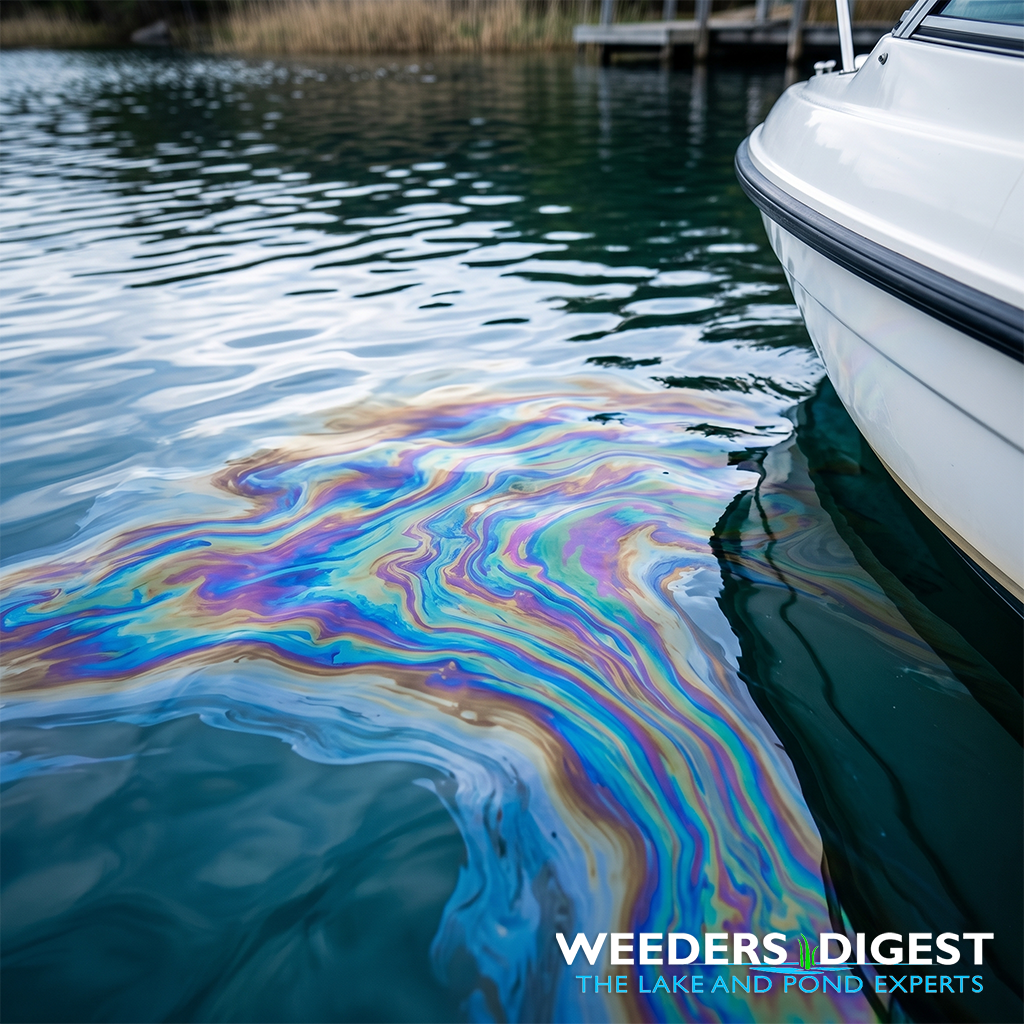
When a bit of gasoline or oil splashes over the side of your boat during a fill-up, it doesn’t just stay there as a colorful sheen. While it might look like a small mistake, the fuel immediately begins a complex transformation process driven by the wind, sun, and water movement. Because fuel is less dense than water, it floats on the surface, spreading into a thin layer known as a "slick" or "sheen."
Over the first few hours, much of the fuel actually disappears into the air through evaporation. This is why you can often smell the spill before you see it. However, the portions that don't evaporate begin to mix with the water column or settle into the sediment at the bottom of your lake or pond. This can be particularly stressful for the tiny organisms and fish that call the surface "home."
As a boat owner, it is easy to assume the water just "washes it away," but the reality is more permanent. Natural bacteria in the water eventually try to break down the remaining hydrocarbons, but this process consumes oxygen and takes time. Understanding this cycle helps us realize that even a few ounces of spilled fuel can have a lingering footprint on the local ecosystem.
The Science Behind It:
The fate of petroleum hydrocarbons in freshwater ecosystems is governed by a series of physical and chemical processes collectively known as "weathering." When fuel is introduced to the aquatic environment, the primary mechanism of removal is volatilization. Light-end hydrocarbons, such as benzene, toluene, ethylbenzene, and xylenes (BTEX), possess high vapor pressures and rapidly transition from the liquid phase to the gaseous phase. Research indicates that under moderate wind conditions and temperatures, up to 75% of a gasoline spill can evaporate within 24 hours (Fingas, 2011).
Simultaneously, the process of emulsification occurs as wave action forces water droplets into the fuel layer, or vice versa. This can create a "mousse" that increases the surface area of the pollutant, making it more accessible to photo-oxidation. Sunlight, specifically ultraviolet radiation, triggers chemical reactions that break down complex hydrocarbon chains into polar compounds. However, these intermediate degradation products can sometimes exhibit higher toxicity to aquatic biota than the original fuel molecules, a phenomenon documented in studies regarding the photo-enhanced toxicity of polycyclic aromatic hydrocarbons (PAHs).
Dissolution is a secondary but critical pathway where the water-soluble fractions of the fuel move into the water column. While petroleum is generally hydrophobic, certain aromatic compounds possess enough solubility to reach concentrations that are lethal to fish larvae and macroinvertebrates. According to the National Research Council (2003), these dissolved fractions are bioavailable, meaning they can be absorbed through the gills or skin of aquatic organisms, leading to physiological stress or reproductive failure.
Long-term remediation is largely dependent on microbial biodegradation. Indigenous populations of hydrocarbon-clastic bacteria, such as Alcanivorax and Pseudomonas, utilize the carbon in the fuel as an energy source. This biological oxidation requires significant amounts of dissolved oxygen and limiting nutrients like nitrogen and phosphorus. In stagnant or low-oxygen environments, such as the benthic zone or deep lake sediments, the degradation rate slows significantly, allowing heavy molecular weight hydrocarbons to persist for years.
Sources / References:
- Fingas, M. (2011). The Basics of Oil Spill Cleanup. CRC Press. https://www.sciencedirect.com/topics/earth-and-planetary-sciences/oil-weathering
- National Research Council (2003). Oil in the Sea III: Inputs, Fates, and Effects. National Academies Press. https://nap.nationalacademies.org/catalog/10388/oil-in-the-sea-iii-inputs-fates-and-effects