


The Secret Calendar of My Shoreline: Why Your Lake Insects All Hatch at Once
 |

Summary:
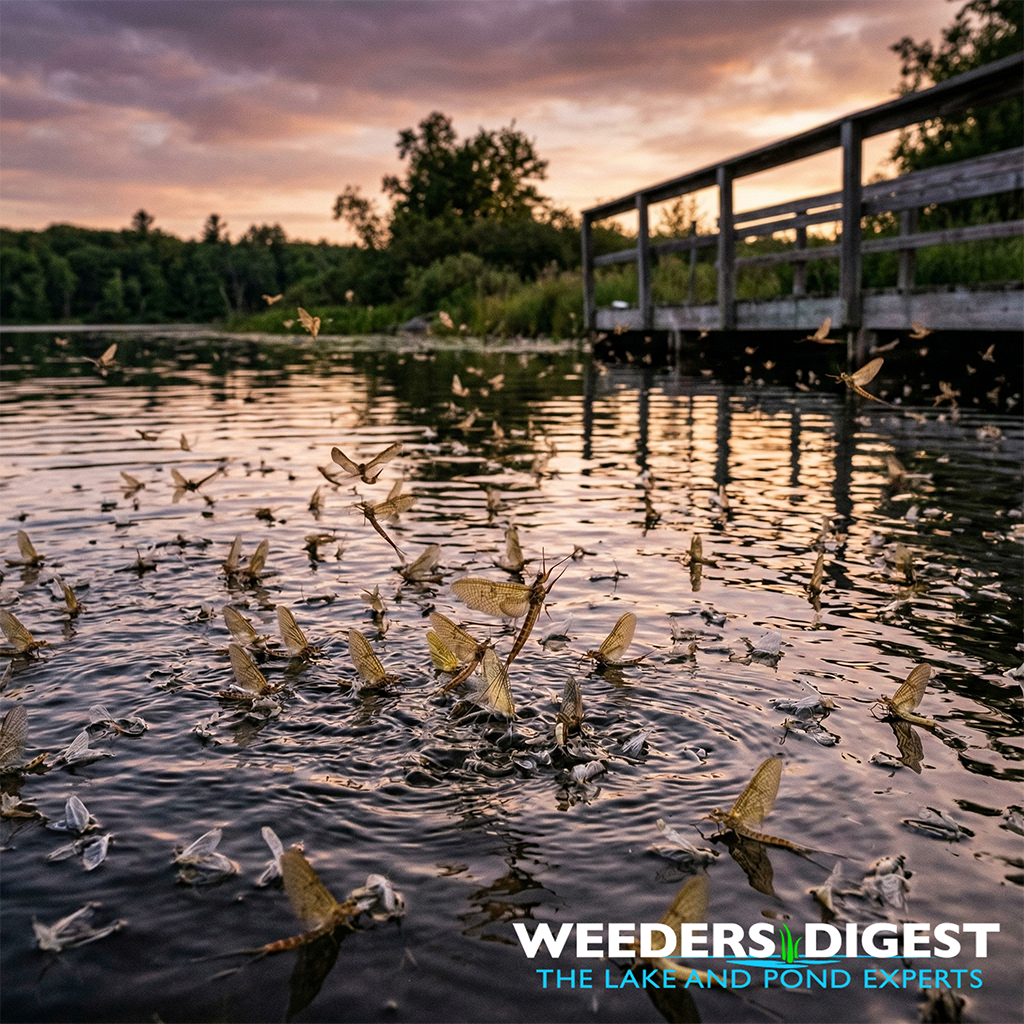
If you have ever stepped out onto your dock in mid-July only to find yourself swarmed by thousands of mayflies or midges that weren't there yesterday, you’ve witnessed one of nature’s most precisely timed events. It can feel like these insects have a synchronized alarm clock set for a very specific week of the summer. As a lake manager, I often hear from frustrated homeowners who think their pond has suddenly "spoiled," but in reality, this massive, fleeting arrival is a sign of a highly productive and rhythmic ecosystem.
These insects spend the vast majority of their lives—sometimes years—hidden in the muck at the bottom of your lake as larvae or nymphs. They are waiting for a very specific set of environmental "green lights" to tell them it is time to transform into flying adults. Because their adult lives are incredibly short, often lasting only 24 to 72 hours, they must emerge all at once to ensure they can find a mate before they die. If they emerged one by one over the whole summer, they would likely never find each other in the vastness of the shoreline.
To us, it looks like a nuisance or a "bug storm," but to the fish and birds, it is an all-you-can-eat buffet. This synchronized hatching is a survival strategy. By appearing in such overwhelming numbers, the insects "swamp" their predators. Even though the fish are eating as fast as they can, there are simply too many insects to consume, ensuring that enough survivors remain to lay eggs and start the cycle over for next year.
While it might make your evening walk a bit crunchy for a week, these hatches are a vital pulse in the life of your water body. Once that specific window of temperature and light passes, the swarm vanishes as quickly as it arrived, leaving behind only the translucent "shucks" or skins on your siding and a very well-fed local fish population.
The Science Behind It:
The phenology of aquatic insect emergence is governed by a complex interplay of exogenous cues, primarily accumulated degree-days ($ADD$) and photoperiod. For many species within the orders Ephemeroptera (mayflies) and Diptera (specifically Chironomidae or non-biting midges), the transition from an aquatic larval stage to a terrestrial adult stage is not merely a matter of age, but a response to specific thermal thresholds. According to research published in Freshwater Biology, temperature acts as the primary rate-controlling factor for metabolic development; once a specific sum of heat energy is absorbed by the water body, the physiological transition to the subimago or adult stage is triggered.
This synchronization is further refined by photoperiod—the length of daylight—which ensures that the insects do not emerge too early during an unseasonably warm spring when air temperatures might still be lethal. This dual-gating mechanism ensures that the population reaches maturity within a narrow temporal window. In temperate lake ecosystems, this often results in "mass emergence" events. Data from the Journal of Animal Ecology indicates that species inhabiting the same thermal micro-niches will often exhibit a unimodal emergence pattern, where the vast majority of the cohort exits the water within a 5-to-10-day period.
The evolutionary driver for this "specific week" phenomenon is known as predator satiation. By emerging in densities that can exceed tens of thousands of individuals per square meter, the insects effectively overwhelm the functional response of local predators such as Centrarchid fish and aerial insectivores. When the density of prey exceeds the physical capacity of predators to consume them, the per-capita risk of predation for any single insect drops significantly. This ensures a high probability of reproductive success for the survivors during their brief aerial existence.
Furthermore, these synchronized hatches are critical for genetic exchange. Since many adult aquatic insects possess vestigial mouthparts and cannot feed, their lifespan is strictly limited by the energy reserves (lipids) stored during their larval stage. A synchronized emergence maximizes the probability of encounter between males and females within a restricted spatial and temporal range. Without this precise timing, the energetic cost of seeking a mate in a low-density environment would likely lead to population collapse.
Sources / References:
- Sweeney, B. W., & Vannote, R. L. (1982). Population Synchrony in Mayflies: A Reexamination of the Role of Temperature and Photoperiod. Science.
- University of Minnesota Extension: Aquatic Insects of Lakes and Streams. https://extension.umn.edu/identify-invasive-species/aquatic-insects