

The Tale of Two Lakes: Why My Local Waterfront Is Managed While Yours Stays Wild
 |

Summary:
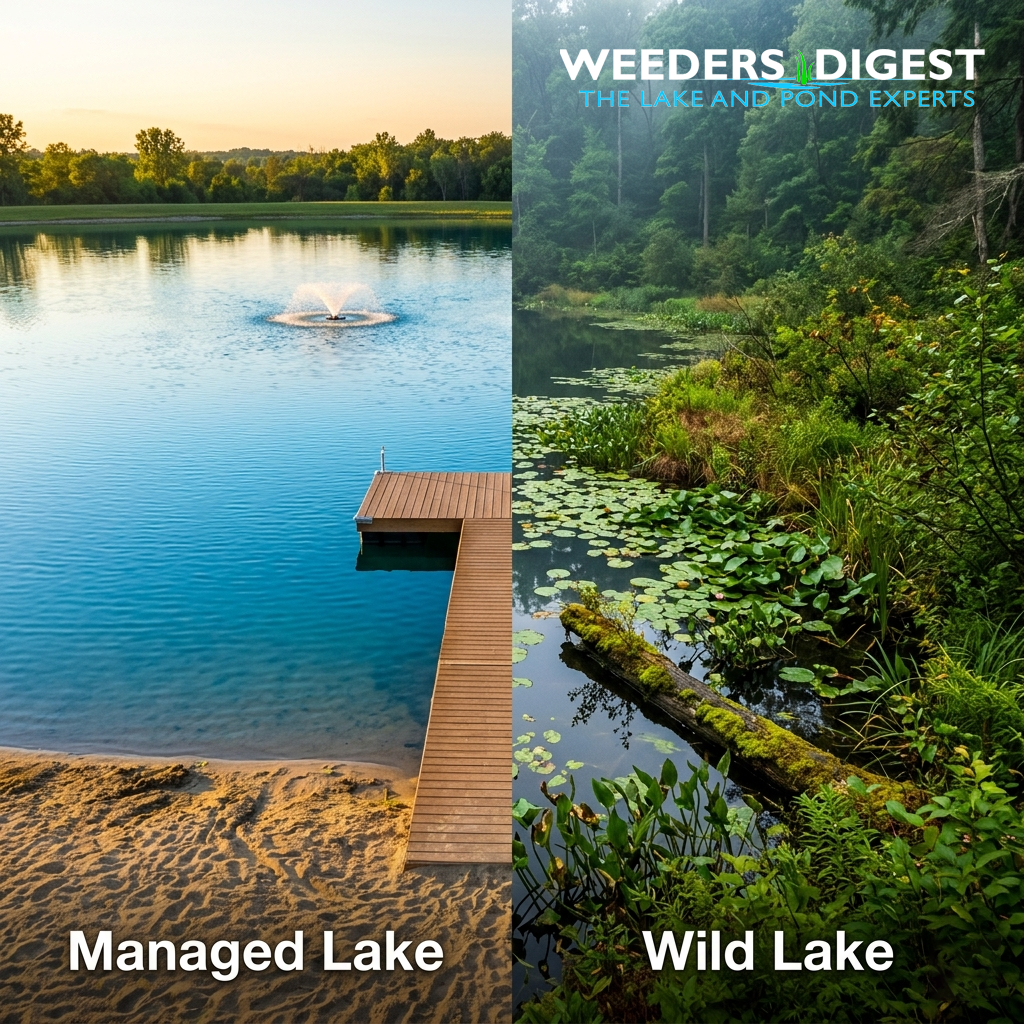
When you look out over a lake, you might see a pristine, manicured shoreline with active weed harvesting and fountain aerators, or you might see a tangle of lily pads, fallen timber, and murky depths. The reason one lake feels like a private park while another remains a rugged wilderness often comes down to the tug-of-war between human utility and natural succession. Lakes that are heavily managed by associations are typically those where property values and recreational access—like swimming, boating, and fishing—are the primary focus. These communities invest heavily to "pause" the natural aging process of the water body to keep it clear and navigable.
On the other hand, wild lakes are often left to their own devices because they lack the concentrated residential density required to fund expensive management programs. In many cases, these lakes are protected by state or federal conservation mandates that prioritize biodiversity over human convenience. In a wild lake, the accumulation of muck and the growth of native vegetation aren't seen as "problems" to be solved, but rather as essential components of a healthy, evolving ecosystem. The difference isn't just about who pays the bills; it’s about a fundamental choice between maintaining a functional backyard and preserving a changing landscape.
Understanding this divide helps us appreciate the complexity of our water resources. A managed lake offers a predictable, high-utility environment for families and enthusiasts, while a wild lake serves as a vital sanctuary for specialized flora and fauna. Neither is inherently better, but they represent two different philosophies of environmental stewardship. Whether a lake is buzzing with mechanical harvesters or silent under a canopy of overhanging trees depends on the historical development of the land and the collective goals of those who live along its shores.
The Science Behind It:
The distinction between managed and unmanaged aquatic systems is often defined by the acceleration of cultural eutrophication. Limnologically, all lakes are in a state of transition from open water to wetland, a process known as natural succession. In managed lakes, anthropogenic nutrient loading—often from lawn fertilizers, septic runoff, or urban stormwater—speeds up this process, leading to excessive primary production. Research from the University of Florida’s IFAS Extension suggests that when nutrient levels (specifically phosphorus and nitrogen) reach certain thresholds, the resulting biomass necessitates intervention to prevent the loss of open-water habitat and the onset of hypoxic conditions.
Management intensity is frequently a function of "Lakeshed" dynamics and the trophic state index (TSI). Associations often implement Integrated Pest Management (IPM) strategies to mitigate the proliferation of invasive macrophytes like Myriophyllum spicatum (Eurasian Watermilfoil). According to studies published in the Journal of Aquatic Plant Management, the presence of invasive species can outcompete native taxa, leading to a monoculture that disrupts the local food web. Managed lakes utilize physical, chemical, and biological controls to maintain a balanced ecosystem that can support both biodiversity and human recreation, effectively creating a "controlled state" of equilibrium.
In contrast, "wild" lakes often benefit from larger riparian buffer zones and lower catchment-to-surface-area ratios, which naturally limit nutrient influx. These systems are allowed to undergo the natural "aging" process, where organic matter accumulates on the benthic floor, eventually transitioning the lake into a bog or marsh over centuries. The ecological value of these unmanaged systems lies in their structural complexity. Fallen trees (coarse woody habitat) and dense littoral zones provide essential nesting sites and thermal refugia for fish and invertebrates that are often absent in highly managed, "clean" shorelines.
Furthermore, the legal and regulatory framework plays a decisive role in the management status of a water body. Many wild lakes are classified under specific conservation tiers that restrict the use of herbicides or mechanical dredging to protect "Outstanding Resource Waters." Peer-reviewed research in Ecological Applications indicates that unmanaged lakes often exhibit higher resilience to climate-induced stressors because their natural seed banks and nutrient cycles remain undisturbed. The decision to manage a lake is therefore an ecological trade-off: management preserves the current physical state for human utility, while non-management allows for the natural, albeit sometimes less "attractive," evolutionary trajectory of the aquatic environment.