


Understanding My Lake's Pulse: Why Water Levels Rise and Fall Over the Years
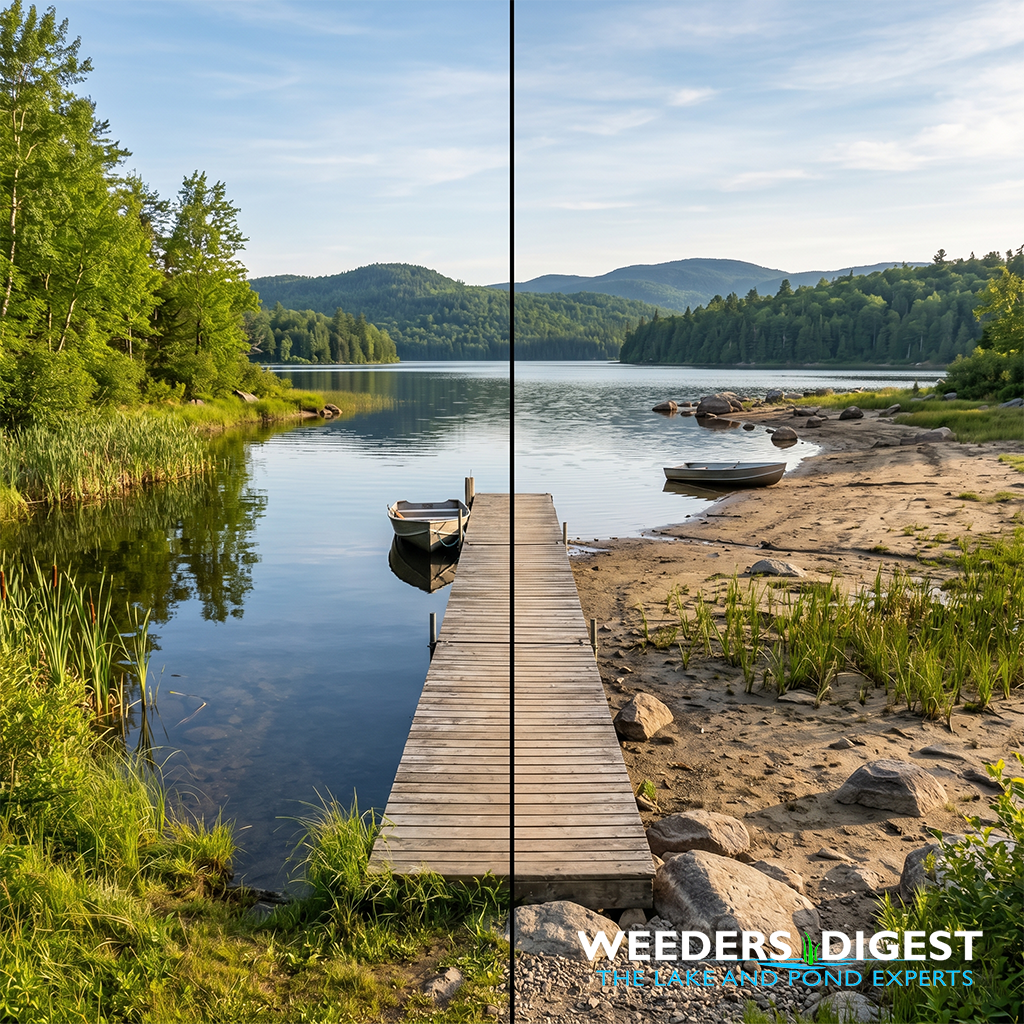

Summary:
If you have lived on a lake for a few years, you have likely noticed that the shoreline is a moving target. Some years, your dock might be nearly underwater, while others leave you with a wide, sandy beach and a long walk to the boat. It is easy to think of a lake as a permanent bowl of water, but in reality, it is a living, breathing system that responds to the environment around it. These changes are rarely the result of a single storm or a dry spell; rather, they are the visual record of how the earth is balancing its water budget over long periods of time.
Natural fluctuations are often driven by massive weather patterns that operate on a scale much larger than your local neighborhood. Think of it like a long-term savings account for water. During wet decades, the "deposits" from rain and snow exceed the "withdrawals" from evaporation and drainage. During dry decades, the opposite happens. Because lakes are connected to the groundwater beneath them, these levels don't just change based on what falls from the sky today, but also based on how saturated the earth has become over the last several years.
Many people worry that a receding shoreline means the lake is "dying," but these cycles are actually quite healthy for the ecosystem. When water levels drop, sunlight can reach the lake bed in areas that were previously too deep, allowing new aquatic plants to germinated and grow. When the water eventually returns, these plants provide essential habitat for fish and filtration for the water. Embracing these shifts is part of understanding the natural rhythm of your lake's life cycle.
While it might be frustrating to move your boat lift or adjust your dock, these decade-long shifts are a testament to the lake's resilience. Understanding that your lake is part of a complex global cycle helps take the mystery out of why the water isn't always where you expect it to be. It is a slow, steady dance between the atmosphere and the earth that has been occurring for thousands of years.
The Science Behind It:
Lake level variability is fundamentally governed by the hydrologic mass balance equation, where the change in storage is determined by the sum of precipitation, surface inflow, and groundwater inflow, minus the sum of evaporation, surface outflow, and groundwater seepage. On a decadal scale, these fluctuations are primarily influenced by large-scale ocean-atmosphere oscillations, such as the El Niño-Southern Oscillation (ENSO) or the North Atlantic Oscillation (NAO). These phenomena shift moisture transport patterns across continents, leading to multi-year periods of above- or below-average net basin supply.
The relationship between a lake and its surrounding aquifer plays a critical role in how these fluctuations manifest. Many natural lakes are "seepage lakes," meaning they lack significant surface inlets or outlets and are essentially windows into the water table. According to research on glacial terrain lakes, there is often a significant lag time between climatic shifts and the lake's response. This is due to the hydraulic conductivity of the surrounding soil; it can take months or years for increased precipitation to percolate through the unsaturated zone and raise the groundwater head enough to reflect a change in the lake’s surface elevation.
Evapotranspiration (ET) serves as the primary "withdrawal" mechanism during decadal droughts. In periods of increased solar radiation and higher average temperatures, the rate of latent heat flux increases, stripping moisture from both the lake surface and the surrounding catchment area. This creates a cumulative deficit. As noted in studies regarding the Great Lakes and similar inland bodies, even if seasonal precipitation remains steady, an increase in winter temperatures can prevent ice cover, leading to significantly higher evaporation rates during the colder months, further depressing water levels over a multi-year trajectory.
Furthermore, the morphometry of the lake basin dictates the visual severity of these fluctuations. In shallow, gently sloping basins, a minor vertical drop in the water table can result in a dramatic horizontal recession of the shoreline. From an ecological perspective, these fluctuations maintain the "pulse" of the littoral zone. Periodic exposure of the lake sediments, known as drawdown, facilitates the oxidation of organic matter and the compaction of sediments. This process, as documented in limnological literature, is vital for nutrient cycling and the maintenance of diverse plant communities, preventing the lake from reaching a state of stagnant senescence.