


Why Does the Air Suddenly Turn Cold? My Experience Boating Into Hidden Bays

Summary:
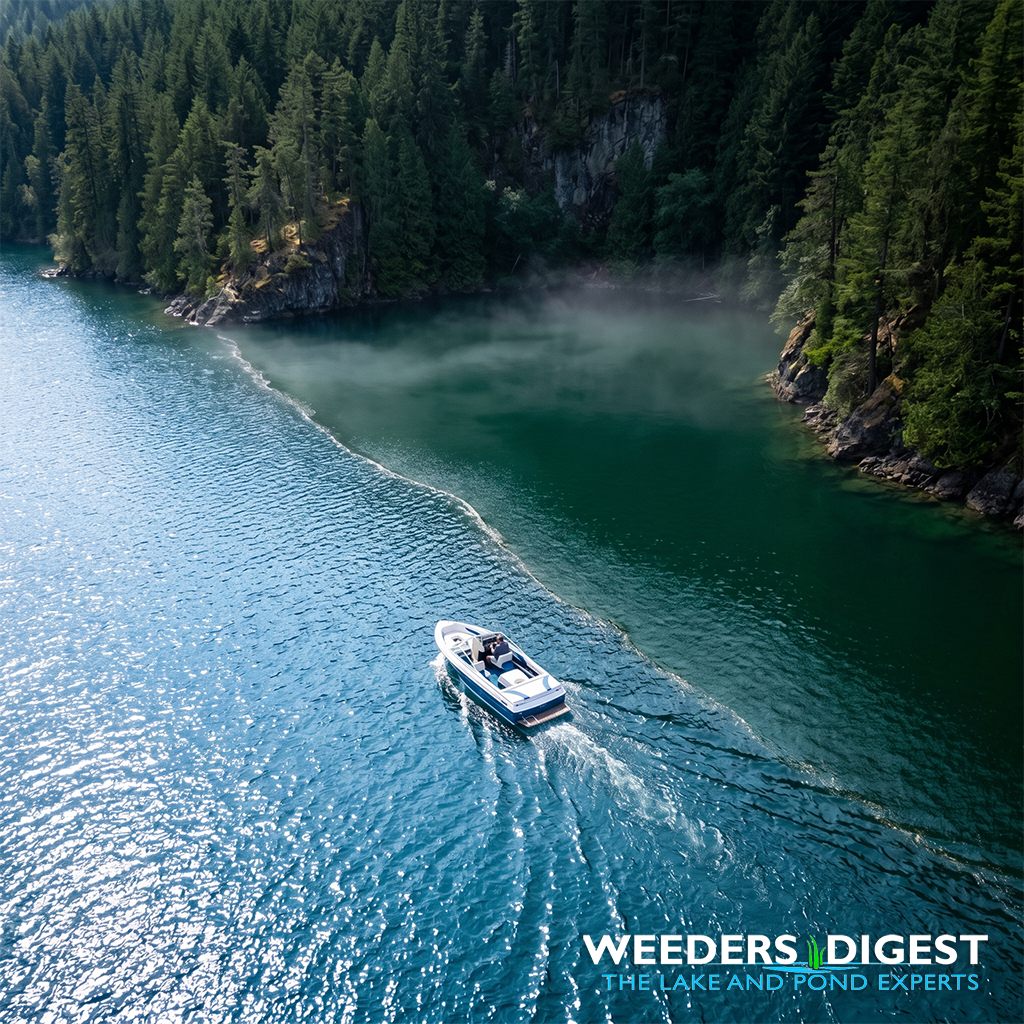
When you are out on the boat on a warm afternoon, the sun feels amazing and the air is thick with heat. But the moment you round a point and steer into a secluded bay, you might feel a sudden, sharp drop in temperature. It feels like someone just opened a giant refrigerator door right in front of your boat. This isn't just your imagination; it is a very real localized weather event that happens because of how differently water and land handle the sun's energy.
These "cold pockets" are usually caused by a combination of deep water holding onto the winter's chill and the way the surrounding landscape protects that air from mixing with the warmer breezes on the open lake. If the bay is surrounded by high bluffs or thick timber, it acts like a bowl that traps the heavy, cooled air right above the water's surface. As your boat moves from the agitated, mixed air of the main lake into this still sanctuary, you cross an invisible line into a microclimate.
Understanding these shifts is part of the magic of being on the water. It’s a reminder that a lake isn't just one big body of water, but a patchwork of different environments. These temperature changes can also tell you a lot about what is happening beneath your hull, as that cold air is often a direct reflection of the thermal layers hiding in the depths of the bay.
The Science Behind It:
The phenomenon of localized cooling in lacustrine environments is primarily driven by the high specific heat capacity of water and the development of a stable atmospheric boundary layer. Large bodies of water exhibit significant thermal inertia, heating and cooling much slower than the surrounding terrestrial landscape. According to research on lake-atmosphere interactions, during late spring and summer, the surface water in protected bays often remains significantly cooler than the ambient air temperature, especially if the bay is deep enough to maintain a stratified hypolimnion.
This temperature differential facilitates the formation of a "lake breeze" or a "marine inversion." As the sun warms the land surrounding the bay, the air over the shore rises due to convection. This creates a localized low-pressure zone that draws the denser, chilled air from the center of the lake or the shaded depths of the bay toward the shoreline. When a vessel enters a protected cove, it transitions from a well-mixed atmospheric environment into a stable air mass where the air directly in contact with the water has undergone sensible heat flux, losing its energy to the cooler water surface.
Furthermore, topographical shading and wind sheltering play critical roles in maintaining these cold updrafts. In a geomorphologically complex shoreline, high relief or dense canopy cover prevents solar radiation from reaching the water surface and blocks the kinetic energy of regional winds. Without wind to induce mechanical mixing, the air becomes stagnant and stratified. The air layer immediately above the water reaches a thermal equilibrium with the surface temperature, which may be $10^{\circ}C$ to $15^{\circ}C$ cooler than the air over the open water or land.
The "updraft" sensation reported by boaters is often a result of the boat’s own forward velocity piercing through a density gradient. As the boat moves from a warm, less dense air mass into a cold, high-density air mass, the sudden increase in air pressure and the lower kinetic energy of the molecules create a sharp sensory contrast. This is further exacerbated by the "cold pool" effect, where gravity causes cooled, heavy air to flow down neighboring hillsides and settle into the low-lying basin of the bay, a process known as catabatic flow.