

Why Does the Water Suddenly Get Freezing Past the Drop-Off in My Lake?
 |

Summary:
If you have ever been swimming in a lake on a hot summer afternoon, you have likely experienced that startling "shock" of cold water the moment you swim over the drop-off and into deeper territory. One moment you are basking in sun-warmed, bathtub-like water near the shore, and the next, your legs are dangling into a fridge-cold abyss. This sudden change isn't just in your head; it is a physical reality of how deep bodies of water manage heat.
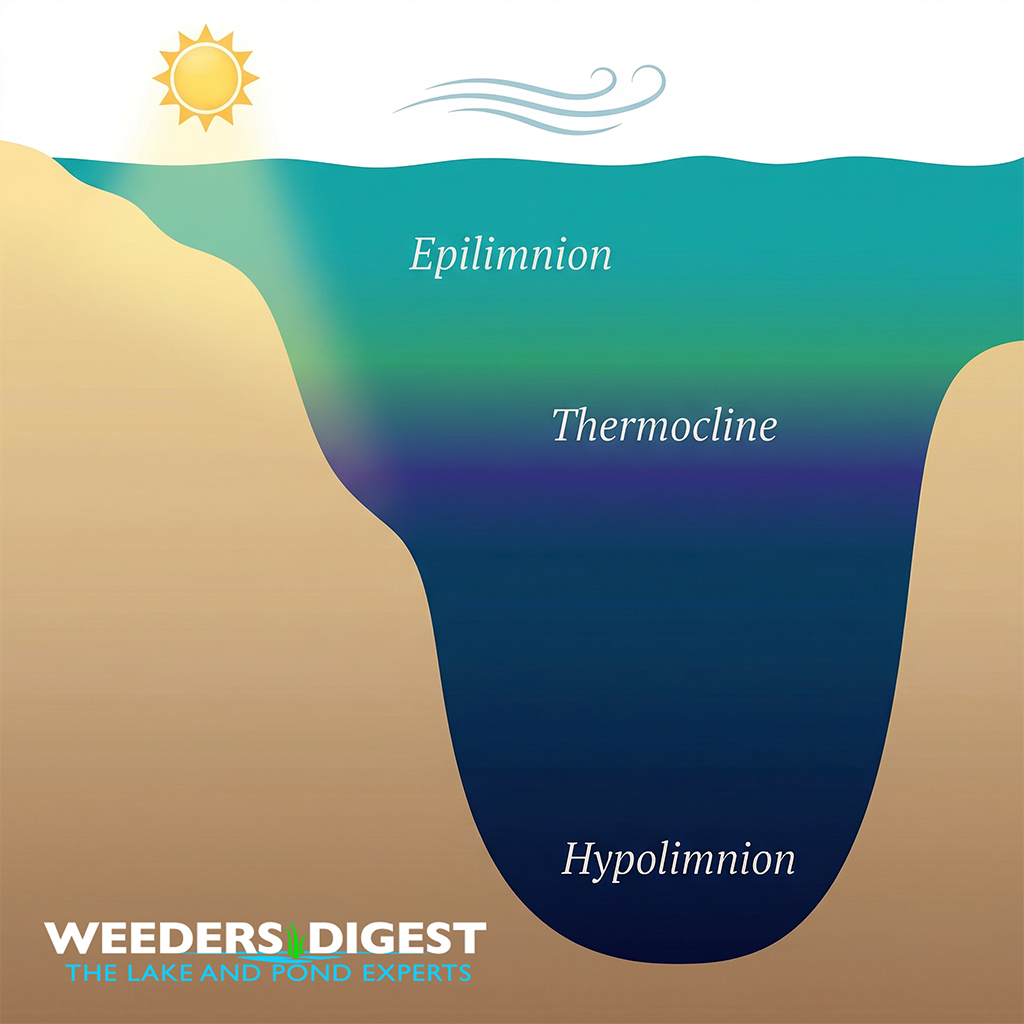
This phenomenon happens because water isn't very good at mixing itself without help from the wind. During the summer, the sun beats down on the surface, heating up the top layer of the lake. Because warm water is lighter and less dense than cold water, it floats on top like a warm blanket. This creates a distinct "invisible floor" between the cozy surface water and the icy depths below.
When you swim past the shallow shelf or "drop-off," you are moving into an area where the water is deep enough to support these separate layers. In the shallows, the sun can reach all the way to the bottom, keeping everything relatively uniform. But once you hit the deep end, you are floating directly above a massive reservoir of cold water that hasn't seen sunlight in months. Even a small kick downward can send your toes through that invisible floor into the cold zone.
Understanding this shift is a classic part of the lake experience. It is a sign of a healthy, "stratified" lake doing exactly what nature intended. While it might give you a quick shiver, that cold water is actually a vital refuge for many fish species that need to escape the summer heat just as much as we do.
The Science Behind It:
The sudden decrease in temperature encountered at a lake's drop-off is a manifestation of thermal stratification, a process governed by the unique density-temperature relationship of water. According to research from the University of Wisconsin-Madison’s Center for Limnology, temperate lakes undergo a seasonal cycle where the water column separates into three distinct layers: the epilimnion (warm surface layer), the metalimnion (transition layer), and the hypolimnion (cold bottom layer). This layering occurs because water reaches its maximum density at approximately 4°C, becoming increasingly buoyant as it warms above that point.
The "shock" a swimmer feels is specifically the result of encountering the thermocline, which is the plane of maximum temperature decrease within the metalimnion. In deep water, solar radiation is absorbed rapidly by the upper few meters of the water column. Because the warmed epilimnion is significantly less dense than the waters beneath it, it resists mixing with the deeper, heavier layers. Brönmark and Hansson (2017) note in The Biology of Lakes and Ponds that the density gradient acts as a physical barrier to vertical mixing, effectively isolating the hypolimnion from atmospheric heat exchange throughout the summer months.
In shallow areas near the shore—the littoral zone—the water is often too shallow for a true metalimnion to form. In these regions, wind-driven turbulence and wave action are sufficient to mix the entire water column from surface to sediment, maintaining a relatively homogenous, warm temperature. However, as the bathymetry dips sharply at the drop-off, the volume of water increases to a point where surface winds can no longer circulate the water to the bottom. This allows the colder, denser water to remain sequestered and undisturbed by the sun’s energy.
The steepness of the temperature change is often exacerbated by the clarity of the water. In oligotrophic (clear) lakes, light may penetrate deeper, pushing the thermocline further down, whereas in eutrophic (murky) lakes, heat is absorbed quickly at the surface, leading to a much shallower and more intense temperature spike. This physical stratification is not merely a temperature curiosity but a critical driver of dissolved oxygen levels and nutrient cycling within the lacustrine ecosystem.
Sources / References:
- University of Minnesota Extension: https://extension.umn.edu/lakes-and-wetlands/water-stratification-and-turnover
- Global Lake Ecological Observatory Network (GLEON): https://gleon.org/research/stratification