

Why I Swapped My Turf for Native Grasses to Save My Shoreline
 |

Summary:
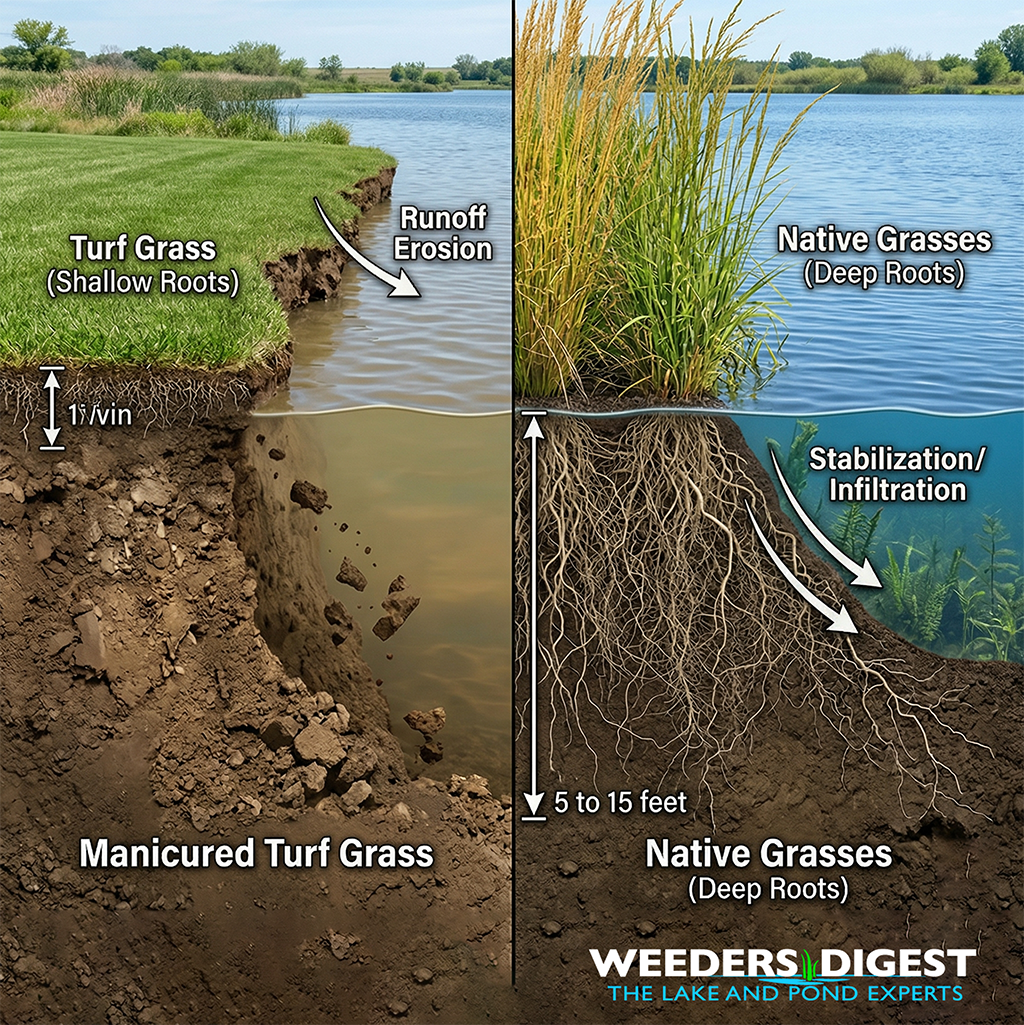
When you look at a typical manicured lawn extending right to the water's edge, it looks clean and orderly, but it is actually one of the most fragile landscapes you can have. I’ve seen countless shorelines crumble away because traditional turf grass, like Kentucky Bluegrass, simply isn't built for the job. Its roots are shallow—barely reaching a few inches deep—making it essentially a green carpet that can be easily peeled back by waves or heavy rain. When the soil underneath gets saturated, there is nothing holding it together, leading to those ugly vertical drops and lost land we call erosion.
Switching to deep-rooted native grasses changed everything for my property. These plants are the "rebar" of the shoreline. While turf grass is focused on looking pretty above ground, native species like Big Bluestem or Switchgrass spend their energy building massive underground networks. These roots act like a physical web, anchoring the soil in place and soaking up runoff before it can wash your shoreline into the lake. It’s a permanent, living solution that actually gets stronger over time, unlike stone walls that eventually crack or turf that simply washes away.
Beyond just holding the dirt in place, these native buffers act as a natural filter. Because their root systems are so extensive, they create channels in the soil that allow rainwater to sink in rather than shearing off the surface. This protects the water clarity of the pond or lake and keeps the shoreline stable even during the most intense spring thaws or summer storms. It is a shift from fighting nature with a lawnmower to partnering with it for a shoreline that stays put.
The Science Behind It:
The mechanical superiority of native riparian vegetation over Poa pratensis (Kentucky Bluegrass) lies in the architecture of the root-to-shoot ratio and the resulting soil shear strength. Research from university extensions, such as the University of Minnesota and Iowa State University, indicates that while typical turf grass roots seldom exceed 2 to 6 inches in depth, native prairie and wetland species frequently reach depths of 5 to 15 feet. This vertical penetration allows for the stabilization of various soil strata, effectively pinning the upper layers of topsoil to the more stable subsoil.
The stabilization process is driven by "root reinforcement," where the tensile strength of the roots increases the overall shear strength of the soil matrix. According to ecological studies published by the USDA Natural Resources Conservation Service, the fibrous root systems of species like Panicum virgatum (Switchgrass) create a dense subterranean web. This web increases the soil's resistance to the erosive forces of "overland flow" and "wave action." As water moves across the surface, the stiff stems of native grasses provide hydraulic roughness, slowing the velocity of the water and allowing for sediment deposition rather than detachment.
Furthermore, the presence of deep roots facilitates increased macroporosity within the soil profile. This improves the infiltration rate, which is the speed at which soil can absorb liquid. High infiltration rates reduce the volume of surface runoff—the primary driver of shoreline "sloughing." When soil becomes oversaturated without deep-rooted anchors, the weight of the water increases the gravitational stress on the bank, often exceeding the soil’s internal friction, leading to catastrophic bank failure. Native grasses mitigate this by transpiring large volumes of water and maintaining the structural integrity of the bank through biological binding.
The long-term efficacy of native buffers is also supported by their ability to adapt to fluctuating water levels, a common stressor in lacustrine environments. Unlike turf grass, which often enters dormancy or dies when submerged or subjected to drought, native shoreline species are evolved for the specific moisture gradients of the littoral zone. This ensures a perennial, self-healing barrier that maintains its ecological and mechanical functions throughout the seasons. The integration of these plants creates a "living shoreline" that outperforms "hard armoring" techniques by absorbing energy rather than reflecting it.
Sources / References:
- University of Minnesota Extension: https://extension.umn.edu/mshl/native-plants-shorelines
- Iowa State University - Science-based Trials of Rowcrops Integrated with Prairie Strips: https://www.nrcs.usda.gov/wps/portal/nrcs/detail/ia/newsroom/features/?cid=nrcseprd1333748