

Why My Backyard Dock is Rusting Faster Than Your Coastal Pier: The Freshwater Corrosion Mystery
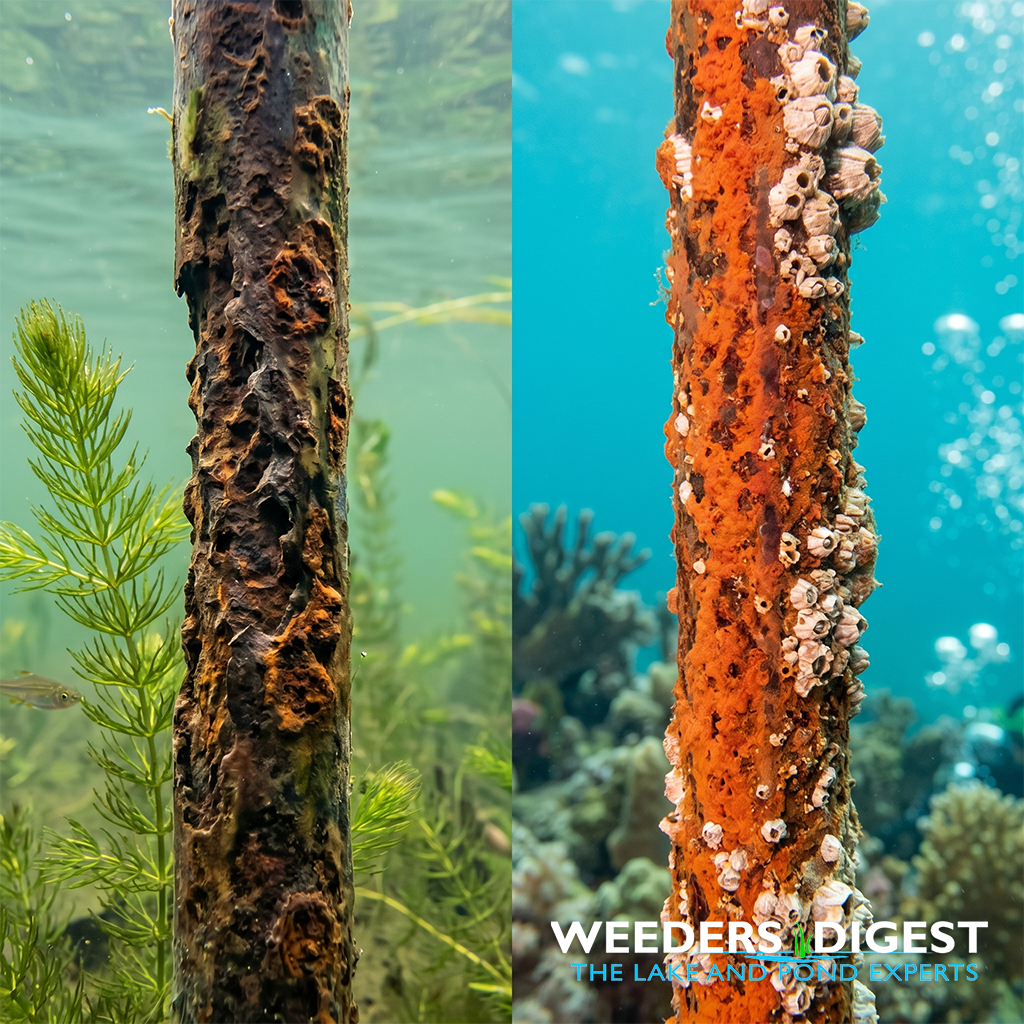 |

Summary:
If you have ever noticed that the metal ladder on your lake dock or the hardware on your pond’s fountain seems to "flake" or discolor differently than equipment at the beach, you aren't imagining things. While we often think of the ocean as the ultimate destroyer of metal due to its salt content, freshwater presents its own unique set of challenges that can catch a property owner off guard. In my experience, the way metal breaks down in a local pond is often more subtle and localized than the aggressive, uniform crusting we see in marine environments.
The main difference lies in how electricity moves through the water. Saltwater is a powerhouse of conductivity, allowing tiny electrical currents to flow easily across a metal surface, which usually leads to fast, widespread rusting. In your freshwater lake, the water doesn't conduct electricity nearly as well. This sounds like a good thing, but it actually means that corrosion often concentrates in one specific spot—like a bolt or a weld—leading to deep "pitting" that can cause a structure to fail unexpectedly even if most of the metal still looks shiny.
Furthermore, our local lakes and ponds are living, breathing ecosystems. The muck at the bottom of my pond is home to specific bacteria that actually "eat" or chemically alter metal in ways you don't typically see in the open ocean. These biological factors, combined with different oxygen levels at various depths, mean that managing freshwater equipment requires a completely different strategy than maintaining a seafaring vessel. Understanding these nuances is the first step in protecting your investment from the invisible chemistry happening right beneath the surface.
The Science Behind It:
The fundamental mechanism of metallic degradation in aquatic environments is electrochemical oxidation, commonly referred to as galvanic corrosion. This process requires an anode, a cathode, an electrolyte, and a return current path. In both freshwater and saltwater, the water acts as the electrolyte. However, the significantly higher ionic concentration in seawater—primarily sodium ($Na^+$) and chloride ($Cl^-$) ions—results in high electrical conductivity. According to research from the University of Wisconsin-Madison’s College of Engineering, this high conductivity facilitates a more uniform flow of electrons, which often results in general wasting, where the metal thins evenly across its entire submerged surface.
In freshwater systems, the lower concentration of dissolved ions results in high electrical resistivity. This resistance prevents the long-distance flow of galvanic currents, which paradoxically leads to more dangerous forms of localized corrosion. Because the electrolyte cannot distribute the "corrosive attack" evenly, the chemical energy concentrates on small sacrificial areas, such as scratches in a coating or heat-affected zones near welds. This phenomenon, known as pitting corrosion, can lead to rapid perforation of metal hulls or pipes. Research published in Corrosion Science indicates that in these low-conductivity environments, the "autocatalytic" nature of pits allows the chemistry inside the pit to become increasingly acidic, accelerating the metal loss internally while the exterior remains seemingly intact.
Biological factors also play a disproportionately large role in freshwater corrosion compared to the high-energy environments of the open sea. Microbiologically Influenced Corrosion (MIC) is prevalent in the stagnant, nutrient-rich benthic zones of lakes and ponds. Sulfate-reducing bacteria (SRB) thrive in anaerobic sediments, where they produce hydrogen sulfide as a metabolic byproduct. This gas reacts directly with iron to form iron sulfide, creating a distinct blackening of the metal and rapid localized decay. This biological pathway operates independently of the chloride-driven mechanisms dominant in marine settings.
Finally, the role of the "passive film"—a thin protective layer of oxide that forms naturally on metals like stainless steel—behaves differently across these two environments. In saltwater, chloride ions are notorious for penetrating and destroying this passive film, leading to rapid breakdown. In freshwater, the primary challenge to the passive layer is often the fluctuation of dissolved oxygen (DO) and pH. Changes in water chemistry, often driven by seasonal lake turnover or algal blooms, can destabilize these protective oxides. Consequently, while saltwater corrosion is often more predictable and linear, freshwater corrosion is highly variable, dictated by the specific limnological characteristics of the water body.