


Why My Beach is Covered in Foam: Is That Sea Suds or Something Worse?
 |

Summary:
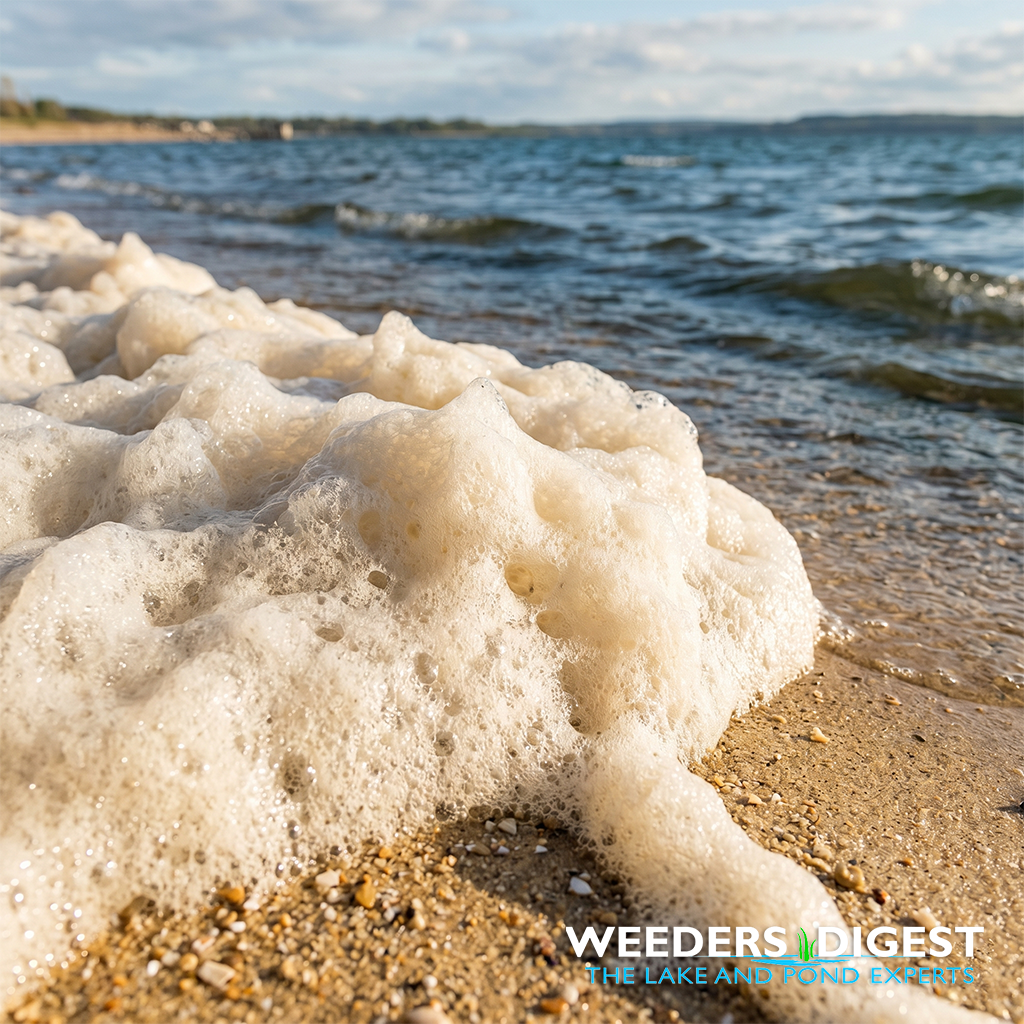
If you have ever walked down to your shoreline after a heavy storm or a particularly gusty afternoon, you might have been startled to find thick, white clumps of foam piled up against the sand. At first glance, it looks like someone dumped a giant bottle of dish soap into the water, or perhaps a localized pollution spill has occurred. It is a common concern for many of my fellow lakefront owners who worry about the health of their water and whether it is safe for their families to swim in.
The good news is that in the vast majority of cases, this foam is a perfectly natural phenomenon and actually a sign of a highly productive ecosystem. It isn't man-made soap at all; it is a result of the lake’s own "organic plumbing." When plants, algae, and fish die and decompose, they release natural oils and proteins into the water. Normally, you can’t see these substances because they are dissolved, but a steady wind acts like a giant kitchen whisk, whipping the surface of the lake and trapping air into these organic compounds.
Think of it like making a meringue out of egg whites. The proteins in the water act as the "glue" that holds the air bubbles together, creating that frothy, sudsy texture. While it might look a bit messy or even have a slightly earthy or fishy smell, this foam is usually harmless. It tends to accumulate on the "lee" side of the lake where the wind pushes it into small coves or onto the beach, where it eventually dries up and disappears as the wind dies down.
The Science Behind It:
The formation of foam on freshwater and marine shorelines is primarily driven by the presence of dissolved organic compounds (DOCs) that act as surfactants. Surfactants, or surface-active agents, are molecules that possess both a hydrophilic (water-attracting) head and a hydrophobic (water-repelling) tail. According to research from the Michigan State University Extension, these organic surfactants are typically composed of lignins, carbohydrates, and proteins derived from the breakdown of aquatic vegetation, algae, and terrestrial leaf litter.
When these DOCs are present in sufficient concentrations, they reduce the surface tension of the water. Surface tension is the cohesive force that holds water molecules together at the air-water interface. By intercalating between water molecules, these natural surfactants weaken those cohesive bonds. As wind-driven waves break or whitecaps form, air is mechanically injected into the water column. In pure water, these bubbles would rise and burst instantly due to high surface tension; however, in the presence of surfactants, the hydrophobic tails of the organic molecules align toward the air inside the bubble, creating a protective film that stabilizes the bubble and prevents it from popping.
The physical accumulation of foam is a result of Langmuir circulation and wind-induced transport. Strong, sustained winds create surface currents that move these stabilized bubbles toward the shore. In many lake environments, the foam is often enriched with microscopic particles, such as phytoplankton or silt, which can give the foam a brownish or off-white tint. Research published in Limnology and Oceanography suggests that while most foam is benign, it can occasionally concentrate natural toxins or bacteria if an active harmful algal bloom (HAB) is present; however, the foam itself is a physical byproduct of turbulence rather than a chemical pollutant.
The persistence of the foam depends on the concentration of the DOCs and the atmospheric conditions. High humidity and low temperatures can extend the "life" of the foam bubbles by slowing the evaporation of the water film surrounding the air. As the wind subsides and the water becomes stagnant, the mechanical energy required to sustain the bubble structures diminishes, leading to the eventual collapse of the foam. This process returns the organic matter to the littoral zone, where it is further broken down by microbial activity.
Sources / References:
- Michigan State University Extension: Natural Foam on Water
- Wisconsin Department of Natural Resources: Foam on Lakes and Rivers