


Why My Favorite Bass Always Hide in Submerged Logs: The Secrets of Woody Cover
 |
Summary:
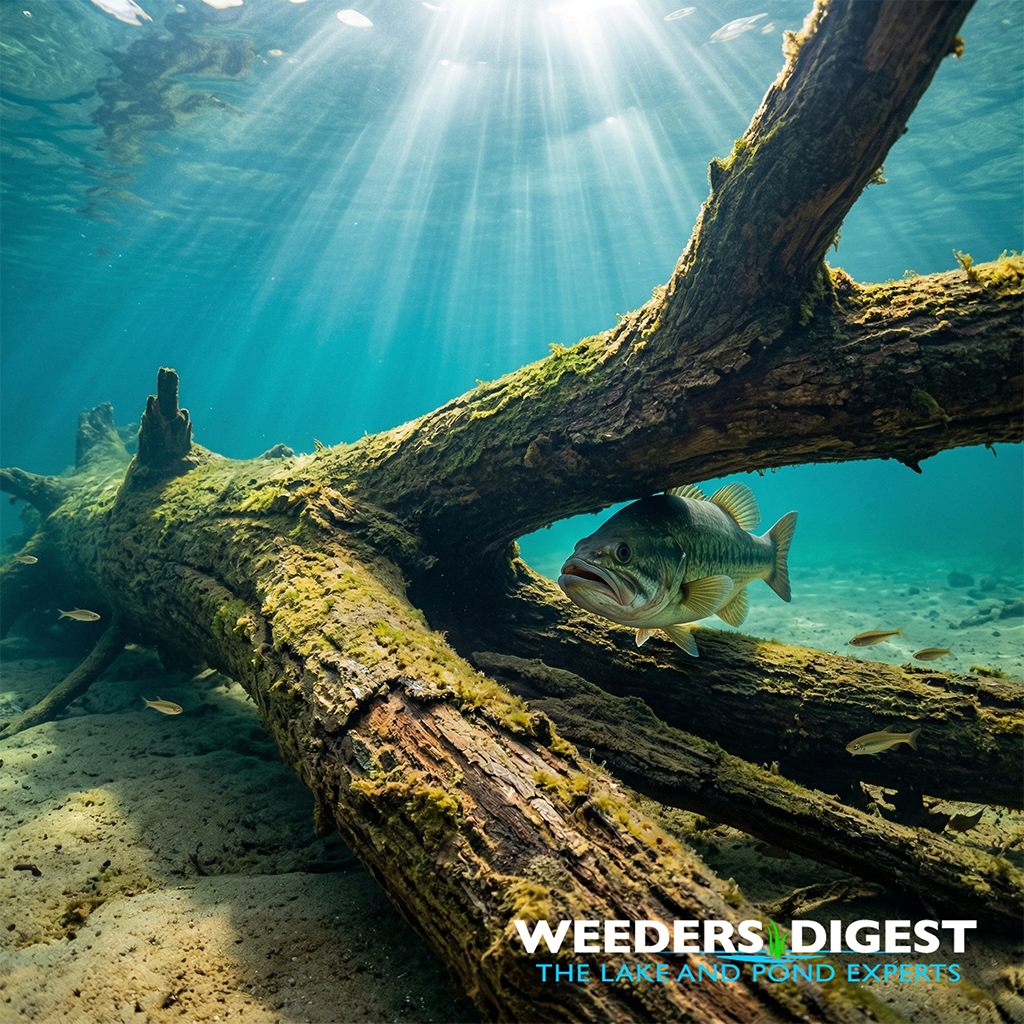
If you have ever spent a day on the water, you know that a fallen tree or a submerged log is like a magnet for largemouth bass. To the casual observer, it just looks like a piece of debris, but to a bass, it is the equivalent of a luxury apartment complex. These structures provide the perfect combination of shade, protection, and a prime hunting ground. Bass are ambush predators, meaning they prefer to sit still and wait for a meal to swim by rather than chasing prey across open water. A log provides the perfect "blind" for them to tuck into, remaining invisible to unsuspecting minnows or crawfish.
The structure of a log is also a foundational piece of the pond's food web. It isn't just about the fish; it’s about what grows on the wood. Within days of a tree falling into the water, a slimy layer of algae and microorganisms begins to coat the surface. This attracts small insects and baitfish, which in turn attracts the larger predators we love to catch. When I look at a submerged log, I don't just see a snag for my lure; I see a self-sustaining ecosystem that provides everything a bass needs to thrive.
Furthermore, these logs offer vital thermal regulation and physical security. In the heat of the summer, the shade provided by a thick trunk can keep the water slightly cooler and shield the fish from the intense ultraviolet rays of the sun. It also offers a physical barrier against larger predators like ospreys or herons. For a bass, a well-positioned log is more than just a home; it is a strategic stronghold that maximizes their energy efficiency and survival.
The Science Behind It:
The ecological importance of submerged aquatic vegetation and coarse woody habitat (CWH) is well-documented in limnology. When a tree enters the littoral zone of a lake, it undergoes a colonization process by periphyton—a complex mixture of algae, cyanobacteria, heterotrophic microbes, and detritus. According to research published in North American Journal of Fisheries Management, CWH significantly increases the surface area available for macroinvertebrate colonization, which serves as the primary caloric engine for the localized food web. This increased density of prey species creates a high-energy foraging patch that attracts Micropterus salmoides (largemouth bass).
From a physiological standpoint, bass utilize these structures to minimize their standard metabolic rate (SMR). As sit-and-wait predators, bass rely on "visual isolation" and "flow refraction." The physical geometry of a log creates areas of reduced water velocity and complex shadows. This allow the bass to remain nearly iridescently camouflaged while maintaining a state of low-energy expenditure. Scientific observations in Transactions of the American Fisheries Society indicate that bass situated within complex woody structures exhibit lower stress levels and higher growth rates compared to those in barren environments, likely due to reduced predator-avoidance behavior and increased foraging efficiency.
The structural complexity of the log, including the interstitial spaces between branches and the main bole, provides critical "edge effects." These edges act as transitional zones where different ecological processes meet. Bass exploit these boundaries to remain in the "dark" interior of the structure while peering out into the "light" open water. This light intensity gradient gives the bass a distinct visual advantage, as their ocular physiology is finely tuned to detect movement against a brighter background while they remain obscured in the shadows.
Furthermore, the decay process of the wood contributes to the chemical and physical heterogeneity of the benthic environment. As the wood slowly breaks down, it releases organic carbon and creates micro-topography on the lake floor. Research suggests that the presence of CWH is a primary determinant in the recruitment success of juvenile bass, providing a "nursery" effect that protects smaller fish from cannibalism by larger conspecifics. The log is not merely a static object but a dynamic biological hub that influences the spatial distribution and population dynamics of the entire aquatic community.