


Why My Favorite Beach Has Smooth Pebbles While Yours Has Jagged Rocks
 |

Summary:
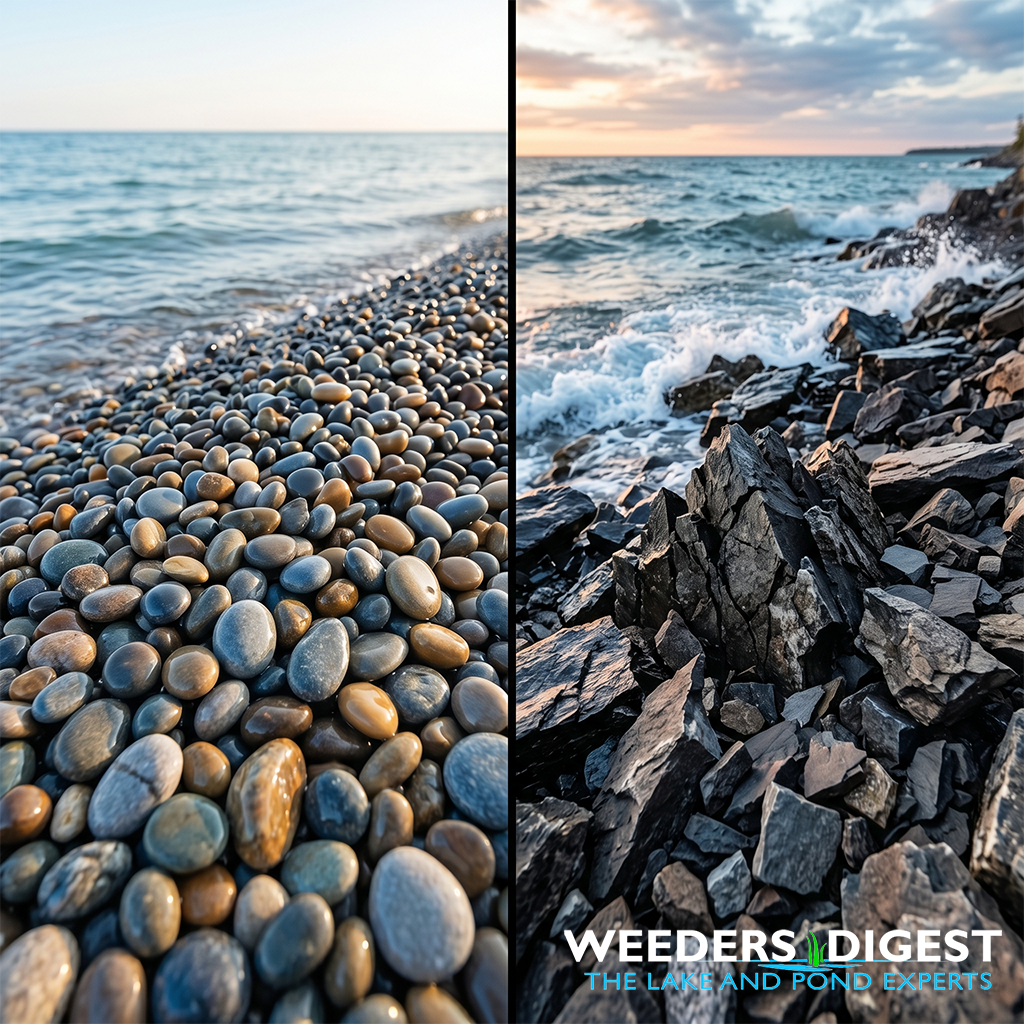
Have you ever wondered why some shorelines feel like a spa for your feet with perfectly rounded, silky-smooth stones, while other beaches require sturdy water shoes to navigate sharp, jagged rocks? It often feels like a roll of the dice by Mother Nature, but the texture of a beach is actually a living record of time, energy, and the specific history of that shoreline. When I walk along a smooth pebble beach, I am looking at a geological "finishing school" where the water has spent centuries refining the rough edges of the earth.
The secret lies in the constant motion of the water. On beaches with smooth stones, the waves are acting like a massive, natural rock tumbler. As waves crash into the shore, they pick up stones and slam them against one another. This constant friction wears down the sharp corners and flat faces of the rocks until they become rounded. If you find yourself on a beach with jagged stones, it usually means the rocks are "newcomers" to the water. Perhaps they recently fell from a nearby cliff or were deposited there by a storm, and the lake or ocean simply hasn't had enough time to polish them yet.
Another factor is the energy of the environment. High-energy beaches with powerful, consistent waves process stones much faster than quiet, sheltered ponds. The type of rock matters too; a soft limestone will become a smooth "worry stone" much faster than a stubborn, hard granite. Understanding this helps us appreciate that a beach isn't just a pile of rocks—it is a snapshot of a process that has been happening for thousands of years.
The Science Behind It:
The transition from angular fragments to rounded clasts is a process known in geomorphology as attrition. This mechanical weathering occurs when particles in transport collide with one another and the substrate, resulting in the removal of surface irregularities. According to research on coastal sedimentology, the rate of rounding is primarily a function of the lithology of the parent material and the hydrodynamic energy of the shoreline. Harder rocks with high quartz content resist abrasion longer than softer sedimentary rocks, which exhibit rapid mass loss and rounding under similar wave conditions (Lorang & Komar, 2024).
The shape of a beach stone is often categorized by its sphericity and roundness. Initial fragmentation, often caused by mass wasting or glacial deposition, produces rocks with high angularity. Once these rocks enter the swash zone—the area where waves break and run up the beach—they are subjected to constant saltation and traction. The kinetic energy of the water forces clasts to slide and roll, a process that focuses erosive pressure on the protruding edges. This "rounding" happens exponentially faster at the beginning of the process when the edges are sharpest, eventually slowing as the stone approaches an ellipsoidal or spherical form.
Environmental factors such as the "sorting" of the beach also play a role in the final texture of the stones. In a well-sorted environment, rocks of similar sizes strike each other with consistent force, leading to uniform smoothing. Conversely, in environments where large boulders are mixed with fine gravel, the smaller stones may be crushed or shielded, leading to a more heterogeneous mix of shapes. Research published in the Journal of Coastal Research indicates that the slope of the beach (beach face gradient) influences the velocity of the backwash, which is a critical driver in the abrasive "grinding" action that polishes stones.
Furthermore, the duration of exposure to hydraulic action is the primary differentiator between jagged and smooth shorelines. Geologically "young" beaches, such as those formed by recent volcanic activity or tectonic shifts, lack the temporal depth required for significant attrition. In contrast, "mature" beaches have been subjected to thousands of years of wave-driven abrasion. In lacustrine environments, such as the Great Lakes, the seasonal impact of ice-push can also play a role, occasionally introducing "fresh," angular material into a previously smoothed system, creating a seasonal cycle of textural variation.