

Why My Favorite Skipping Stone Creates Ripples That Reach Your Entire Shoreline

Summary:
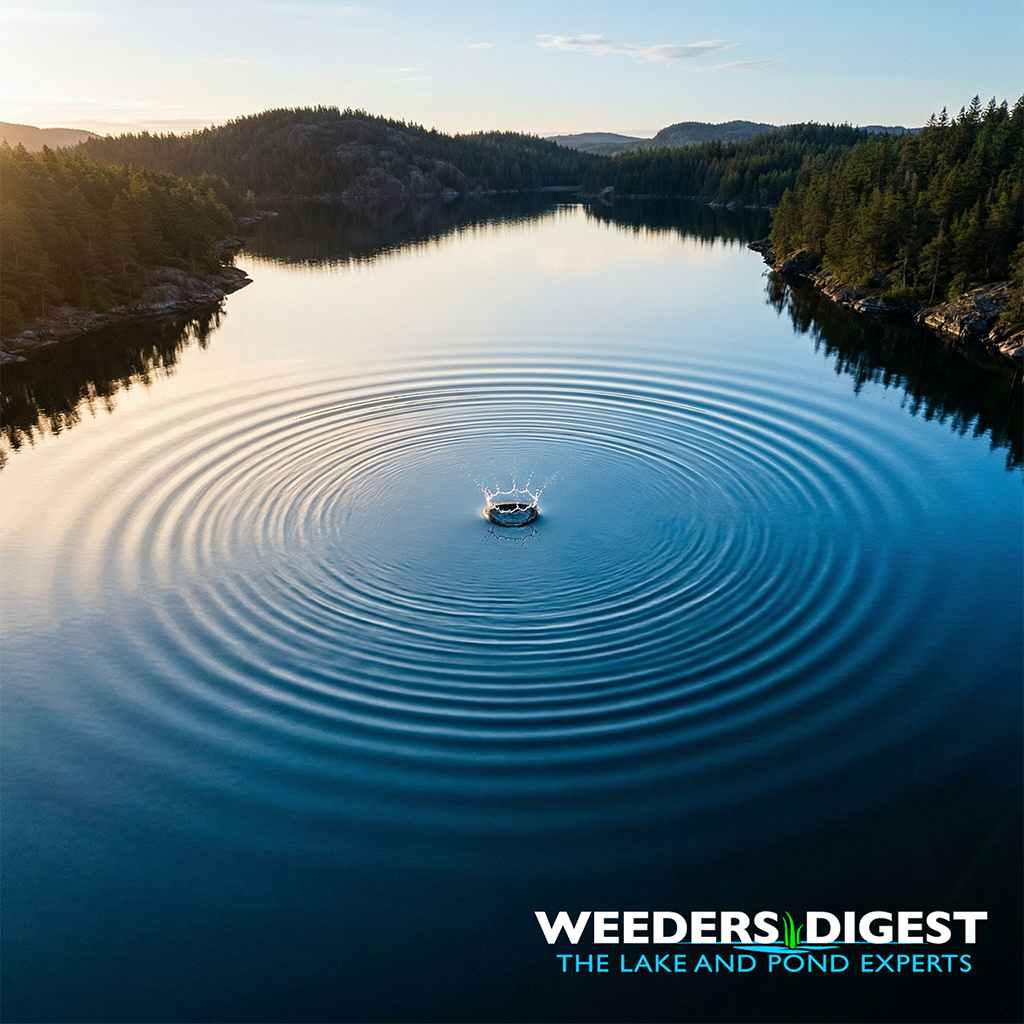
When I toss a rock into the water, I’m doing more than just making a splash; I am initiating a transfer of energy that travels much further than the eye initially perceives. The "plop" you hear is the sound of a stone displacing water, pushing it out of the way to create a momentary void. As the water rushes back in to fill that hole, it overshoots the level surface, bobbing up and down like a liquid spring. This vertical movement creates the first circular wave, which then sets off a chain reaction across the surface of the bay.
You might notice that the ripples seem to get smaller as they move away from the center, but the energy doesn't just vanish. It spreads out in ever-widening circles, traveling across the surface of the bay until it encounters an obstacle or the shoreline. Even if the visible wave looks tiny by the time it reaches the far side, the kinetic energy I started with has successfully navigated the distance, moving through the water molecules without actually dragging the water itself along with it.
It is helpful to think of the water's surface like a tight trampoline. When I drop a weight in the middle, the fabric bounces. That bounce sends a pulse through the material to the edges. In a calm bay, there is very little friction to stop this pulse, allowing those delicate rings to glide gracefully across the mirror-like surface until they gently lap against the distant sand.
The Science Behind It:
The phenomenon of a ripple traveling across a body of water is defined by the physics of surface gravity waves. When a solid object enters the water, it introduces kinetic energy that creates a localized disturbance in the hydrostatic equilibrium. This disturbance manifests as a "capillary wave" initially, where surface tension acts as the primary restoring force. However, as the scale of the disturbance increases, gravity becomes the dominant force attempting to return the water to its original level state. According to research on fluid dynamics, the propagation of these waves is a result of the oscillation of water particles in circular or elliptical orbits, rather than the lateral transport of the water itself.
As the wave moves outward, it undergoes a process known as geometric spreading. The energy density of the wave decreases because the circumference of the wave front—calculated as $C = 2\pi r$—increases as the radius $r$ expands. While the total energy remains relatively constant (minus minor losses to internal friction and viscosity), it must be distributed over a larger area, which explains why the amplitude, or height, of the ripple diminishes as it nears the far side of a bay. The velocity at which these ripples travel, known as phase speed, is influenced by the wavelength and the depth of the water, though in the context of surface ripples, the relationship is primarily governed by the balance between gravitational pull and the inertia of the fluid.
In a controlled environment or a calm bay, the attenuation of these waves is remarkably low. Water has a relatively low viscosity, meaning there is minimal internal resistance to the wave's motion. This allows the transverse wave to maintain its momentum over significant distances. The interaction between the crests (high points) and troughs (low points) creates the visible pattern of concentric circles. These circles represent the wave front moving through the medium of the water, utilizing the hydrogen bonding of water molecules to pass the energy pulse from one molecule to the next.
Research published in various geophysical journals highlights that the persistence of these ripples is also dependent on the absence of destructive interference. In a bay with high winds or significant boat traffic, the organized energy of a single rock splash would be quickly dissipated by larger, chaotic wave actions. However, in a quiescent limnological setting, the harmonic motion of the initial splash creates a clean signal. This signal propagates until it reaches a boundary layer, such as a shoreline, where the energy is finally absorbed or reflected, completing the journey of the initial kinetic input across the aquatic landscape.