


Why My Favorite Swimming Spots Are Overrun While Other Weeds Simply Vanish in Mid-Summer
 |

Summary:
If you have ever noticed a sudden, mysterious "die-off" of aquatic plants in your pond during the heat of July, you aren't imagining things. It can be incredibly frustrating to watch one area of your shoreline clear up naturally while another spot becomes a tangled mess of green slime and dense stalks. This mid-summer disappearing act usually isn't due to a lack of nutrients or poor water quality; rather, it is the result of the specific life cycles of the plants living in your water.
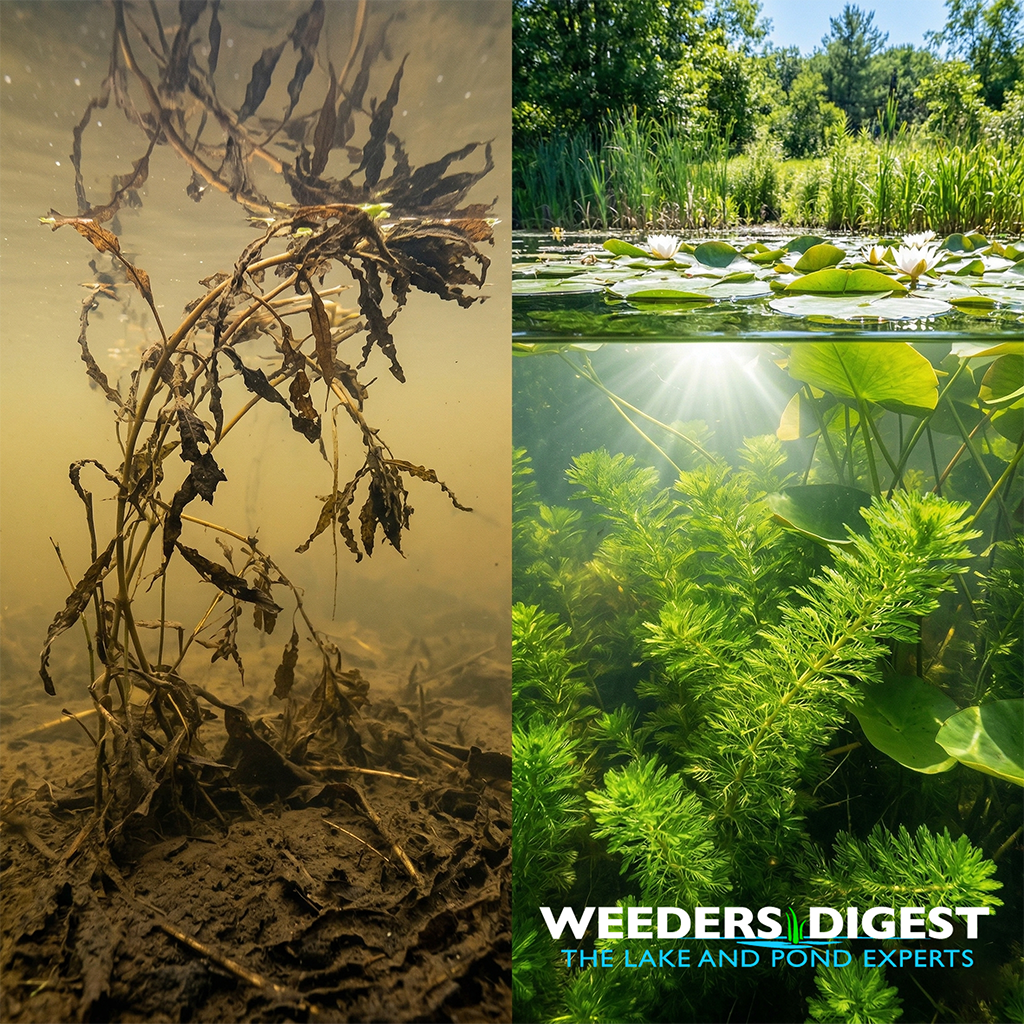
Some of the most common invasive species, like Curly-leaf Pondweed, are actually "cool-weather" plants. They do most of their growing in the spring and are genetically programmed to shut down and drop to the pond floor once the water temperature hits a certain threshold. While it feels like a win to see them turn brown and sink, this process actually releases a massive pulse of nutrients back into the water, which often fuels the next wave of growth.
On the flip side, the weeds that flourish when the sun is at its peak are the true heat-lovers. These species, such as Eurasian Watermilfoil or various types of Algae, have evolved to thrive in warm, stagnant water and high-intensity sunlight. While the spring plants are checking out for the season, these summer giants are just getting started, taking advantage of the space and food left behind by the dying weeds.
Understanding this transition is key to managing your water effectively. It is a biological hand-off where the "relay race" of the pond ecosystem moves from one species to the next. Knowing which plants are in your "lane" helps explain why your pond looks like a pristine pool one week and a swamp the next.
The Science Behind It:
The phenological divergence observed in mid-summer aquatic ecosystems is primarily driven by the metabolic requirements and reproductive strategies of specific macrophytes. A primary example of the mid-summer die-off phenomenon is Potamogeton crispus (Curly-leaf Pondweed). Unlike many native North American species, P. crispus exhibits a distinct life cycle where germination occurs in late autumn or under ice, allowing it to reach peak biomass in late spring. According to research from the University of Minnesota Extension, this species undergoes senescence—the biological process of aging and death—once water temperatures consistently exceed 25°C (77°F). This mass senescence is a survival mechanism, as the plant produces turions (specialized overwintering buds) that settle into the benthos to await cooler temperatures.
The sudden decomposition of P. crispus and similar early-season species triggers a significant biochemical shift in the water column. As the vegetative matter breaks down, microbial respiration increases, often leading to localized hypoxic conditions. More importantly, this process releases significant concentrations of bioavailable phosphorus and nitrogen that were previously sequestered in the plant tissue. Research published in the Journal of Aquatic Plant Management indicates that this internal nutrient loading often facilitates a "secondary bloom" of species with higher thermal tolerances, such as Myriophyllum spicatum (Eurasian Watermilfoil) or filamentous algae.
Species that flourish during the mid-summer heat are often characterized by high photosynthetic efficiency under high irradiance and low dissolved carbon dioxide levels. Myriophyllum spicatum, for instance, utilizes an expansive canopy-forming growth habit that allows it to capture maximum solar energy at the water's surface while shaded lower sections of the water column are neglected. These heat-tolerant species often possess specialized physiological adaptations, such as the ability to utilize bicarbonate as a carbon source when aqueous $CO_2$ is depleted by high primary productivity.
The environmental "tipping point" in mid-summer is further exacerbated by thermal stratification. In many lentic systems, the surface water (epilimnion) becomes significantly warmer and less dense than the bottom water (hypolimnion). This prevents vertical mixing, trapping the nutrients released by decaying spring plants in the upper, sunlit layers where heat-loving weeds and cyanobacteria can exploit them. Consequently, the transition from brown, dying weeds to flourishing green mats is a predictable ecological succession dictated by thermobiology and nutrient cycling.
Sources / References:
- https://extension.umn.edu/identify-invasive-species/curly-leaf-pondweed
- https://www.apms.org/journal/ (The Journal of Aquatic Plant Management)