

Why My Lake Looks Like It’s on Steroids: The Truth About Nutrient Runoff
 |

Summary:
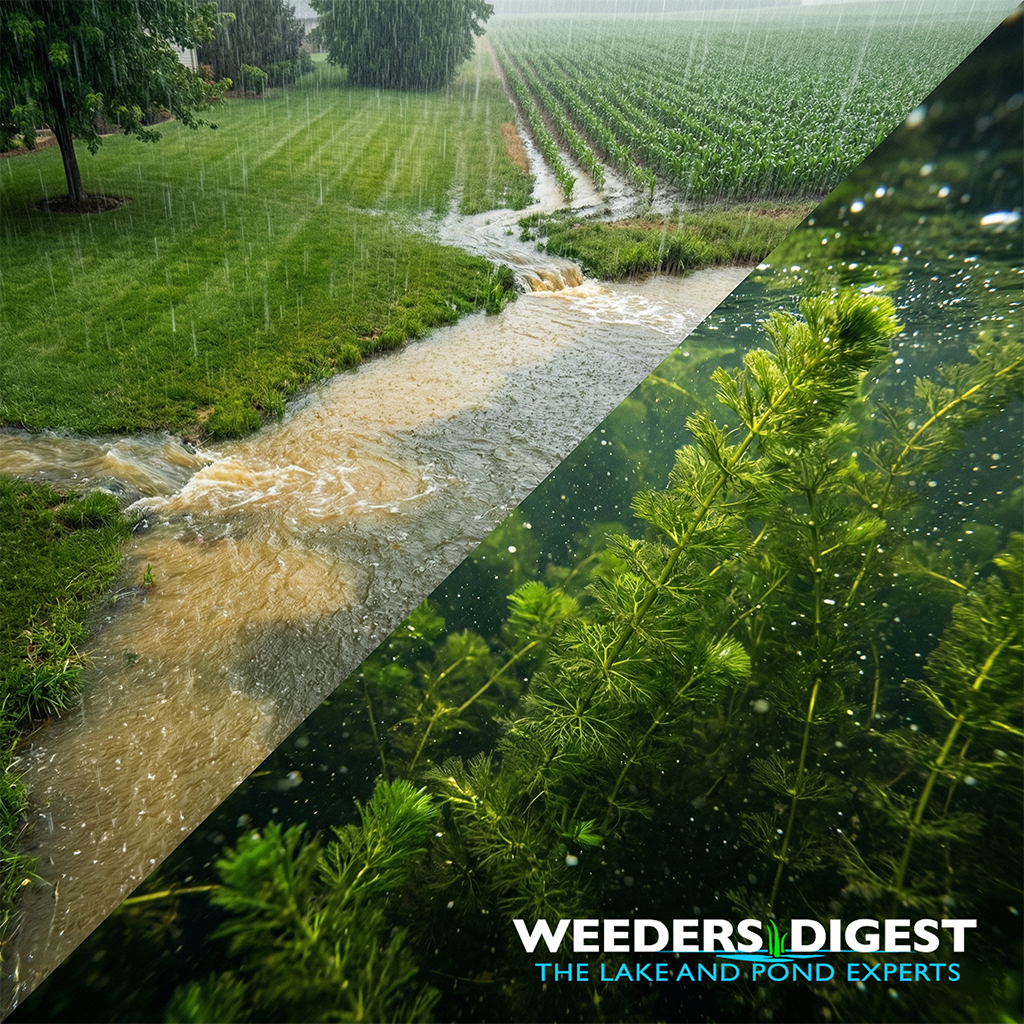
If you have noticed your lake or pond transforming from a clear swimming hole into a thick, green soup of weeds and algae, you are essentially witnessing a biological growth spurt. While we often think of "runoff" as just extra water from a rainstorm, it is actually a delivery system for high-powered fertilizers. Phosphorus and nitrogen, which are commonly found in lawn fertilizers, agricultural fields, and even pet waste, act like a massive dose of vitamins for aquatic plants.
Think of these nutrients as the fuel that drives an engine. In a healthy lake, the engine idles at a steady, manageable pace. However, when heavy rains wash nitrogen and phosphorus into the water, it is like flopping the gas pedal to the floor. The weeds aren't just growing; they are hyper-accelerated. This process can happen so fast that native plants and fish cannot keep up, leading to a crowded, murky environment that makes it nearly impossible to enjoy your waterfront.
Understanding this "steroid" effect is the first step in reclaiming your shoreline. When we manage the land around our water, we are directly controlling the diet of the lake. By reducing the amount of "junk food" entering the system, we can help the water return to its natural, balanced state rather than allowing it to be dominated by aggressive, nutrient-hungry weeds.
The Science Behind It:
The accelerated growth of macrophytes and phytoplankton in freshwater systems is primarily governed by the principles of limiting nutrients. In most freshwater ecosystems, phosphorus ($P$) is the primary limiting nutrient, meaning its scarcity keeps plant growth in check. When anthropogenic runoff introduces high concentrations of bioavailable phosphorus (orthophosphates) and nitrogen ($N$), it circumvents the natural constraints of the ecosystem, triggering a phenomenon known as cultural eutrophication. This influx acts as a catalyst for rapid biomass production, significantly altering the trophic state of the water body.
Nitrogen and phosphorus function at the cellular level to facilitate different growth mechanisms. Nitrogen is a fundamental component of chlorophyll, the compound plants use for photosynthesis, and is a building block for amino acids and proteins. Phosphorus is essential for energy transfer in the form of Adenosine Triphosphate ($ATP$) and is a structural component of $DNA$ and $RNA$. According to research published by the University of Florida’s IFAS Extension, when these nutrients are available in excess, aquatic plants can bypass their normal seasonal growth cycles and achieve "luxury consumption," where they store excess phosphorus for future use, fueling even more aggressive expansion.
The interaction between these two nutrients is often measured by the $N:P$ ratio. While nitrogen is vital, phosphorus is frequently the "on-switch" for massive blooms. Research from the Journal of Freshwater Ecology indicates that even minute increases in phosphorus can result in a disproportionate increase in plant biomass. This is because many invasive species, such as Eurasian Watermilfoil (Myriophyllum spicatum), have evolved to thrive in high-nutrient environments, outcompeting native flora that are adapted to lower nutrient levels.
Furthermore, this "steroid" effect creates a feedback loop within the benthos, or the lake bottom. As the massive surge of weeds eventually dies off, their decomposition consumes dissolved oxygen ($DO$) and releases stored nutrients back into the water column. This internal loading ensures that even if external runoff is halted, the lake may continue to struggle with hyper-growth for years. The chemical synergy between runoff and aquatic biology effectively shifts the lake from a clear-water state to a turbid, weed-dominated state that is difficult to reverse without significant intervention.
Sources / References:
- University of Florida IFAS: Understanding Trophic State Indices and Phosphorus Loading
- Journal of Ecology & Natural Resources: Impact of Nitrogen and Phosphorus on Aquatic Plant Growth