

Why My Local Pond’s Water Striders Never Sink: The Secret to Their Aquatic Acrobatics
 |

Summary:
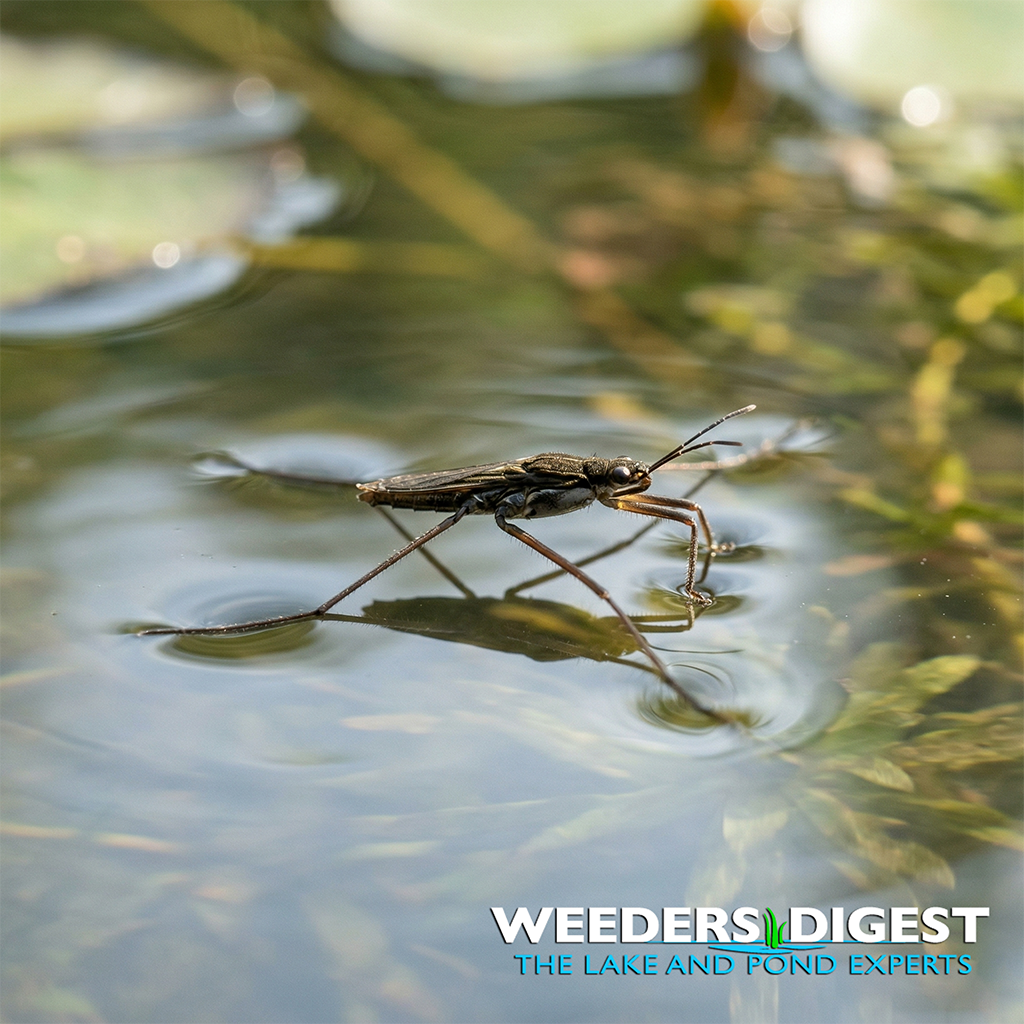
Watching a water strider dart across the surface of your pond can feel like witnessing a tiny miracle. These slender insects, often called "pond skaters," seem to defy the laws of gravity as they glide effortlessly over the water's edge. You might notice that their feet create small dimples on the surface, yet they never break through. This isn't just luck; it's a masterful display of evolutionary engineering that allows them to treat the water’s surface like a trampoline rather than a liquid.
The reason they stay dry and afloat comes down to a perfect partnership between their unique body structure and the natural "skin" of the water. Their legs are covered in thousands of microscopic hairs that trap a cushion of air, acting like tiny life jackets for their feet. Because they are so light and their weight is spread out so perfectly, the water’s surface tension is strong enough to support them. It’s a delicate balance that allows them to hunt and move without ever getting their "toes" wet.
Understanding this behavior helps us appreciate the complexity of the life in our own backyards. When you see these insects skating around, you are looking at one of nature's most efficient designs for specialized movement. They aren't just swimming; they are utilizing physics to stay on top of their world, navigating a habitat that would swallow almost any other creature of their size.
The Science Behind It:
The ability of the water strider (family Gerridae) to maintain its position atop the water column is primarily dictated by the principle of surface tension and the presence of extreme hydrophobicity. Surface tension occurs because water molecules at the air-liquid interface are more strongly attracted to one another through hydrogen bonding than they are to the air above them. This creates a cohesive "film" or elastic-like quality. According to research published in Nature, the water strider exploits this by utilizing specialized leg morphology covered in micro-setae—thousands of tiny, needle-like hairs—which are further subdivided into nanogrooves (Gao and Jiang, 2004).
These nanostructures perform a critical role by trapping air in the spaces between the hairs, forming a stable "plastron" or air cushion. This air layer prevents the water from wetting the insect’s legs, resulting in a state of superhydrophobicity. The contact angle of a water droplet on a strider’s leg can exceed $150^\circ$, meaning the water is physically repelled. Because the leg does not break the surface, the water strider is supported by the vertical component of the surface tension force, which acts upward along the perimeter of the leg’s contact area.
Furthermore, the locomotion of Gerridae is not achieved through simple rowing, but through the transfer of momentum via hemispherical vortices. As the strider strikes the water with its middle legs, it creates a "sculling" motion. Research by Hu et al. (2003) at the Massachusetts Institute of Technology demonstrated that these insects do not need to pierce the surface to move; instead, they push against the "dimples" created by their weight. This mechanical interaction sheds vortices beneath the surface, which provide the necessary backward momentum to propel the insect forward at speeds of up to 1.5 meters per second.
The total weight of the water strider is significantly less than the maximum curvature force the water’s surface tension can sustain. Calculations show that a single leg can support approximately fifteen times the total body weight of the insect before submerged. This high safety margin allows the strider to jump or land from significant heights without risking entrapment in the surface film. This evolutionary specialization ensures that the insect remains in a two-dimensional environment, avoiding the high energetic costs and predation risks associated with being fully submerged.