


Why My Morning Wades Are More Intense Than Any Gym Session

Summary:
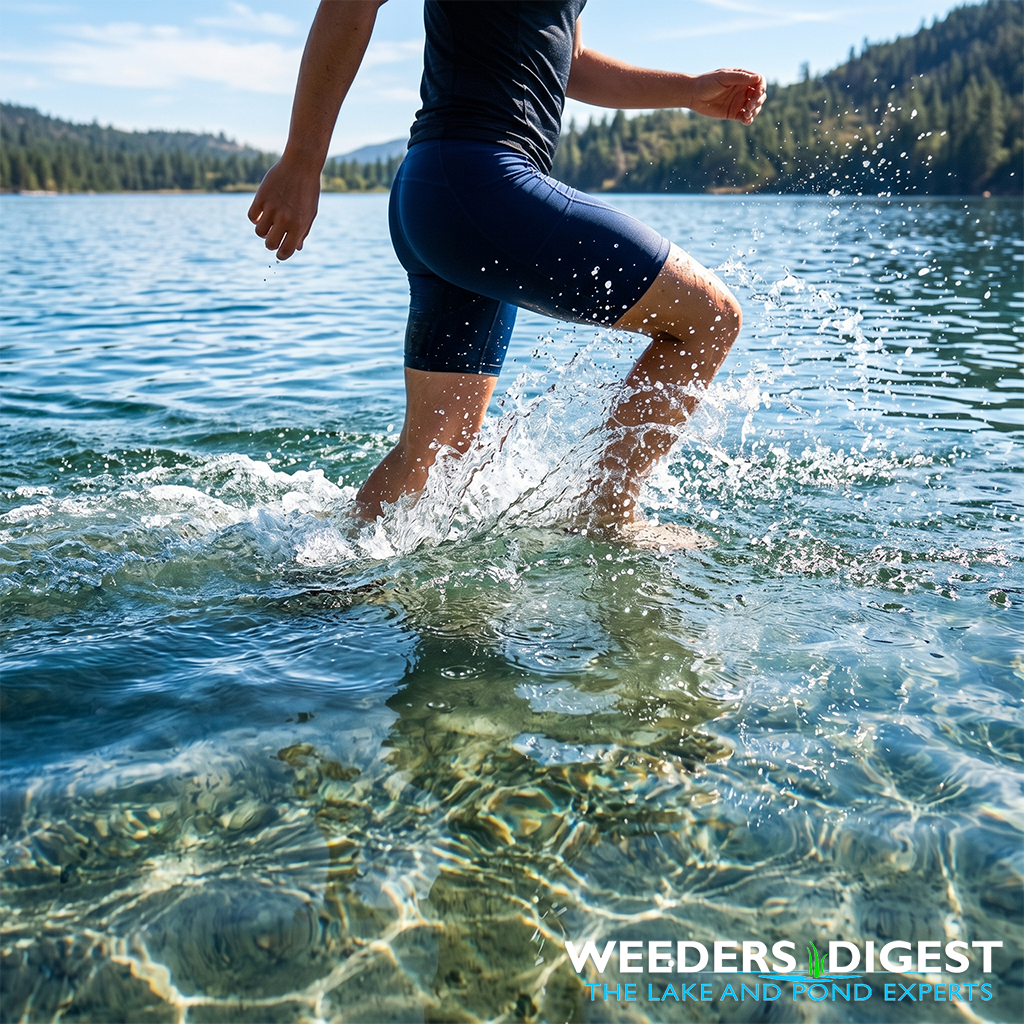
If you have ever tried to move quickly through waist-deep water at the lake, you know that your body works significantly harder than it does on dry land. What feels like a simple stroll through the shallows quickly turns into a heavy-duty workout that leaves your heart racing and your muscles burning. This happens because water provides a unique environment where every movement is met with immediate, consistent resistance from all directions.
When you are submerged to your waist, you are essentially fighting against a medium that is hundreds of times denser than air. Unlike lifting a weight where the resistance is only vertical due to gravity, water pushes back against you no matter which way you move your legs. This creates a natural "weight machine" effect that engages your core, glutes, and legs simultaneously, all while the water's buoyancy supports your joints and prevents the jarring impact of pavement.
I find that walking in the water is one of the most efficient ways to build functional strength and cardiovascular endurance without the wear and tear of traditional exercise. The deeper you go, the more the water "fights" back, requiring your nervous system to recruit more muscle fibers just to maintain a steady pace. It is a hidden gem of aquatic physical activity that transforms a scenic view into a high-performance training ground.
The Science Behind It:
The intensity of walking in waist-deep water is primarily governed by the principles of fluid dynamics, specifically the forces of drag and viscosity. Water is approximately 773 times denser than air, which significantly alters the Reynolds number ($Re$)—a dimensionless quantity used to predict flow patterns in different fluid situations. As a human limb moves through water, it creates a pressure differential between the front and back of the limb, resulting in pressure drag. According to research published in Journal of Biomechanics, the resistive force ($F_d$) encountered is proportional to the square of the velocity ($v^2$), meaning that doubling your walking speed increases the resistance fourfold.
Furthermore, the concept of added mass plays a critical role in metabolic expenditure. When an individual moves through a fluid, they are not only moving their own body mass but also accelerating a volume of the surrounding fluid. This requires significant muscular force to overcome the inertia of the displaced water. Scholarly analysis in Physical Therapy suggests that at waist depth, buoyancy reduces weight-bearing by approximately 50%, yet the metabolic cost of walking remains substantially higher than on land due to the constant recruitment of stabilizing muscles required to maintain an upright posture against turbulent eddies and currents.
Hydrostatic pressure also contributes to the physiological intensity. As depth increases, the pressure exerted by the water column enhances venous return to the heart. While this can improve stroke volume, it also requires the respiratory muscles to work harder against the external pressure on the thoracic cavity. Research from the University of New Mexico’s Department of Exercise Science indicates that aquatic walking at 2.0 to 3.0 miles per hour can elicit heart rate responses and caloric burns comparable to running on land at much higher speeds, due to the total-body engagement required to overcome viscous resistance.
The neuromuscular demand of aquatic locomotion is distinct because of the absence of a "recovery phase" in the gait cycle. On land, gravity assists the downward swing of the leg; in water, the antagonistic muscles must actively pull the limb through the dense medium. This constant tension leads to rapid fatigue of the hip flexors and quadriceps. Consequently, the combination of high-density resistance, hydrostatic pressure, and the square-law relationship of drag forces transforms a low-impact environment into a high-intensity metabolic furnace.