


Why My Shoreline Retaining Wall is Bulging After a Heavy Rain
 |

Summary:
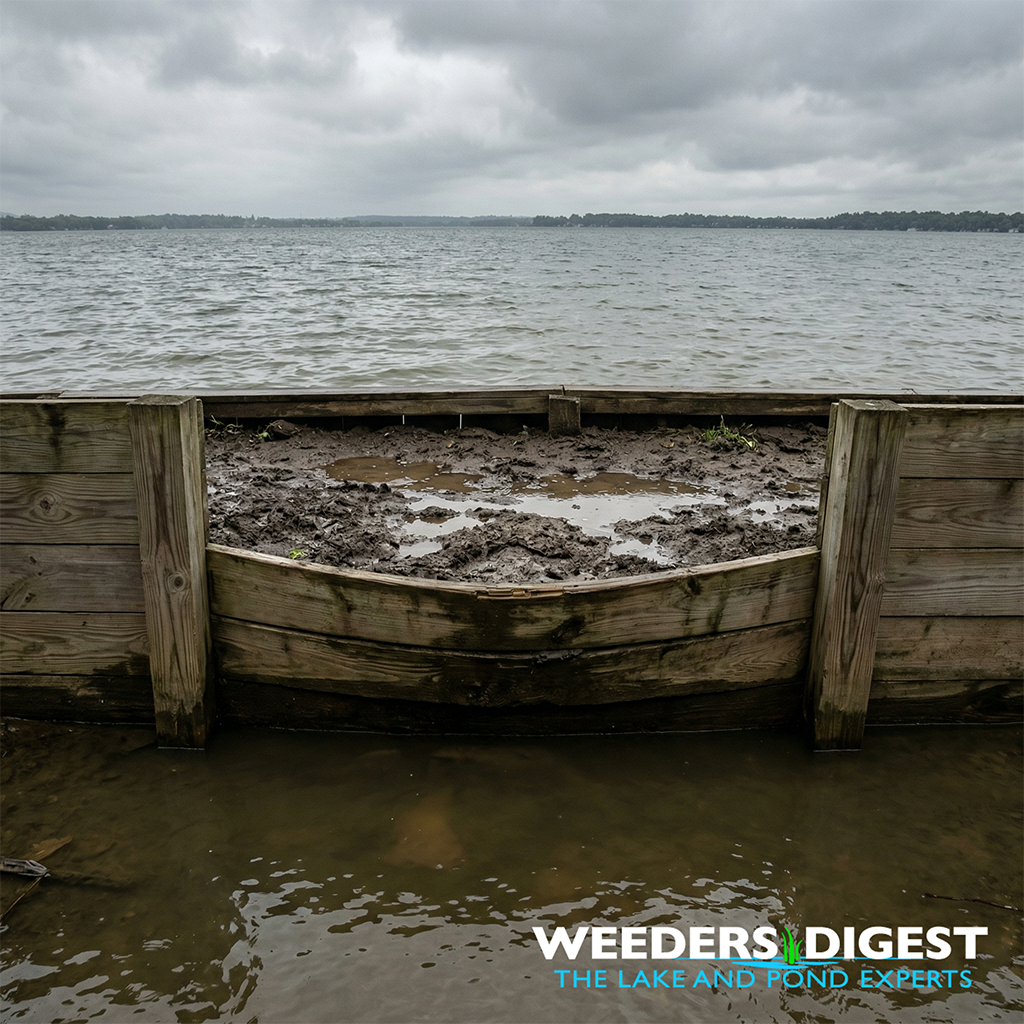
Seeing your shoreline retaining wall start to lean or bulge after a massive downpour is a heart-sinking experience. It feels like the ground is physically trying to push your hard work into the lake, and in a way, that is exactly what is happening. When we experience heavy rain, the soil behind your wall acts like a giant sponge, soaking up every drop of water it can hold. This makes the earth significantly heavier and more fluid-like, creating an immense amount of pressure that your wall wasn't necessarily built to hold back.
The real culprit behind this "bulge" is almost always trapped water. If the water has nowhere to go, it builds up behind the wall, creating what professionals call hydrostatic pressure. Think of it like a balloon being overfilled; eventually, something has to give. In the case of a shoreline, the "give" is usually the wall itself bowing outward or, in the worst-case scenario, collapsing entirely into the water.
This issue is often compounded by the type of soil you have and how the wall was originally designed. For instance, heavy clay soils hold onto water much longer than sandy soils, keeping that pressure pinned against your wall for days after the clouds have cleared. If your wall lacks proper drainage holes—those little pipes you sometimes see poking through the bottom—the water becomes a silent, heavy force that slowly wins the battle against the wood, stone, or steel.
Understanding this isn't just about spotting a problem; it’s about protecting your property value and the safety of your shoreline. A bulging wall is a final warning sign that the balance between the land and the water has shifted. Addressing the drainage and the weight of the saturated earth is the only way to keep your shoreline stable and your view intact.
The Science Behind It:
The structural failure of shoreline retaining walls following significant precipitation events is primarily a function of increased lateral earth pressure and the development of hydrostatic pressure. When soil becomes saturated, the pore water pressure increases, effectively reducing the effective stress between soil particles. According to the principles of soil mechanics defined by the Terzaghi principle, the total vertical stress is the sum of the effective stress and the pore water pressure ($\sigma = \sigma' + u$). As pore water pressure rises, the shear strength of the soil—the internal friction that keeps it stable—decreases, causing the soil to transition toward a more fluid state that exerts a greater lateral force against the bulkhead or seawall.
The most critical factor in these failures is the accumulation of hydrostatic pressure behind the structure. In a dry state, a wall only needs to support the weight of the dry soil. However, once the "phreatic surface" (the water table) rises behind the wall due to heavy rain, the wall must support both the saturated soil and the weight of the water itself. Water weighs approximately 62.4 pounds per cubic foot. Without adequate drainage systems, such as weep holes or high-transmissivity backfill like clean gravel, this pressure can exceed the structural capacity of the wall’s tie-backs, deadmen, or the flexural strength of the piling materials.
Furthermore, the "active earth pressure" increases as the soil becomes saturated. Utilizing the Rankine Theory of Earth Pressure, the coefficient of active pressure ($K_a$) dictates how much horizontal force is applied. In saturated conditions, the unit weight of the backfill increases significantly, and the internal friction angle ($\phi$) of the soil may be compromised, leading to a dramatic spike in the resultant force acting upon the upper third of the wall. This often manifests as a "toe failure" or a "kick-out" if the wall is not embedded deeply enough into the lakebed or if the anchors fail under the tension of the saturated mass.
Environmental factors such as "rapid drawdown" can also play a role in shoreline environments. If the lake level remains lower than the saturated water level behind the wall, there is no counteracting force from the lake side to balance the internal pressure. Research from university geological extensions highlights that the lack of granular, free-draining backfill is the leading cause of such failures. When fine-grained soils like silt or clay are used against a wall, they retain moisture and expand, leading to "frost heave" in colder climates or excessive swelling in temperate ones, both of which apply relentless rhythmic pressure on the structure until it reaches a point of plastic deformation or catastrophic collapse.
Sources / References:
- University of Minnesota Extension: Shoreline stabilization: Retaining walls
- Journal of Geotechnical and Geoenvironmental Engineering: Influence of Drainage on the Stability of Retaining Structures