

Why Your Boat Anchor Bites Into Mud But Fails on My Favorite Fishing Rocks

Summary:
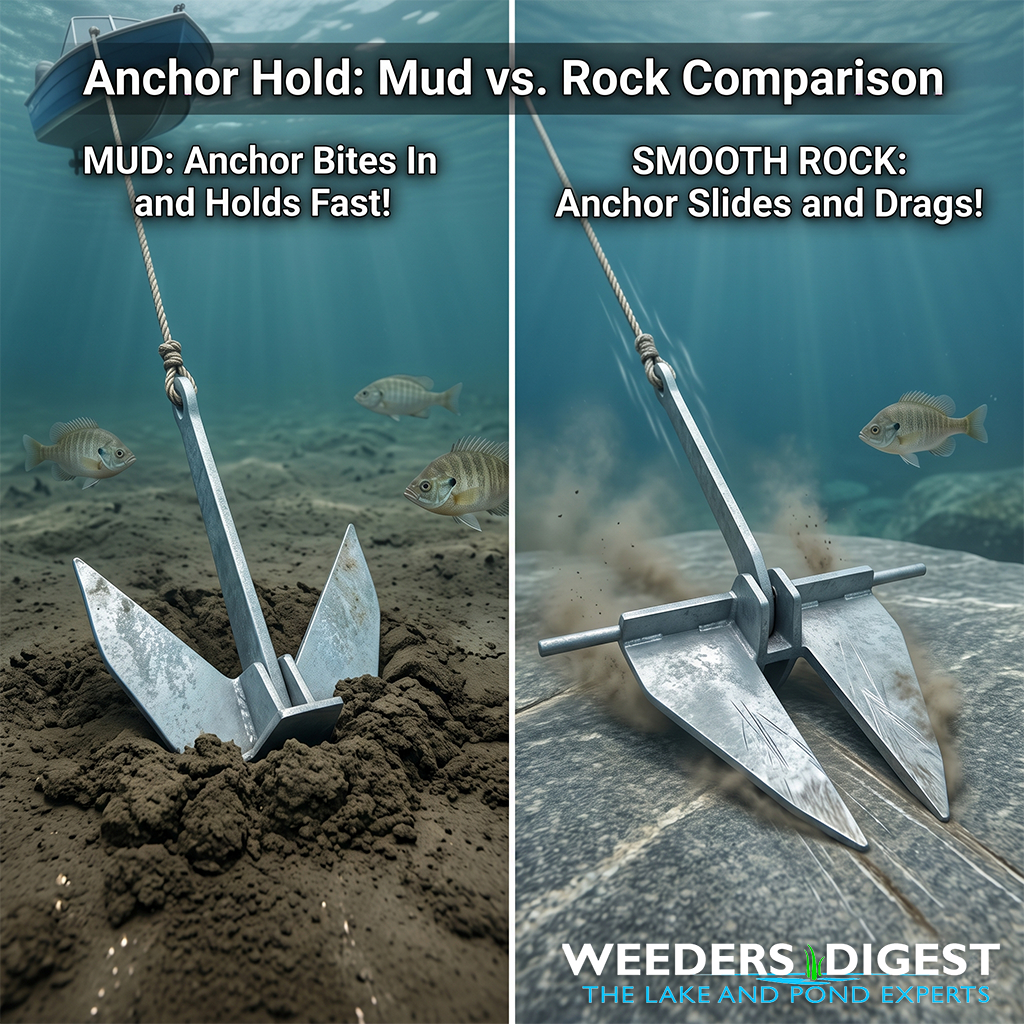
Have you ever found the perfect fishing spot, dropped your anchor, and then spent the next hour drifting away from it? It is a frustrating experience that every boater has faced. When you drop an anchor into a soft, muddy bottom, it acts like a shovel. The flukes of the anchor dig deep into the muck, using the weight of the mud above it to lock itself in place. As you pull against it, the anchor actually buries itself deeper, creating a secure hold that feels like it’s glued to the lakebed.
On the other hand, smooth rock offers nothing for an anchor to "grab." Think of it like trying to use a fork to pick up a marble; there are no crevices or soft spots for the metal to penetrate. Instead of digging in, the anchor simply glides across the surface. No matter how heavy your anchor is, without the ability to penetrate the surface or hook onto a ledge, the physical forces of the wind and current will eventually cause your boat to drag. Understanding the relationship between your anchor design and the lake bottom is the secret to staying put.
The Science Behind It:
The mechanical performance of an anchor is dictated by the principles of soil mechanics and the coefficient of friction. When an anchor interacts with a cohesive substrate like mud or silt, it relies on "suction" and "shear strength." As the anchor flukes penetrate the sediment, they displace the material, which then settles over the anchor. This overburden pressure, combined with the cohesive nature of fine-grained sediments, creates a massive amount of resistance against upward or horizontal movement. According to research on maritime anchoring systems, the holding power in soft bottoms is a function of the fluke area and the depth of penetration, where the sediment effectively acts as a physical weight holding the fluke in a fixed position.
Conversely, the interaction between an anchor and a lithic or rocky substrate is governed almost entirely by the coefficient of sliding friction. On a smooth, non-porous rock surface, there is no opportunity for "mechanical interlock," which is the primary mechanism of anchor stability. Because the rock cannot be deformed or penetrated by the anchor's flukes, the anchor remains on the surface. The only force resisting movement is the frictional force, which is often insufficient to counteract the hydrodynamic drag forces acting upon the vessel's hull.
In engineering terms, the "holding power ratio" (the ratio of the force the anchor can withstand to its own weight) drops significantly on hard surfaces. On a muddy bottom, a modern Danforth or plow-style anchor can achieve a holding power ratio of over 20:1. On smooth rock, this ratio may approach zero if the anchor cannot find a crack or protrusion. This is why specialized "Grapnel" anchors are often used in rocky environments; they do not rely on penetration but rather on the high probability of one of several tines snagging a physical obstruction or "micro-topography" on the rock surface.
Furthermore, the angle of pull, or "scope," plays a critical role in how these forces are applied. A long scope ensures that the pull remains horizontal, which maximizes penetration in mud. On rock, however, even a horizontal pull may fail if the surface lacks irregularities. Without the "embedment" phase of the anchoring cycle, the anchor remains in a state of kinetic friction rather than static stability. This lack of penetration means the anchor cannot convert the lateral energy of the boat into downward pressure, resulting in the common phenomenon known as "dragging."
Sources / References:
- Texas A&M University - Anchoring Systems and Substrate Interaction
- Journal of Aquatic Plant Management / University of Florida IFAS - Sediment Characteristics and Their Impact on Benthic Stability