


Why Your Boat Breathes on Its Own: The Secret Life of My Bilge Pump

Summary:
As a boat owner, there is a specific kind of peace of mind that comes from hearing that low hum of a bilge pump kicking on after a heavy rain or a choppy day on the lake. For a long time, I wondered how this little machine under my deck floor seemed to have a mind of its own, knowing exactly when the water level was getting too high and, more importantly, when to stop so it wouldn't burn itself out. It feels like magic, but it is actually a very clever bit of automated sensing that keeps our vessels buoyant without us having to lift a finger.
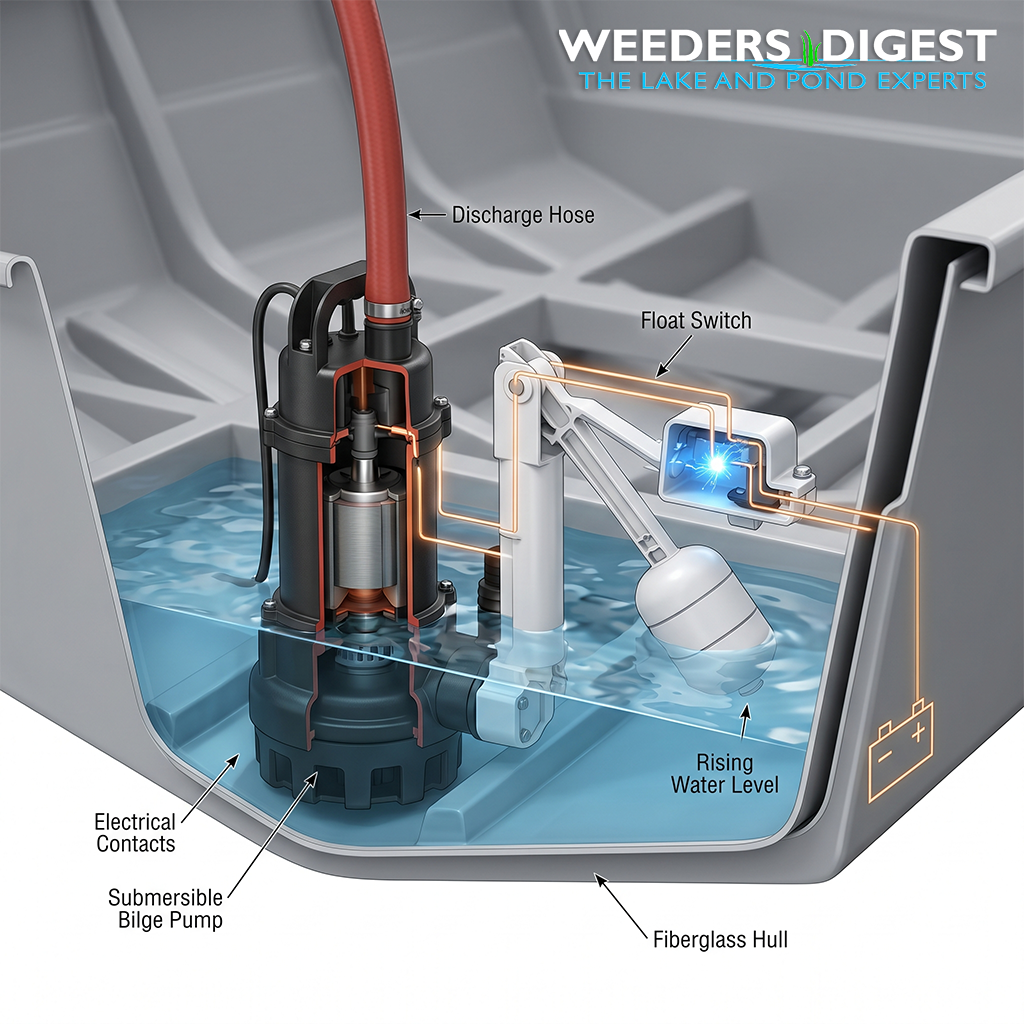
The process of "knowing" when to eject water is handled by a specialized switch that acts as the brain for the pump. In my experience, most boats use one of three main methods: a physical float that rises with the water, a digital sensor that feels for electrical conductivity, or a clever pressure system that detects the weight of the water. When the water hits a certain threshold, the switch closes an electrical circuit, sending power to the pump’s motor. Once the water level drops and the "trigger" is removed, the circuit opens back up and the pump rests.
Understanding this system is vital because the bilge is often the most neglected part of a boat until something goes wrong. These automatic systems are designed to be "always on," drawing a tiny amount of power from the battery so they can stand guard even when the boat is docked and the owner is miles away. It is a simple loop of detection and action that serves as the first line of defense against the slow accumulation of water that could otherwise lead to a very bad day on the water.
The Science Behind It:
The automation of bilge water evacuation relies on the integration of fluid dynamics and electrical circuit theory, primarily managed through float switches or solid-state sensors. The most common mechanical iteration utilizes Archimedes' principle of buoyancy; as water enters the bilge, a hinged float—often containing a microswitch or a rolling metal ball—displaces its weight in water and rises. Once the float reaches a predetermined angular displacement, it completes the electrical path between the power source and the pump motor. This mechanical interface is robust but prone to interference from debris or "bio-fouling" common in stagnant aquatic environments.
Advanced systems utilize capacitive or field-effect sensing technology to eliminate moving parts. These sensors create a low-level electric field; when a conductive liquid like water enters this field, the dielectric constant changes, which is detected by the internal circuitry. Research into sensor reliability, such as studies conducted by university maritime extensions, indicates that these solid-state devices offer higher longevity because they are not susceptible to the physical sticking or corrosion of mechanical pivots. These sensors are often programmed with a delay-off logic to ensure the pump clears the suction line completely before deactivating, preventing "cycling" where residual water flows back and re-triggers the sensor.
Another sophisticated method involves hydrostatic pressure sensing. In these configurations, a "bell" or air chamber is submerged in the bilge; as the water level rises, it compresses the air trapped within the chamber. This increase in air pressure is transmitted via a tube to a pressure-sensitive diaphragm switch located above the waterline. When the pressure reaches a specific $P = \rho gh$ (where $\rho$ is fluid density, $g$ is gravity, and $h$ is height of the liquid column), the diaphragm moves to close the electrical contacts. This method is particularly effective in deep hulls where traditional float switches may be difficult to mount.
The integration of these sensors into the vessel's DC electrical system requires a three-way wiring configuration: manual, off, and automatic. In the automatic mode, the sensor remains in a "normally open" state, drawing negligible parasitic current until the medium (water) bridges the gap or lifts the float. According to maritime safety standards and technical literature from the American Boat and Yacht Council (ABYC), these systems must be ignition-protected to prevent the sparking of any fuel vapors present in the bilge, ensuring that the automation of water removal does not introduce secondary combustion risks.