


Why Your Lake’s Rocky Bottom is the Secret to My Favorite Fishing Spot
 |
Summary:
If you have ever wondered why certain fish seem to crowd around rocky shorelines or gravel bars during the spring, it isn't just a coincidence. For many of the most popular game fish, a rocky bottom is a high-stakes nursery. These species have evolved to seek out hard, "clean" surfaces because their survival depends on keeping their eggs safe from the suffocating effects of silt and muck.
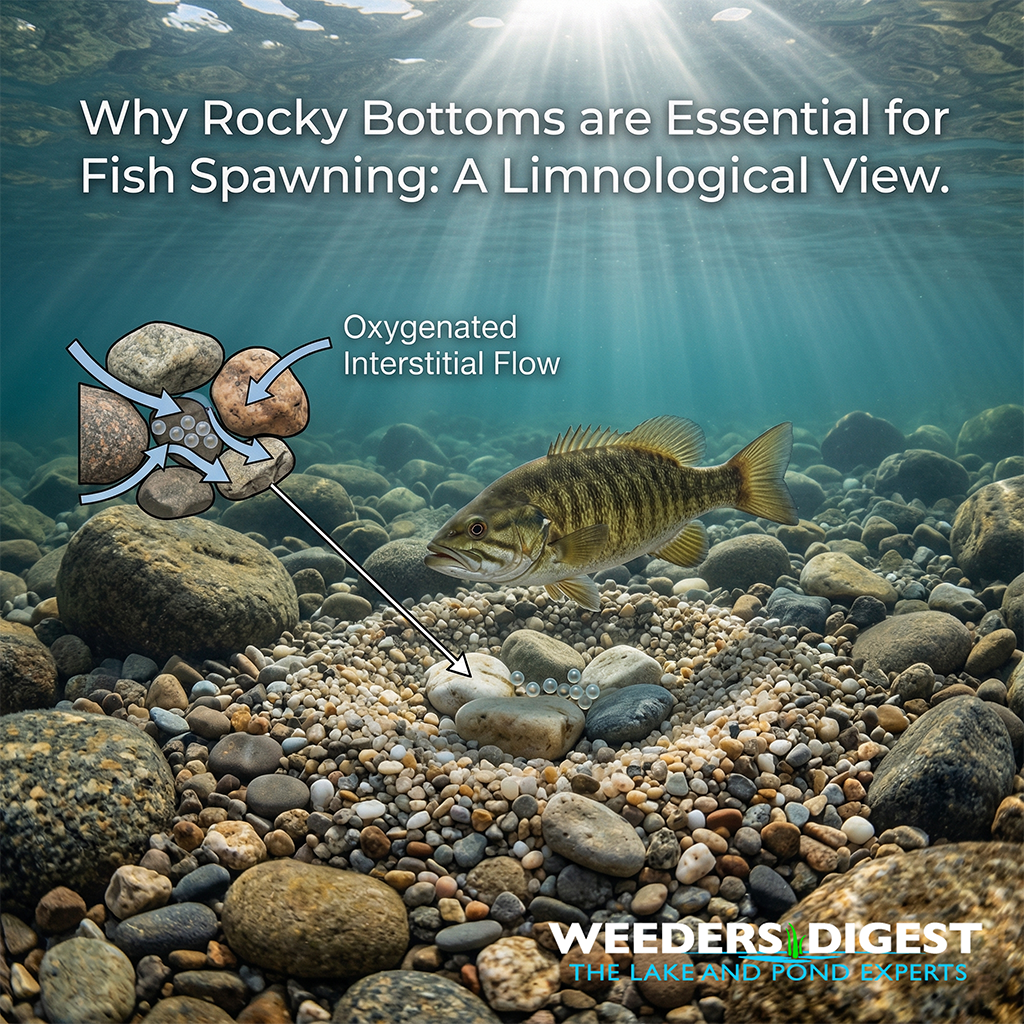
When fish like bass, trout, or walleye lay their eggs on rocks, the physical structure of the stones creates a protective fortress. The tiny gaps between pebbles and cobble allow fresh, oxygen-rich water to flow directly over the eggs, which is vital for their development. Without these rocky areas, eggs often settle into soft mud where they can easily be buried or deprived of oxygen, leading to a failed spawn.
As a lake manager, I often see how a lack of rocky substrate can cause a fish population to dwindle. Homeowners often want to "clean up" their beach by removing rocks, but that act can unintentionally destroy the very habitat that keeps the lake's ecosystem thriving. Understanding this relationship helps us appreciate that a "messy" rocky bottom is actually a sign of a healthy, productive fishery.
By protecting these areas, we ensure that the next generation of fish has a stable place to start life. It is the difference between a lake full of life and one that struggles to maintain its balance.
The Science Behind It:
The preference for lithophilic (rock-loving) spawning sites is driven primarily by the physiological requirements of the developing embryo and the mechanical properties of the substrate. In aquatic environments, the "interstitial space"—the gaps between individual rocks—serves as a critical microhabitat. According to research published in the Journal of Fish Biology, these spaces provide a high-surface-area environment that facilitates superior dissolved oxygen transfer. Because fish embryos are stationary and have high metabolic demands, they rely on the convective flow of water through the rocky matrix to remove metabolic waste and provide constant oxygenation.
Substrate composition significantly influences the rate of interstitial flow, a concept often measured by hydraulic conductivity. In silty or sandy environments, the fine particles pack tightly together, creating a low-permeability barrier that inhibits the movement of oxygenated water. Research from the University of Wisconsin Extension notes that even a thin layer of fine sediment can "smother" eggs, leading to high mortality rates from hypoxia or fungal infections. Rocky bottoms, particularly those composed of well-graded gravel and cobble, maintain their structural integrity against current and wave action, preventing the entombment of the eggs.
Furthermore, the physical complexity of a rocky bottom offers essential "predator-avoidance" architecture. The irregular surfaces and deep crevices of a lithophilic spawning bed make it physically difficult for larger predators to access the eggs. Some species, such as the Smallmouth Bass (Micropterus dolomieu), actively clean the rocks of debris before spawning to ensure maximum adhesion of the eggs to the hard surface. This adhesive property is a specialized evolutionary trait; the eggs are designed to stick to the substrate to prevent them from being swept away into deeper, less hospitable waters.
The chemical environment of a rocky substrate is also typically more stable than that of an organic-rich, mucky bottom. Muck is often characterized by high rates of decomposition, which consumes oxygen and can lead to the production of hydrogen sulfide or other toxic byproducts. By selecting mineral-based rocky sites, fish ensure their offspring are raised in a chemically neutral environment. This strategic selection of spawning habitat is a fundamental pillar of population recruitment and is a primary focus for limnologists during lake restoration projects.
Sources / References:
- https://extension.unh.edu/resource/habitat-requirements-freshwater-fish-fact-sheet
- https://onlinelibrary.wiley.com/journal/10958649 (Journal of Fish Biology - Fish Spawning Substrates)