


Why Your Lake Water Looks Deeply Black: The Secrets of Light and Tannins

Summary:
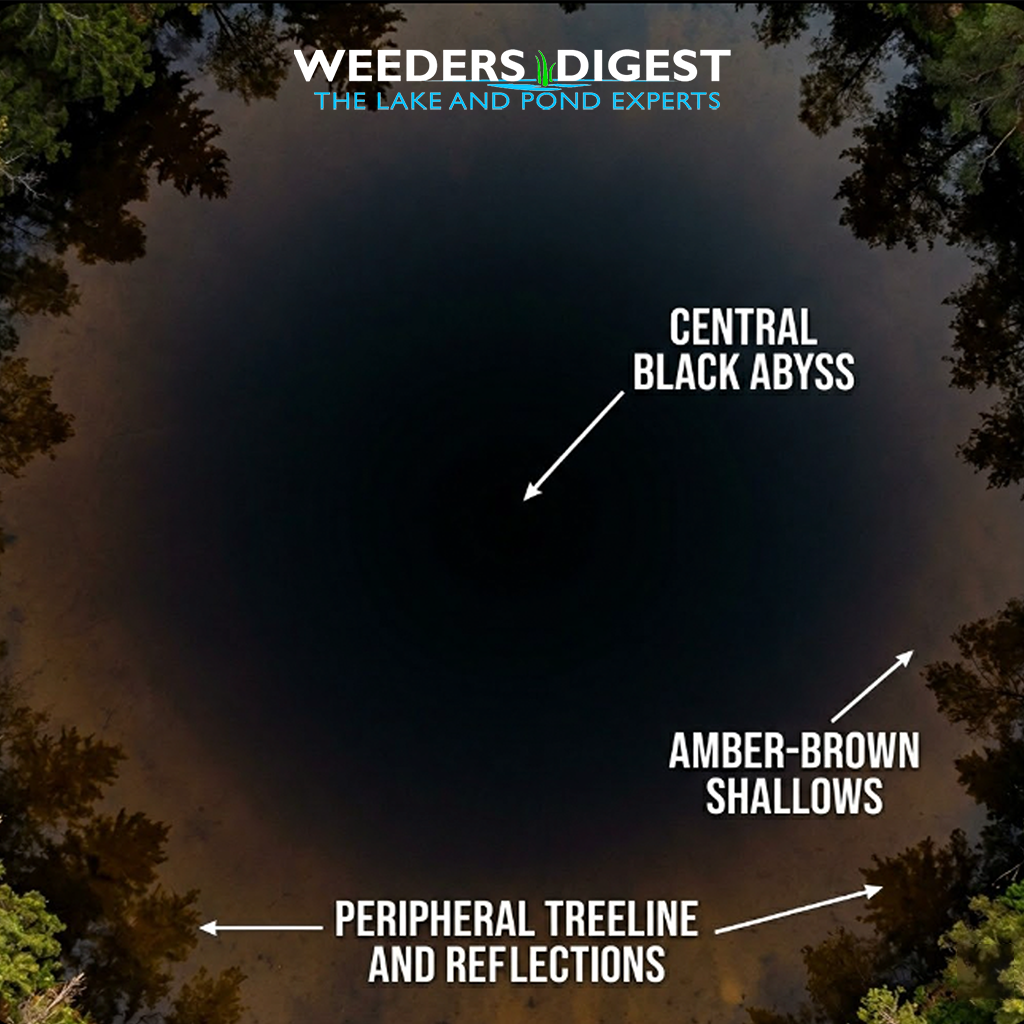
When you look straight down into the depths of a lake or pond and see nothing but an abyss of ink-black water, it can be a bit unnerving. You might wonder if the water is heavily polluted or if something is wrong with the ecosystem. In reality, what you are seeing is usually a sign of a very specific, and often healthy, chemical process involving organic material. This "blackwater" effect is common in areas surrounded by heavy vegetation, forests, or wetlands, where the water has essentially turned into a very dark tea.
This visual phenomenon occurs because of the way light interacts with dissolved organic matter. As leaves, bark, and roots break down in the soil and water, they release natural dyes. When the sun hits the surface of your pond, these dyes act like a sponge, soaking up almost every color of the visible spectrum. By the time you look down into the deep, there is simply no light left to reflect back to your eyes, creating that characteristic midnight-black appearance.
While it might look dark and mysterious, this black water often provides excellent cover for fish and helps keep unwanted weed growth at bay by blocking sunlight from reaching the bottom. It isn't necessarily "dirty" water; it is simply water that is highly enriched with the leftovers of the surrounding forest. Understanding the chemistry of your water can turn that sense of unease into an appreciation for the complex natural filter happening right in your backyard.
The Science Behind It:
The primary driver of the black appearance in deep lentic systems is the concentration of Chromophoric Dissolved Organic Matter (CDOM), also known as "yellow substance" or gelbstoff. CDOM consists of complex organic molecules, such as humic and fulvic acids, which are leached from decaying terrestrial vegetation and peat. According to research published in Limnology and Oceanography, these substances are highly effective at absorbing short-wavelength light, particularly in the ultraviolet and blue portions of the spectrum. As the concentration of CDOM increases, the absorption coefficient rises, leaving only longer wavelengths like red to penetrate deeper, though even these are eventually extinguished in high-tannin environments.
The specific optical property at play is known as vertical attenuation. In clear water, light scatters and reflects off suspended particles or the benthos, returning to the observer's eye. However, in "dystrophic" or tannin-rich waters, the molecular structure of the dissolved humics absorbs photons before they can strike a reflective surface. When an observer looks vertically down into deep water, the path length of the light is doubled—once as it travels down and once as it attempts to reflect back up. This leads to a near-total loss of radiance, resulting in a perceived blackness. This process is documented extensively in studies regarding the "Optical Properties of Colored Dissolved Organic Matter" (Kirk, 1994).
Furthermore, the depth of the water body acts as a natural light trap. In shallow areas, some light may reach the bottom and reflect back, but as depth increases, the probability of photon absorption by CDOM reaches 100%. This is often exacerbated by the presence of suspended solids or phytoplankton, which can further scatter and absorb light. In stratified lakes, the accumulation of organic debris in the hypolimnion (the cold, bottom layer) can lead to even higher concentrations of these light-absorbing compounds, intensifying the dark appearance when viewed from the surface.
The chemical composition of these humic substances is characterized by aromatic rings and conjugated double bonds, which are particularly "excited" by incoming solar radiation. This molecular configuration is what allows the water to act as a pigment. Research from the Journal of Geophysical Research: Biogeosciences indicates that the influx of these terrestrial carbon sources—a process called "brownification"—is increasing in many northern hemisphere water bodies due to changes in precipitation and land use. This shift alters the underwater light climate, effectively turning many deep lakes into high-absorption environments where visibility is limited to the uppermost surface layer.