


Why Your Pontoon Might Need a Third Log: The Physics of the "TriToon"

Summary:
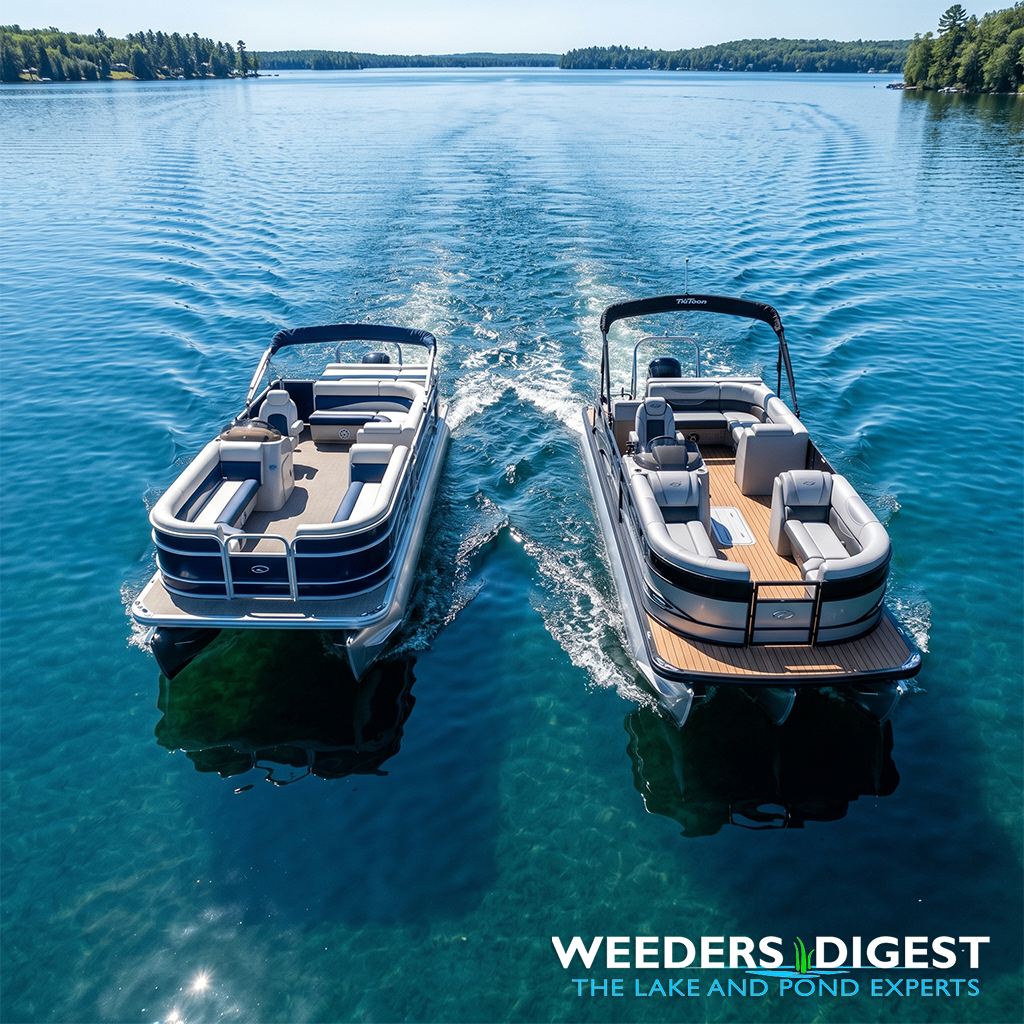
When you look at pontoon boats on the lake, you’ll notice two distinct styles: the traditional twin-log setup and the increasingly popular three-log design, often called a TriToon. I often get asked if that extra log is just for show, but it actually changes the entire fundamental way the boat interacts with the water. Think of a standard two-log boat like a flat-bottomed raft; it’s incredibly stable when you’re sitting still or puttering along, but it can feel a bit sluggish or "plow" through the water when you try to go fast or take a sharp turn.
The addition of a third log transforms the boat’s footprint. By adding buoyancy and structure directly down the center of the vessel, the boat can sit higher out of the water, which reduces drag. For you as a boat owner, this means you can mount much larger engines and achieve speeds that were once reserved for fiberglass sportboats. It also changes how the boat handles waves; rather than bobbing over them, a three-log system allows the boat to slice through chop much more smoothly.
Choosing between them really comes down to how you plan to spend your day on the water. If your goal is a quiet afternoon of fishing or a slow sunset cruise on a calm pond, two logs are perfectly adequate and very efficient. However, if you want to pull tube riders, navigate larger, wind-whipped lakes, or carry a dozen friends without the floorboards feeling low to the water, the third log becomes a necessity for safety and performance.
Beyond just "more floats," the third log allows for advanced hull features like lifting strakes. These are metal fins that help lift the boat onto the surface of the water, known as "planing." While a two-log boat tends to lean outward during a turn—which can feel a bit unnerving—a properly designed TriToon will lean into the turn like a V-hull boat, providing a much more athletic and secure feeling for everyone on board.
The Science Behind It:
The distinction between twin-log and triple-log configurations is rooted in the principles of hydrodynamics and static buoyancy, specifically Archimedes' Principle. A standard pontoon operates as a displacement hull, where the weight of the water displaced by the logs equals the weight of the vessel. According to research by the American Boat & Yacht Council (ABYC) regarding flotation and stability standards, the distribution of this buoyancy is critical. In a twin-log setup, the center of gravity is often high relative to the narrow points of contact with the water, leading to a tendency for the vessel to "roll" or lean away from the direction of a turn due to centrifugal force.
The introduction of a third longitudinal cylinder—the center "log"—significantly increases the Total Waterplane Area ($A_{wp}$). This increase in surface area at the waterline enhances the transverse metacentric height ($GM$), which is a primary measure of the initial static stability of a floating body. By placing the third log lower than the outer two or equipping it with lifting strakes, engineers create a "V-hull" simulation. This allows the vessel to achieve dynamic lift more efficiently. As velocity increases, the hydrodynamic pressure on the underside of the logs overcomes the static buoyant force, allowing the boat to transition from displacement mode to planing mode.
Furthermore, the third log serves as a structural reinforcement that mitigates "torsional racking." In a two-log configuration, the cross-members supporting the deck are subject to significant stress as the two logs move independently in rough water. Research into aluminum multi-hull structures indicates that a center member provides a third point of attachment, creating a tripod-like rigidity that distributes mechanical loads more evenly across the chassis. This structural integration allows for the installation of higher-horsepower engines, often exceeding 300 HP, as the center log can house a reinforced motor pod that directs thrust more linearly through the center of the vessel's mass.
Hydrofoil effects and spray deflection are also optimized in triple-log configurations. When a vessel encounters wave action, a twin-log pontoon often experiences "sneezing," where water is trapped between the logs and forced out the front as a fine mist. The presence of a center log, particularly one with a sharpened leading edge or integrated splash guards, bifurcates the incoming water more effectively. This reduces the wetted surface area and drag coefficient ($C_d$), resulting in higher fuel efficiency at cruising speeds and a significant reduction in vertical accelerations (pitching) in choppy aquatic environments.