


Why Your Shoreline Rocks Keep Getting Smoother: The Secret Life of My Waterfront

Summary:
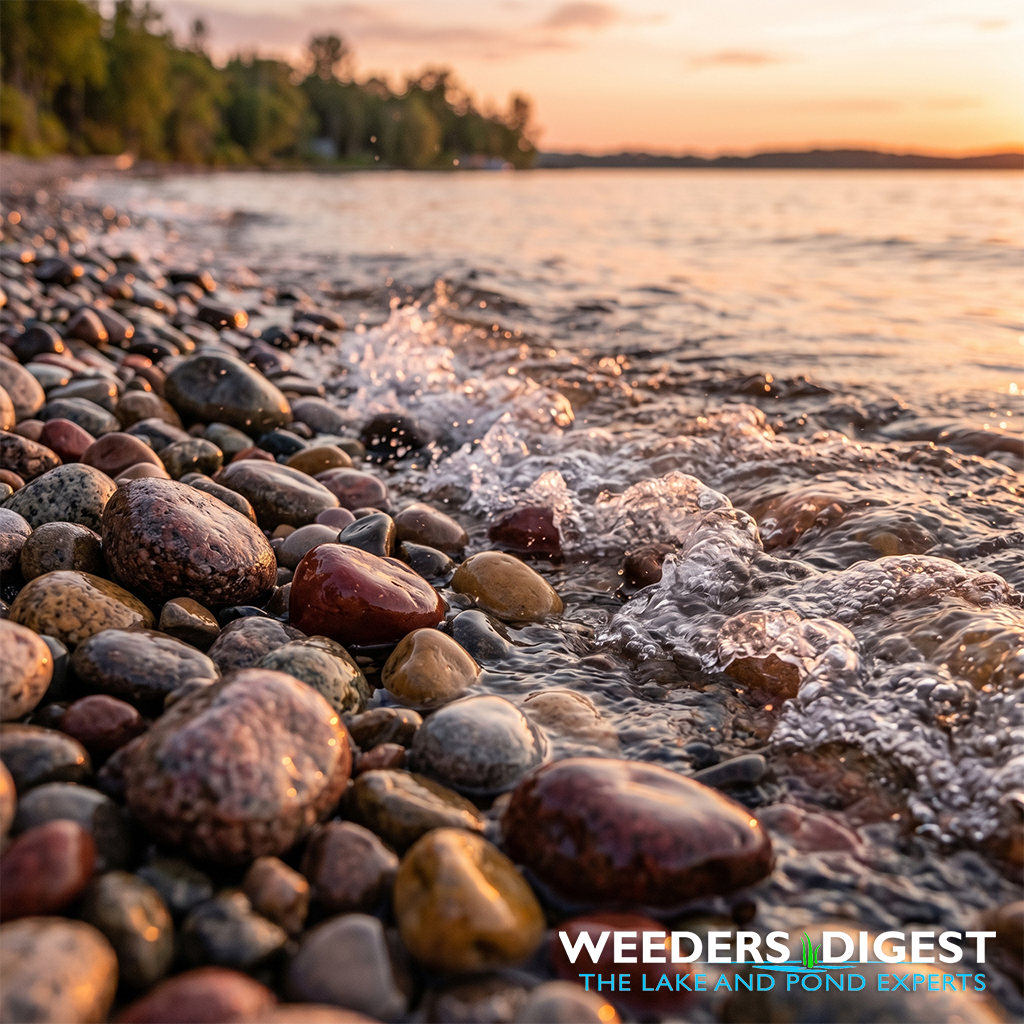
If you have ever spent a day at your waterfront, you have probably noticed that the rocks aren't as jagged as the stones you find deep in the woods. There is a reason my favorite beach stones feel like smooth worry stones in the palm of my hand. This transformation isn’t magic; it is the result of a never-ending cycle of movement where the water acts as both a vehicle and a sculptor.
Every time a wave rolls into your shore, it isn't just moving water. It is tossing around tiny grains of sand and smaller pebbles that act like sandpaper against the larger rocks. Over years of constant tumbling and sliding, the sharp edges that used to define these stones are slowly ground away. This process happens so gradually that we rarely see it in real-time, but the results are visible every time we look down at the water's edge.
The shape of the rocks on your shoreline can actually tell you a lot about the energy of your lake or pond. Higher wave action usually leads to rounder, more polished stones because the "tumbling" effect is more frequent and intense. It’s nature’s way of recycling and refining the landscape, turning rugged debris into the smooth, aesthetic shoreline we enjoy today.
Even the hardest granite eventually yields to the persistence of water. By understanding how these waves interact with your land, you can better appreciate the dynamic environment of your own backyard. It is a constant reminder that the shoreline is never truly still, even on the calmest days.
The Science Behind It:
The physical transformation of shoreline lithology is governed by a process known as mechanical weathering, specifically through the mechanisms of abrasion and attrition. When wind-driven waves approach a shoreline, they possess kinetic energy that is transferred to the sediment load—ranging from microscopic silts to large cobbles. According to fundamental principles in coastal geomorphology, as these waves break in the swash zone, they induce high-velocity collisions between suspended particles and stationary coastal features.
Abrasion occurs when sediment-laden water is forced against the surface of a rock, acting as a natural abrasive agent. As cited in research regarding sediment transport and clast rounding (e.g., studies found through the Journal of Sedimentary Research), the rate of rounding is heavily influenced by the mineralogical hardness of the rock and the frequency of high-energy wave events. During these events, the shearing force of the water moves smaller particles across the surface of larger stones, grinding down protrusions and irregularities through microscopic fractures and surface friction.
Simultaneously, the process of attrition facilitates the rounding of the mobile sediments themselves. As waves oscillate, stones are rolled, slid, and tossed against one another. These inter-particle collisions preferentially target the "corners" or high-curvature points of a rock because these areas experience the highest stress concentrations during impacts. Over time, this leads to a reduction in angularity and an increase in sphericity, a progression often measured by geologists using the Powers Roundness Scale.
The environmental conditions of the water body, such as the fetch (the distance over which wind blows) and the depth of the nearshore shelf, dictate the "energy regime" of the shoreline. In high-energy environments, the constant "milling" effect of the waves accelerates the smoothing of lithic fragments. Research published via university geological extensions emphasizes that this is a self-limiting process; as a rock becomes smoother and rounder, it offers less hydrodynamic resistance and fewer points of impact, eventually reaching a state of equilibrium with its environment.